The regulatory package for Etomidate API should establish three points: who manufactures the material, whether the stated manufacturing site operates under the relevant regulatory controls, and whether the supplier can support the buyer’s intended market submission. Depending on the target jurisdiction, this package may include a Drug Master File, Active Substance Master File, Certificate of Suitability, GMP evidence, manufacturing authorisation and supporting regulatory declarations.
Document availability alone is not sufficient. A DMF number may exist without authorisation for the buyer to reference it, a GMP certificate may not cover the stated Etomidate manufacturing activity, and an outdated CEP may refer to a different site or material grade. These gaps can delay supplier qualification, regulatory filing or approval of a source change.
This article explains which regulatory documents pharmaceutical buyers should request, what each document establishes and how to evaluate whether it corresponds to the Etomidate API proposed for supply.
Which Regulatory Documents Matter Most When Sourcing Etomidate API?
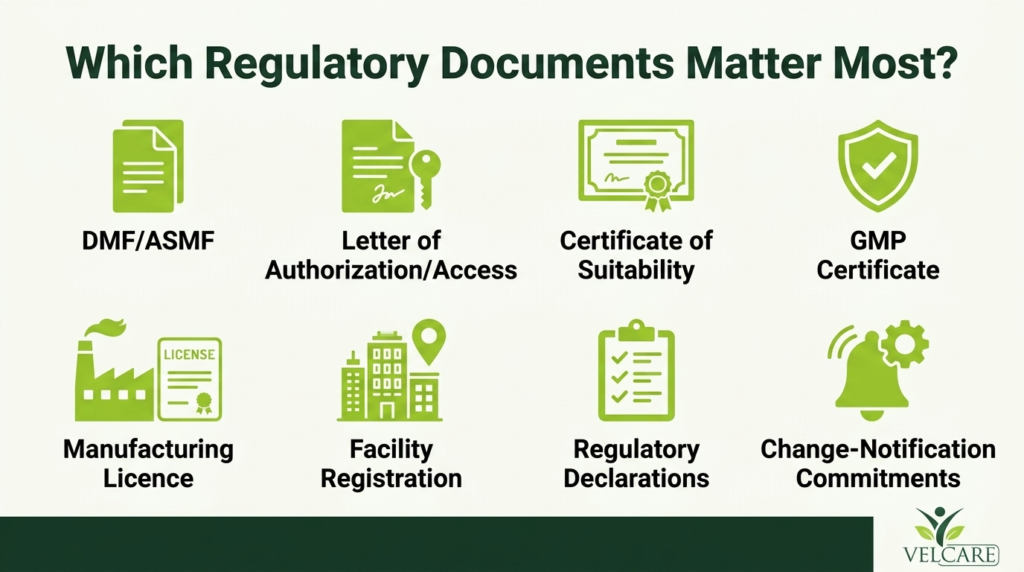
The principal documents and records to evaluate are:
- Drug Master File or Active Substance Master File documentation
- Letter of Authorization or Letter of Access
- Certificate of Suitability, where used for the proposed filing
- GMP certificate and recent inspection evidence
- Manufacturing licence or authorisation
- Facility registration or site-listing records
- Regulatory declarations and impurity risk assessments
- Current document revisions, validity records and change-notification commitments
No single certificate establishes complete regulatory suitability. EDQM expressly states that a Certificate of Suitability does not replace either a batch Certificate of Analysis or a GMP certificate. A CEP establishes that the substance can be suitably controlled by the relevant European Pharmacopoeia monograph, with supplementary controls where necessary. It does not demonstrate that a particular batch conforms to specification. (EDQM FAQs)
Regulatory Documents to Evaluate
1. Drug Master File for the United States
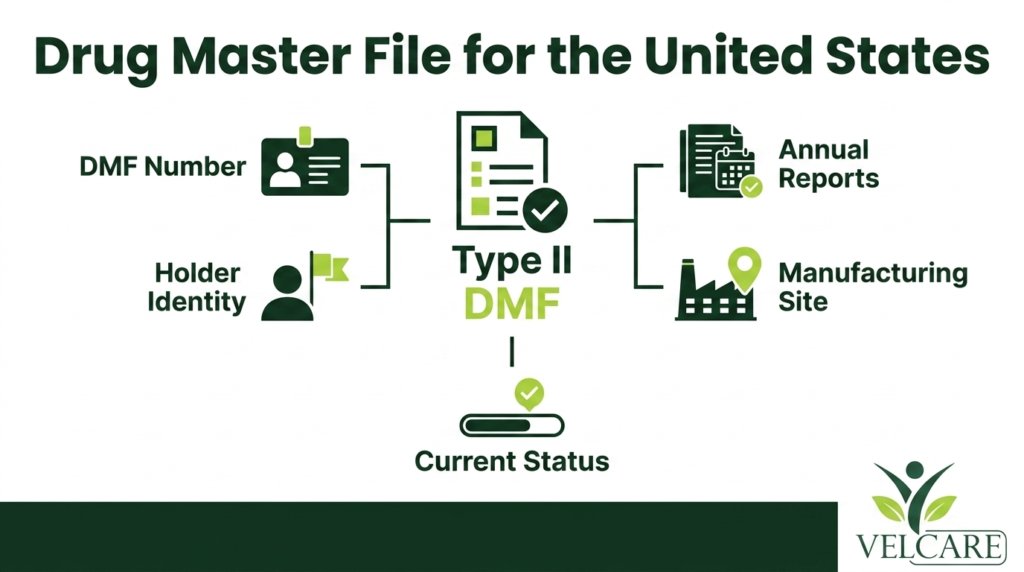
A Drug Master File allows confidential manufacturing, control and facility information to be submitted directly to the FDA and referenced by another party’s application. A DMF is not independently approved or disapproved. FDA reviews its technical content when an application, such as an ANDA, NDA or IND, relies on it. DMFs are also not mandatory in every transaction, since the relevant information may instead be included directly in the applicant’s dossier. (U.S. Food and Drug Administration)
Information concerning a drug substance or API is generally submitted through a Type II DMF in the United States. (U.S. Food and Drug Administration)
What to Request
Obtain or confirm:
- DMF number
- DMF holder’s complete legal name
- Name of the drug substance
- DMF type
- Manufacturing-site name and address
- Filing or acknowledgement information
- Current status in the FDA DMF list
- Availability for reference, where relevant to an ANDA
- Dates of recent amendments
- Confirmation that annual reports remain current
- Confirmation that the proposed Etomidate source is covered by the file
An acknowledgement letter establishes that FDA has accepted the DMF administratively and assigned a number. It does not confirm that the technical content is complete or adequate for the buyer’s application.
The DMF holder should maintain the file through amendments and annual reports. FDA guidance states that the annual report should confirm that the DMF remains current, identify amendments submitted since the previous report and provide an updated list of authorised parties. Failure to maintain annual reporting can result in termination of the file. (U.S. Food and Drug Administration)
The buyer should also establish whether the DMF holder is the actual manufacturer. Where the holder and manufacturer are different entities, responsibilities for maintaining the technical information, answering deficiencies and reporting manufacturing changes should be documented.
2. Letter of Authorization for FDA Reference
Possession of a DMF number does not permit a pharmaceutical company to rely on the file.
The DMF holder must submit a Letter of Authorization to the DMF that permits FDA to review the identified information in support of the authorised party’s application. The holder should provide a copy to that party, and the applicant includes the copy in its submission. (U.S. Food and Drug Administration)
The letter should be checked for:
- Correct DMF holder
- Correct DMF number
- Exact legal name of the authorised party
- Product or application covered
- Information or sections authorised for reference
- Relevant submission dates
- Statement that the DMF is current
- Signature of an authorised representative
- Evidence that the authorisation has not been withdrawn
The legal name in the Letter of Authorization should match the entity submitting the application. A letter issued to an affiliate, distributor or former company name may not provide the required right of reference.
A separate Letter of Authorization is generally prepared for each authorised party. FDA also requires the DMF holder to maintain an updated list of parties authorised to incorporate information from the file by reference. (U.S. Food and Drug Administration)
3. Active Substance Master File for European Submissions
An Active Substance Master File may be used when a European marketing-authorisation application relies on confidential active-substance manufacturing information.
The ASMF is divided into an Applicant’s Part and a Restricted Part. The Applicant’s Part contains information that the marketing-authorisation applicant needs to assess and control the active substance. The Restricted Part contains confidential manufacturing knowledge submitted by the ASMF holder directly to the competent authority.
The procedure protects the manufacturer’s confidential information while allowing the applicant or marketing-authorisation holder to remain responsible for the quality of the active substance and finished medicinal product. The authority receives the complete information needed to assess the proposed API source. (European Medicines Agency (EMA))
Documents and Details to Review
Confirm:
- ASMF holder’s legal name
- ASMF number or regulatory reference
- Applicant’s Part and its version
- Restricted Part submission commitment
- Letter of Access
- Active-substance manufacturing sites
- Testing and processing sites
- Document version and effective date
- Revision history
- Submission letters to the relevant authority
- Alignment with the buyer’s application and proposed source
The Applicant’s Part supplied to the buyer and the Restricted Part submitted to the authority must represent the same manufacturing process and version. A mismatch can lead to questions concerning process description, impurity controls, specifications or manufacturing-site responsibilities.
The buyer should also confirm that the ASMF holder will respond directly to authority questions concerning confidential sections. Access to the Applicant’s Part alone does not ensure that the Restricted Part will be submitted or maintained.
4. Certificate of Suitability to the European Pharmacopoeia
A Certificate of Suitability, commonly called a CEP, can be used to support the active-substance section of certain regulatory submissions.
Etomidate is associated with European Pharmacopoeia monograph 1514 in the current EDQM reference-standard catalogue. This means that the CEP route can be relevant to Etomidate, but it does not mean that every manufacturer holds a CEP or that a particular supplier’s material is covered by one. (CRS Catalogue)
A CEP is one possible route for supporting a European application. It is not mandatory in all cases. Where an applicable and acceptable CEP is unavailable, the active-substance information may need to be supported through an ASMF or provided within the marketing-authorisation dossier. (EDQM FAQs)
Where a CEP Is Presented, Verify
Review:
- Complete CEP number
- Revision number
- CEP holder
- Substance and monograph
- Current status in the EDQM Certification database
- Manufacturing sites listed in the annex
- Role assigned to each manufacturing site
- Covered physical treatment or micronisation activity
- Material grade or subtitle
- Specification appended to the CEP
- Additional tests and limits
- In-house analytical procedures appended to the certificate
- Container-closure system
- Retest period, where included
- Human-derived or animal-derived material statement
- Letter of Access or completed access declaration
- Correspondence between the certificate and supplied Etomidate
Under the CEP 2.0 format, the certificate number includes a revision indicator. Manufacturing sites involved after introduction of the declared starting materials are listed in an annex, with their respective roles. The CEP holder should also issue a Letter of Access permitting the customer to use the certificate.
The appended specification requires particular attention. It can contain controls beyond the individual monograph, including additional related substances, residual solvents, elemental impurities, mutagenic impurities or nitrosamines. Some CEPs may also cover a particular polymorphic form, particle-size distribution, micronised grade or sterile grade.
The CEP status should be checked directly in the EDQM Certification database rather than relying solely on a PDF supplied by the vendor. The public database can show whether the certificate remains valid, has been suspended, withdrawn or replaced by a later revision. (EDQM)
A valid CEP still does not establish final suitability for the buyer’s finished product. EDQM notes that product-specific calculations or assessments may remain necessary for residual solvents, elemental impurities and mutagenic impurities.
5. GMP Certificate
The buyer should obtain evidence that the site manufacturing Etomidate API operates under the applicable GMP framework.
ICH Q7 provides the principal harmonised GMP framework for APIs. Its scope covers receipt of materials, production, packaging, labelling, quality control, batch release, storage and distribution.
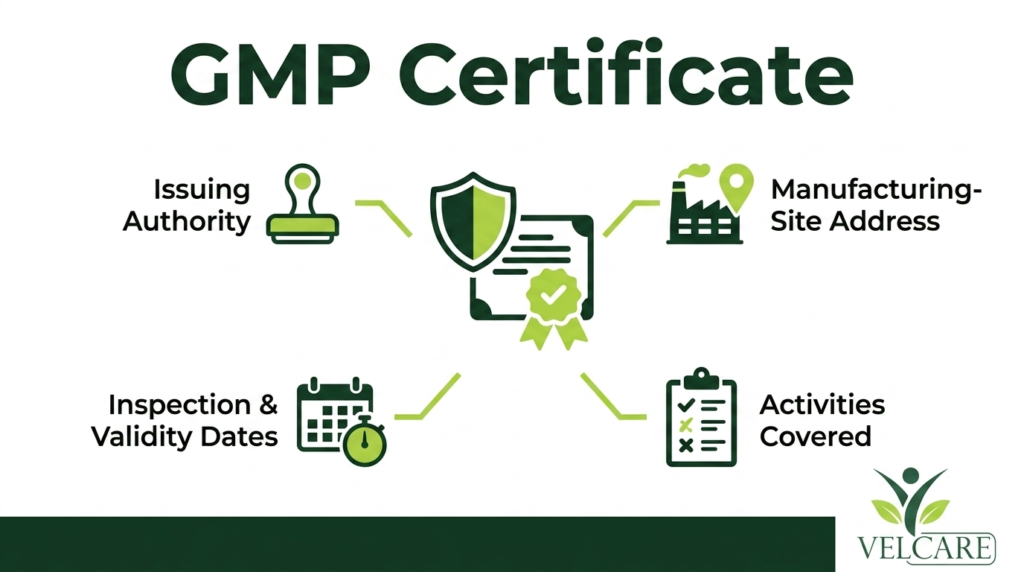
Review the GMP certificate for:
- Issuing regulatory authority
- Manufacturer’s complete legal name
- Exact manufacturing-site address
- Date of inspection
- Certificate issue date
- Stated validity or reinspection period
- Activities covered
- API or product scope, where listed
- Manufacturing, testing, packaging and storage operations
- Restrictions, qualifications or exclusions
- Certificate number and authenticity
The manufacturing address must correspond to the Etomidate site identified in the DMF, ASMF, CEP, manufacturing licence, audit records and commercial documents. A certificate issued to another plant within the same corporate group does not cover the proposed source.
For EU-related verification, EudraGMDP contains GMP certificates, non-compliance statements, active-substance manufacturer registrations and manufacturing or import authorisations. EU competent authorities enter a GMP certificate or non-compliance statement after inspecting a site. (EUDRAGMDP)
A GMP certificate should not be replaced by an ISO certificate, business registration or general quality-system statement. These records do not establish inspection against pharmaceutical API GMP requirements.
6. Regulatory Inspection Evidence
A GMP certificate should be read together with the site’s inspection history. Inspection evidence helps establish how recently the site was assessed, which authority conducted the inspection and whether unresolved observations or enforcement actions remain.
Relevant records can include:
- Inspection date
- Inspection scope
- Inspection report or summary
- Form FDA 483, where issued
- Establishment Inspection Report information, where available
- Inspection classification
- Responses to observations
- Corrective and preventive action summary
- Evidence that critical actions were completed
- Warning letters
- Import alerts
- Suspension or restriction notices
- GMP non-compliance statements
For FDA inspections, the public classifications are No Action Indicated, Voluntary Action Indicated and Official Action Indicated. An OAI classification means that regulatory or administrative action is recommended, while a VAI classification indicates that objectionable conditions were found but the agency is not recommending formal action at that stage. (U.S. Food and Drug Administration)
The complete inspection report may contain confidential information and may not be available to a prospective buyer. The supplier should nevertheless provide enough information for the buyer to determine the nature of significant observations, the affected operations, the CAPA status and whether the authority has closed any resulting compliance action.
Inspection records should be assessed by site and activity. A satisfactory inspection covering an unrelated finished-product line may not provide sufficient assurance for the building, equipment or quality systems used to manufacture Etomidate API.
7. Manufacturing Licence
A manufacturing licence or equivalent national authorisation establishes whether the site is legally permitted to conduct the stated pharmaceutical manufacturing activities in its home jurisdiction.
Verify that the licence:
- Was issued by the responsible national, state or regional authority
- Identifies the correct legal manufacturer
- Includes the actual production-site address
- Covers APIs, bulk drugs or the relevant pharmaceutical substances
- Covers the operations conducted at the site
- Remains current
- Includes applicable annexes or product schedules
- Matches the English translation supplied by the manufacturer
Where manufacturing, testing, micronisation, packaging and storage occur at different sites, obtain the applicable authorisation for each regulated activity.
A trading company’s incorporation certificate, wholesale licence, tax registration or import-export registration should not be accepted as evidence that the company is authorised to manufacture Etomidate API. The regulatory identity of the manufacturer must remain distinct from that of an exporter, agent or distributor.
8. Regulatory and Compliance Declarations
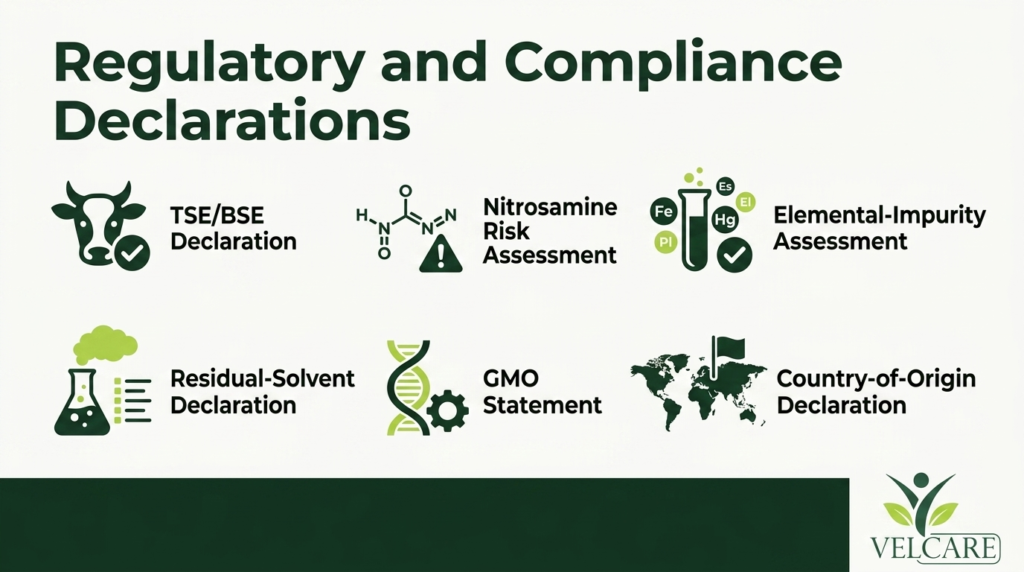
Supporting declarations can be required for a regulatory submission, supplier qualification or product-specific risk assessment. Their relevance depends on the manufacturing process, starting materials, target market and intended finished product.
Potential documents include:
- TSE and BSE declaration
- Statement on human-derived or animal-derived materials
- Nitrosamine risk assessment
- Mutagenic or genotoxic impurity assessment
- Elemental-impurity risk assessment
- Residual-solvent declaration
- GMO-status declaration
- Allergen statement
- Country-of-origin declaration
- Pharmacopoeial-compliance statement
For a synthetic API such as Etomidate, particular attention should be given to the reagents, solvents, catalysts, recovered materials and process conditions that could introduce or generate impurities.
ICH Q3C addresses toxicologically acceptable levels of residual solvents, while ICH Q3D establishes a risk-based approach to elemental impurities. ICH M7 provides the framework for identifying, categorising and controlling DNA-reactive mutagenic impurities. (European Medicines Agency (EMA))
A nitrosamine statement should consider the actual route of synthesis, amine-containing materials, nitrosating agents, recovered solvents, water quality, cross-contamination and degradation pathways. It should not consist only of a signed sentence stating that the material is “nitrosamine free.” Regulatory authorities expect risk evaluation to be based on process knowledge and scientific assessment. (European Medicines Agency (EMA))
The same principle applies to TSE, GMO and allergen declarations. Their conclusions should be traceable to raw-material origin and manufacturing-process information. Generic declarations issued without technical assessment provide limited regulatory value.
9. Facility Registration and Site-Listing Records
Facility registration should be reviewed where the target market or supply route requires the site to be registered with the relevant authority.
For a US programme, the buyer should determine whether the proposed manufacturing establishment should appear in FDA’s current drug-establishment registration records. The registered name and address should be compared with the DMF, GMP evidence and commercial documentation. FDA expressly states that establishment registration and drug listing do not indicate product approval or verification of the information submitted. (U.S. Food and Drug Administration)
For European supply chains, EudraGMDP includes registrations of active-substance manufacturers, importers and distributors, together with GMP and non-compliance information. (European Medicines Agency (EMA))
Registration is therefore an identity and regulatory-status check, not proof of GMP compliance, dossier acceptability or batch quality.
10. Change-Notification and Regulatory-Commitment Documents
The supplier should provide a written commitment to notify the buyer before implementing changes that could affect the approved source or regulatory submission.
The commitment should cover changes to:
- Manufacturing site
- Synthetic route
- Starting materials
- Starting-material suppliers
- Key intermediates
- Solvents, reagents or catalysts
- Recovered-material practices
- Process parameters
- Specifications
- Analytical methods
- Impurity controls
- Physical processing or micronisation
- Packaging system
- Storage conditions
- Retest period
- DMF, ASMF or CEP ownership
- DMF, ASMF or CEP status
- GMP or manufacturing-licence status
ICH Q7 requires a formal system for assessing changes to raw materials, specifications, analytical methods, facilities, equipment, processing steps and packaging materials. It also states that dosage-form manufacturers should be notified of changes that can affect API quality.
For US DMFs, the holder must notify affected authorised parties of pertinent changes. FDA guidance states that notification should occur sufficiently in advance to allow the applicant to amend or supplement an affected application. (U.S. Food and Drug Administration)
The commercial or quality agreement should define the notification process, responsible contacts and required supporting information. An undocumented change can leave the commercially supplied Etomidate inconsistent with the source described in the buyer’s regulatory dossier.
Regulatory Documents vs. Quality Documents
Regulatory and quality documents are both needed, but they answer different questions.
| Regulatory Documents | Quality and Batch Documents |
| DMF, ASMF or CEP | Certificate of Analysis |
| Letter of Authorization or Access | API specification |
| GMP certificate | Analytical methods |
| Manufacturing licence | Method-validation records |
| Inspection evidence | Stability data |
| Facility registration | Impurity and physical-property data |
Can Regulatory Documents Alone Qualify an Etomidate API Supplier?
Regulatory records are a major part of supplier qualification, but they cannot independently establish:
- Conformity of a particular batch
- Reproducibility of the supplier’s analytical results
- Suitability for the proposed formulation
- Long-term batch consistency
- Supply reliability
- Complete supply-chain transparency
- Acceptability of every aspect of the finished-drug application
The assessment should therefore continue through technical-document review, supplier due diligence, quality-system evaluation and sample testing.
Related evaluations are covered in:
- Documents to Request from an Etomidate API Supplier
- How Pharmaceutical Companies Qualify an Etomidate API Supplier
- Why Supply-Chain Transparency Matters When Sourcing Etomidate API
Request Regulatory Information for Etomidate API
Buyers requesting regulatory support for Etomidate API from Velcare Pharma should provide:
- Target market
- Development or commercial stage
- Required quantity
- Applicable pharmacopoeia
- Intended regulatory filing route
- Required supporting documents
- Expected submission or procurement timeline
This information allows the regulatory-document request to be assessed against the proposed application and supply arrangement.
Disclaimer
This article provides general information for pharmaceutical sourcing and supplier-evaluation purposes. Regulatory requirements depend on the target market, application type, product, manufacturing arrangement and current authority guidance. Buyers should have the proposed Etomidate API source and its supporting documentation reviewed by qualified quality, regulatory and legal personnel before relying on it in a regulatory submission or commercial supply programme.