An Etomidate API quality agreement that says the supplier will “promptly report significant quality events” still leaves both parties with several unanswered questions.
Which manufacturing changes require the buyer’s approval? Does every deviation need to be reported? Who investigates an out-of-specification result when the buyer and supplier obtain different results? If the Etomidate API comes through a distributor, how will a complaint reach the original manufacturer?
These questions become harder to resolve after an affected batch has been shipped. The agreement should therefore define the responsibilities, information requirements, decision rights and communication routes before the first quality event occurs.
A quality agreement does not replace the supplier’s or buyer’s quality system. It also cannot transfer away either party’s applicable GMP responsibilities. Its purpose is to make those responsibilities clear enough for the parties to work together without relying on commercial correspondence or assumptions.
Quick Answer: What Should an Etomidate API Quality Agreement Define?
The exact scope depends on the proposed supply chain, target market and stage of the buyer’s program. At minimum, the agreement should address the following areas:
| Clause area | What the agreement should establish |
| Change control | Which changes require advance notice, prior approval or supporting technical data |
| Deviations | Which events are reportable, who investigates them and how affected batches are controlled |
| OOS results | How supplier and buyer results are communicated, investigated and reconciled |
| Complaints | Who receives, investigates, responds to and trends quality complaints |
| CAPA | Who proposes, approves, tracks and verifies corrective and preventive actions |
| Communication | Quality contacts, escalation routes, notification windows and required records |
| Batch disposition | Which quality unit decides the status of material under its control |
| Records | What evidence will be shared, who maintains the originals and how records remain accessible |
This agreement forms one part of the wider Etomidate API document package. It should be negotiated against the actual manufacturing and supply arrangement rather than copied from a general supplier template.
Start by Identifying Every Party Covered by the Agreement
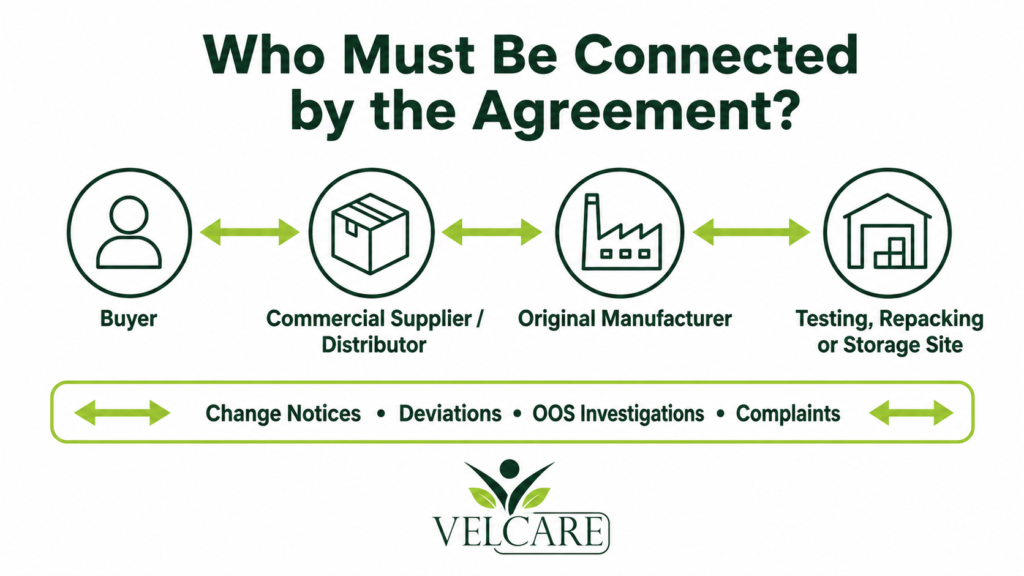
Responsibilities cannot be assigned correctly until the buyer knows which organizations manufacture, test, release, store and supply the Etomidate API.
Identify the Operational Roles
The relevant parties may include:
- Buyer or drug-product manufacturer
- Commercial Etomidate API supplier
- Original API manufacturer
- Contract testing or stability laboratory
- Repacker or relabeler
- Distributor, exporter or logistics intermediary
- DMF holder, where different from the manufacturer
The company issuing the quotation or invoice may not hold the production and laboratory records needed for an investigation. The distinction between the Etomidate API manufacturer and commercial supplier therefore affects more than procurement. It determines who can investigate a process deviation, explain an impurity shift or authorize a manufacturing change.
ICH Q7 recommends complete traceability through distributors, traders, repackers and relabelers. It also recommends transferring quality and regulatory information from the original manufacturer to the customer and from the customer back to the manufacturer. A buyer should confirm this information path while mapping the Etomidate API supply chain.
Decide Who Must Be Bound by the Arrangement
The appropriate structure may be:
- A direct agreement between the buyer and original manufacturer
- A buyer-supplier agreement incorporating manufacturer obligations
- A tripartite agreement among the buyer, supplier and manufacturer
- Separate agreements with aligned responsibilities and communication routes
Where a distributor receives the order, the customer-facing agreement should not promise access to change notices, investigation reports or manufacturing data unless equivalent obligations exist between the distributor and original manufacturer.
The buyer should verify these arrangements as part of the wider process used to qualify an Etomidate API supplier.
Separate Quality Terms From Commercial Terms
The quality agreement should focus on GMP responsibilities and quality-related communication.
FDA’s guidance on contract manufacturing recommends keeping quality agreements separate from, or at least severable from, commercial agreements. Pricing, payment, general delivery terms, limits on liability and other business conditions normally belong in the supply or commercial contract.
However, the documents must still align. For example, the purchase order should not permit substitution of another manufacturing site or packaging configuration if the quality agreement requires prior approval for that change.
Assign Responsibilities Before Defining Notification Times
A responsibility matrix can reveal gaps that are easy to miss in narrative clauses.
| Activity | Manufacturer or responsible laboratory | Commercial supplier | Buyer |
| Detect and document a manufacturing event | Opens the source quality record | Receives and transmits information where applicable | Receives the agreed notification |
| Perform the source investigation | Reviews manufacturing and laboratory records | Coordinates access where it does not hold the records | Provides receipt, sampling or testing information |
| Assess effect on the buyer’s product or filing | Supplies relevant technical evidence | Supports communication | Performs the product- and market-specific assessment |
| Decide the source-batch disposition | Controls release or rejection within its quality system | Communicates the approved status | Decides whether received material may be used |
| Maintain original records | Retains source manufacturing and laboratory records | Retains distribution and communication records | Retains incoming-testing and product-impact records |
| Communicate with regulators | Supports the information under its control | Coordinates where contractually assigned | Determines reporting required for its application or product |
The party that investigates an event and the party that decides how a received batch may be used are not necessarily the same. The agreement should preserve each quality unit’s authority over the material or operation under its control.
Define the Etomidate API Change-Control Clauses
“Supplier will notify the buyer of major changes” is not specific enough. The supplier’s internal change classification may not reflect the effect on the buyer’s formulation, analytical controls or regulatory filing.
List the Changes Covered by the Agreement
ICH Q7 recommends a formal system for changes that could affect API production or control. For an Etomidate API supply arrangement, the agreement should address changes to:
- Original manufacturer or manufacturing site
- Synthetic route or relevant process conditions
- Significant starting materials or material suppliers
- Production scale, equipment or manufacturing train
- Manufacturing, release-testing or stability laboratory
- Specification, acceptance criteria or test frequency
- Analytical procedures, calculations or reporting limits
- Reference standards
- Impurity controls
- Reprocessing or reworking practices
- Container-closure system, pack size or repacking arrangement
- Storage and transportation conditions
- Retest period or stability program
- Subcontractors and other quality-relevant supply-chain parties
- Applicable DMF, CEP, ASMF or related regulatory documentation
A specification change needs to be assessed against the buyer’s approved requirements rather than treated as an administrative revision. Velcare’s guide to comparing Etomidate API specifications explains the difference between a supplier limit, compendial requirement and buyer-controlled criterion.
Similarly, a process change may alter the Etomidate impurity profile without causing an immediate assay failure. The notice should provide enough information for the buyer to assess that possibility.
Classify Changes by the Required Buyer Involvement
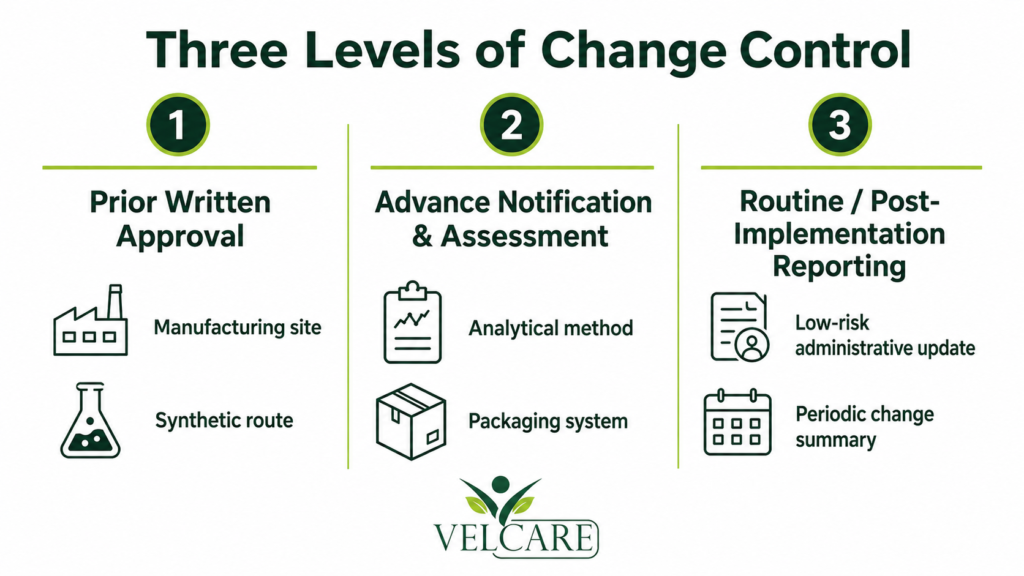
The agreement can divide changes into three categories:
- Changes requiring the buyer’s prior written approval
- Changes requiring advance notification and buyer assessment
- Changes that may be reported after implementation or through periodic review
The classification should consider the potential quality, regulatory and supply impact. A change described as minor within the manufacturer’s system may still affect a buyer-specific analytical method, registered source or finished-product process.
The parties should define which changes cannot be implemented for the supplied material until the buyer has completed its assessment. They should also agree on how urgent, temporary or legally required changes will be handled when the normal advance-notification period is impractical.
Define What a Change Notice Must Contain
A usable change notice should identify:
- Controlled change number
- Current and proposed condition
- Reason for the change
- Proposed implementation date
- Affected products, sites and batches
- Quality-risk assessment
- Potential effect on the specification and impurity profile
- Validation, comparability or stability support
- Potential regulatory-filing impact
- Documents requiring revision
- First batch expected under the new condition
- Contact responsible for questions and approval
Changes to the manufacturing source, filing content or registered controls should also be assessed against the applicable Etomidate API regulatory documentation.
Address Implementation and Post-Change Review
Approval of a change proposal should not end the process. The agreement should define:
- Additional testing or qualification required before implementation
- Documents that must be updated
- Identification of the first post-change batch
- Additional COA, sample or method-comparison requirements
- Stability commitments, where applicable
- Review of initial batches manufactured or tested under the change
- Assessment of whether the change achieved its objective without harming quality
Define the Deviation Clauses
A buyer does not necessarily need a report for every minor internal deviation. However, the agreement should prevent the supplier from withholding an event that could affect supplied material or the buyer’s regulatory responsibilities.
Specify Which Deviations Are Reportable
Reportable events may include deviations affecting:
- A supplied or potentially supplied Etomidate batch
- Identity, assay, impurities or another agreed quality attribute
- Batch traceability or document reliability
- Manufacturing or laboratory data integrity
- Validated processing or testing conditions
- Packaging integrity, storage or transportation
- Stability-program results
- Approved sites or subcontractors
- Other batches manufactured under the same conditions
- Commitments made in applicable regulatory documentation
The clause should define the decision criteria. Terms such as critical, major and minor should either be defined in the agreement or linked to an approved classification system understood by both parties.
Define Initial Notification and Investigation Responsibilities
The clause should state:
- Who sends the initial notification
- Which facts are required in the first communication
- Who opens and owns the investigation
- Whether affected material must be quarantined
- How frequently interim updates will be provided
- When the investigation must expand to other batches
- Which supporting records the buyer may review
- Who evaluates the effect on the buyer’s product and filing
The original manufacturer normally investigates a manufacturing deviation because it holds the source records. The buyer still assesses whether the event affects incoming release, manufacturing use or regulatory commitments.
Define Investigation Closure and CAPA
The final investigation package should address:
- Event description and chronology
- Immediate containment
- Root-cause conclusion
- Batch and cross-batch impact
- Product-quality and regulatory assessment
- Final material disposition
- Corrective and preventive actions
- CAPA owner and target date
- Effectiveness check
- Approval and closure status
ICH Q10 connects deviations, complaints, rejections, recalls, audit findings and quality trends with a structured CAPA system. It also recommends making the formality and documentation of an investigation proportionate to risk.
Define the OOS Result Clauses
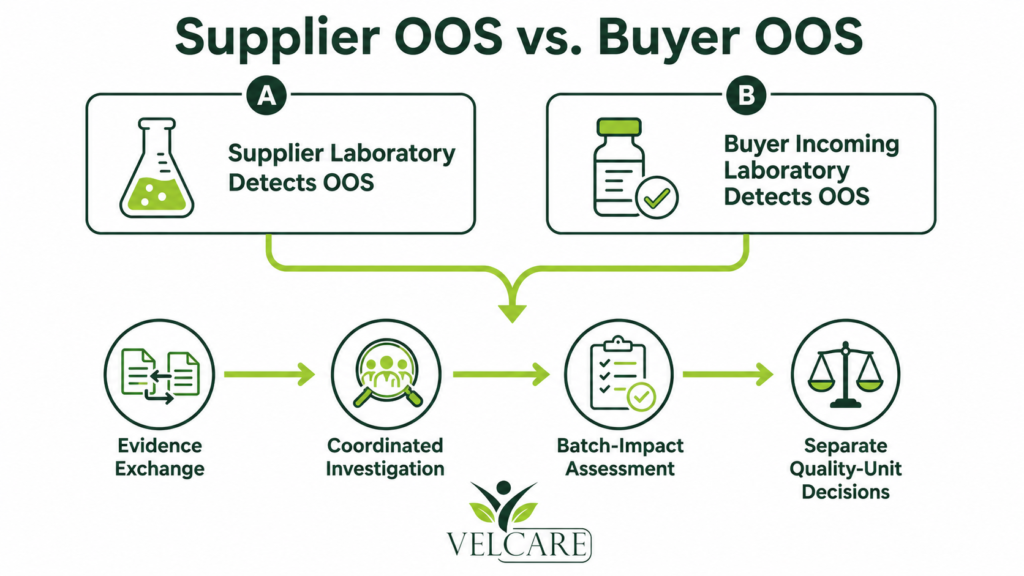
An OOS result is outside an established specification or acceptance criterion. A deviation is a departure from an approved procedure, instruction or operating condition. An event may involve both, but the terms should not be used interchangeably.
ICH Q7 recommends investigating and documenting API OOS results according to an approved procedure. FDA’s OOS investigation guidance also applies its principles to APIs, purchased drug-product components and contract laboratories.
Supplier-Generated OOS Results
The agreement should define when the supplier reports an OOS that:
- Occurs on a batch intended for the buyer
- Affects a stability batch supporting the supplied material
- Concerns a shared process, method, material or equipment train
- Indicates possible impact on a previously released batch
- Leads to rejection, reprocessing, reworking or delayed release
The initial notice does not need to claim a root cause before the investigation has established one. It should state the result, test, specification, batch, current investigation status and immediate containment.
Buyer-Generated Incoming-Test OOS Results
When the buyer obtains an OOS result, it should provide enough information for a meaningful comparison. This may include:
- Batch and container identification
- Sampling procedure and sample history
- Analytical method and version
- Specification and calculation basis
- Reference-standard information
- System-suitability results
- Chromatograms or relevant data extracts
- Storage and sample-handling conditions
A passing supplier Etomidate API COA does not automatically invalidate the buyer’s result. Likewise, one buyer result does not by itself prove that the supplier’s manufacturing process failed.
The investigation may need to compare sampling, test methods, calculations, reporting bases, reference standards and ordinary inter-laboratory variability. Results from other representative batches can provide context, but batch-to-batch consistency remains a separate assessment.
Control Retesting, Resampling and Result Invalidation
The agreement should confirm that:
- The original result remains part of the investigation record.
- Retesting and resampling follow approved, scientifically justified procedures.
- A favorable retest does not erase an earlier OOS result without an assignable cause.
- The number of retests is defined before testing begins.
- Both parties share the information needed to examine an inter-laboratory difference.
- Commercial personnel do not decide the technical outcome.
These controls become especially relevant when a buyer is evaluating an Etomidate API sample and method differences have not yet been fully resolved.
Define Batch Disposition and Wider Impact
The agreement should separate:
- The manufacturer’s decision to release or reject the source batch
- The buyer’s decision to release, reject or restrict received material
- The regulatory assessment for the buyer’s drug product or application
For U.S. drug-product manufacturers, 21 CFR 211.192 requires investigation of unexplained discrepancies and component or batch failures. This is a drug-product CGMP provision rather than an API-specific quality-agreement clause, but it shows why the buyer may need timely supplier records to meet its downstream responsibilities.
Define the Complaint Clauses
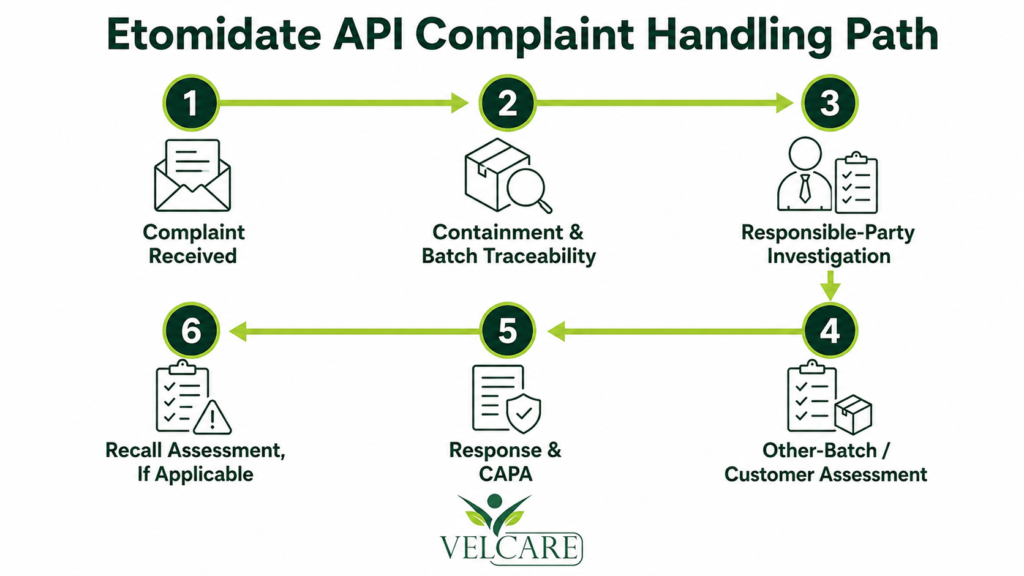
A complaint can begin with a damaged drum, mismatched label, unexpected analytical result, visible contamination, missing document or problem observed during manufacturing. The agreement should define how that information reaches the party capable of investigating it.
Establish Complaint Intake and Immediate Containment
The clause should identify:
- Approved complaint channels and quality contacts
- Information required to open a complaint
- Expected acknowledgment
- Batch, container and shipment identification
- Photographs, samples, seals, labels or logger data required
- Quarantine and sample-preservation instructions
- Conditions for returning material
- Immediate escalation for contamination, mix-up, tampering or potential patient risk
Assign the Investigation to the Party With the Records
The commercial supplier may receive and coordinate a complaint, but the original manufacturer usually holds the production, packaging and laboratory records needed for root-cause work.
A repacker or logistics provider may need to investigate breached packaging, relabeling errors or transport excursions. The buyer provides evidence covering receipt, storage, sampling, testing and material use.
ICH Q7 recommends recording and investigating API quality complaints under a written procedure. It also recommends maintaining complaint information through agents, brokers, distributors, repackers and relabelers and involving the original manufacturer when further action may be required.
Define Complaint Response and Closure
The final complaint record should address:
- Initial assessment and containment
- Investigation findings
- Root cause or justified conclusion
- Effect on the reported batch
- Effect on other batches or customers
- Corrective and preventive actions
- Final response
- Return, replacement or destruction instructions, where applicable
- Complaint trending
- Recall or regulatory escalation, where necessary
For U.S. drug products, 21 CFR 211.198 establishes complaint-file requirements for finished drug products. It should not be presented as an API complaint procedure. However, a finished-product complaint linked to the API may require information from the supplier’s investigation.
Set Notification Windows Without Creating Ambiguity
FDA and ICH guidance do not prescribe one universal notification period for every quality event. The parties need to define appropriate timeframes according to event severity, filing impact and potential effect on supplied material.
| Event classification | Initial communication | Follow-up expectation | Final record |
| Urgent or potentially critical | Immediate escalation through the agreed quality contacts | Regular updates while containment and impact assessment continue | Approved investigation and CAPA package |
| Significant | Within the agreement’s defined business-day window | Interim update if the target closure date will be missed | Final investigation by the negotiated due date |
| Routine or low-risk | Through the agreed routine channel | As requested or during periodic review | Retained in the applicable quality record |
Words such as “immediately,” “promptly” and “timely” should be defined or connected to a severity matrix.
The clause should also explain what happens when:
- The normal quality contact is unavailable
- Initial information is incomplete
- The investigation cannot close by its target date
- Confidential records cannot be distributed without restriction
- The parties disagree about classification or batch impact
- A required notification was not provided on time
Add the Supporting Clauses Needed to Make the Agreement Work
The four main event clauses depend on several supporting provisions.
CAPA and Effectiveness Verification
Define who approves CAPA, how due-date extensions are justified, what evidence demonstrates completion and how effectiveness is checked. Recurrence should trigger reassessment rather than repeated closure under the same explanation.
Subcontracting and Responsibility Flow-Down
ICH Q7 recommends prior evaluation and approval before contracted work is passed to another party. The agreement should prevent quality responsibilities from disappearing when manufacturing, testing, repacking or storage is subcontracted.
Records, Audits and Regulatory Communication
Define:
- Ownership and availability of original records
- Applicable retention periods
- Access to investigation evidence
- Routine and for-cause audit rights
- Communication of relevant inspection findings
- Responsibility for market-specific regulatory assessment
- Handling of information that requires controlled or confidential review
Quality Contacts and Disagreement Escalation
List primary and backup contacts for both parties. Quality issues should move through quality-to-quality communication before escalation to senior management. The agreement should identify final decision rights without allowing one party to direct another quality unit to disregard its procedures.
Agreement Review and Revision
State when the agreement will be reviewed, who approves revisions and how open events are handled when the relationship ends. A major source change, recurring OOS pattern, serious complaint or restructuring of the supply chain may justify an event-driven review.
The agreement should also be completed before the relationship advances from qualification to routine supply. This fits within the wider process of moving from an Etomidate API sample to the first commercial order.
Etomidate API Quality Agreement Review Checklist
Before approval, confirm that:
- All manufacturing, testing and supply roles are identified.
- Quality information can move between the buyer and original manufacturer.
- Reportable changes and deviations are defined.
- Notification windows are linked to severity.
- Supplier and buyer OOS responsibilities are separated.
- Retesting and result invalidation are controlled.
- Complaint intake, investigation and recall escalation are covered.
- Batch-disposition authority is clear.
- CAPA closure and effectiveness checks are assigned.
- Supporting records will be available when needed.
- The agreement aligns with the approved source, specification and filing.
- The arrangement supports ongoing monitoring of the supplier’s long-term reliability.
Discuss Your Etomidate API Requirements With Velcare Pharma
If your company is evaluating an Etomidate API source, share the intended market, required specification, procurement stage, quantity and quality-document expectations with Velcare Pharma. The inquiry can also identify the manufacturing, testing, release and supply roles applicable to the proposed material so your team can determine the appropriate quality-agreement scope.