How to read an etomidate certificate of analysis (COA) comes down to six checks:
- Lot number,
- Grade,
- Every result against specifications,
- Method validation,
- Signature and retest date,
- Any out-of-specification (OOS) reading
This guide runs QA, procurement, and regulatory staff at registered pharmaceutical companies through each of those checks to help you identify a real etomidate API COA.
A COA itself is simple: it reports the actual test results for one batch against its written specification, and it’s the release-gate record that decides whether a lot ships or gets quarantined.
Read this guide in that order and you can call any etomidate COA clean, or flag it as OOS, without guessing. Continue reading below to learn more.
What an Etomidate COA Actually Is?
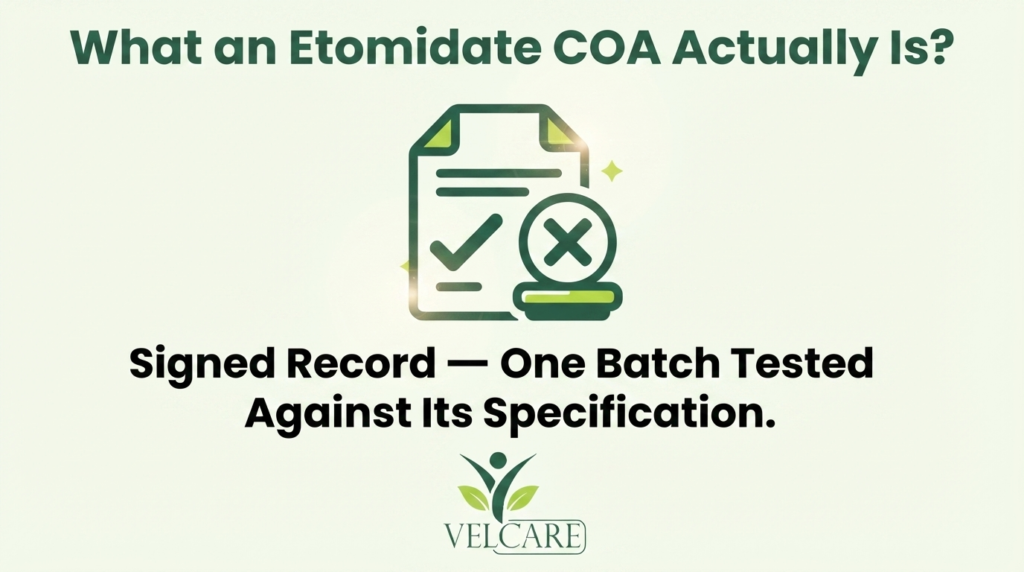
An etomidate COA is the manufacturer’s signed record that one identified batch was tested and either met or failed each parameter in the specification. It is not a marketing sheet and it is not a generic product description. It reports numbers, methods and a verdict for a single lot.
A little about Etomidate
Etomidate is a small-molecule imidazole carboxylate ester, the ethyl ester of 1-[(1R)-1-phenylethyl]-1H-imidazole-5-carboxylic acid, CAS 33125-97-2, molecular formula C14H16N2O2, molecular weight 244.29. It is not a peptide, and it should never be described or tested as one. As a drug substance, it typically presents as a white to almost-white crystalline powder. Those facts anchor everything the COA claims.
Components of Certificate of Analysis
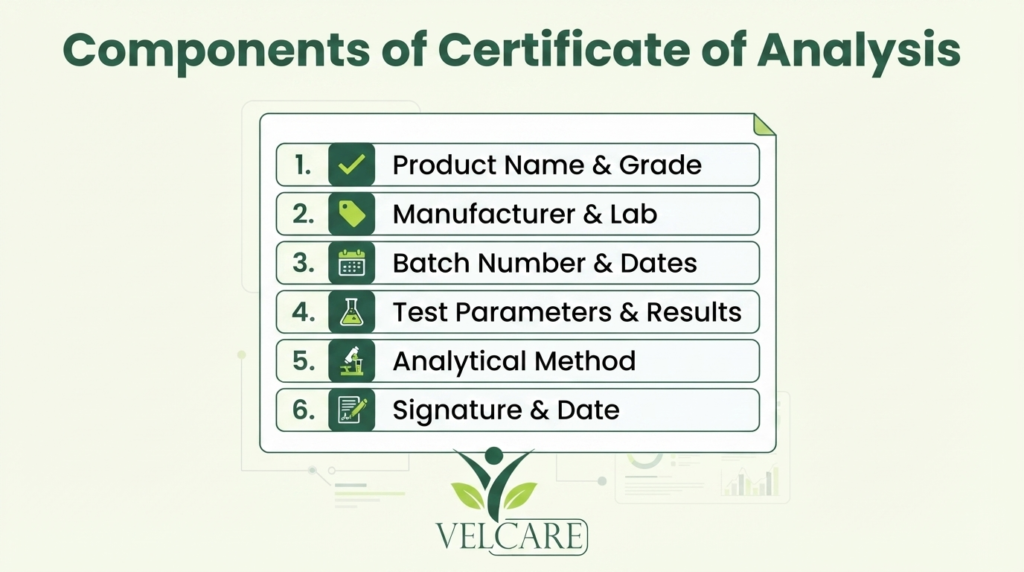
A complete etomidate COA should contain the following components:
- Product name, CAS number and the grade or pharmacopoeial reference claimed
- Manufacturer name and manufacturing site, plus the testing laboratory if different
- Batch/lot number and batch size, manufacture date and retest date
- Each test parameter with its specification (acceptance criterion) and the actual result
- The analytical method used for each parameter, named or referenced
- A conformance statement, the name and title of the authorizing person, a signature and a date
How Do You Actually Read an Etomidate Certificate of Analysis?
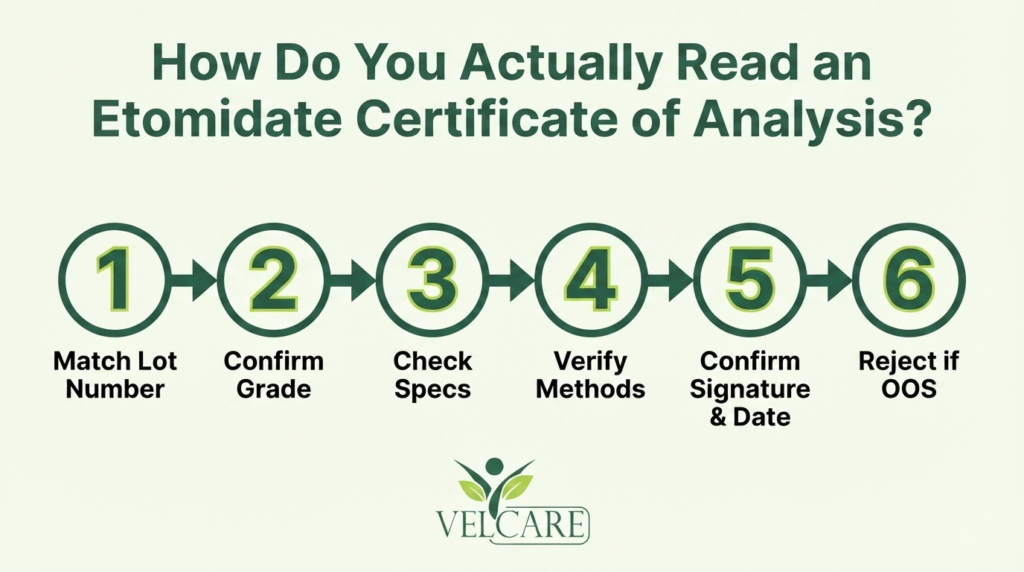
The following are the steps to perform an Etomidate COA. Work through it in a fixed sequence and do not skip steps.
Match the lot number to the shipment
Confirm the batch number on the COA equals the batch number on the containers and the shipping documents. If it does not reconcile, stop here and quarantine.
Confirm the grade matches your requirement
Check the claimed standard. For example, a Ph. Eur. or USP grade is the one your registered process and marketing authorization require. A COA for a different grade is not fit for your filing.
Check that every result falls inside its specification
Read each parameter individually: assay, each named impurity, total impurities, water by KF, residual solvents, elemental impurities, appearance. Every line must be within its acceptance criterion. One failing line is a failing batch.
Verify the methods are compendial or validated
Each result should name a method that is either the pharmacopoeial method or a validated in-house method. “Tested” with no named method is not verifiable.
Confirm the signature and retest date
The COA must be signed and dated by an authorized member of the quality unit, and it should carry a retest date rather than an expiry date (see below). An unsigned COA is a draft, not a release document.
If any result is out-of-specification (OOS), reject and quarantine
A confirmed OOS result means the batch does not meet its standard. Do not accept, do not “average in” a better retest, and do not use the material. Quarantine it, refuse release, and require the supplier’s OOS investigation.
Anatomy of an Etomidate COA
The core of an etomidate COA is a table of parameters, each pairing a specification with a batch result and a method. The parameters below are what QA should expect to see, and each one protects the buyer from a specific failure.
Identification Tests for COA
Identity testing confirms the material in the container is actually etomidate and not a mislabeled, substituted or analog compound.
According to the UNODC 2025 report Synthetic Drugs in East and Southeast Asia, etomidate was “first identified as a drug of misuse in 2021,” and its analogues now include “metomidate, isopropoxate, propoxate, sec-butomidate, butomidate, CF3-etomidate and 4F-etomidate,” with six new analogues identified in 2024 alone. Because several of these analogs differ from etomidate by only small structural changes, proving identity is not a formality.
A COA usually shows identity confirmed by more than one orthogonal method.
- High-performance liquid chromatography (HPLC) confirms identity by retention-time match against a reference standard, and is also the workhorse for assay and purity.
- Infrared spectroscopy (IR) confirms identity by matching the sample’s absorption spectrum to a reference spectrum; it fingerprints the molecular structure.
- Mass spectrometry (MS) confirms identity by molecular mass and fragmentation pattern, which for etomidate should correspond to a molecular weight of 244.29.
Analysis Components of COA
The following are the critical components of COA:
1. HPLC Chromatogram
The assay and impurity numbers on the COA are summaries of an underlying chromatogram. The chromatogram is the raw evidence: a dominant etomidate peak plus small, resolved impurity peaks on a stable baseline. QA should be entitled to request the chromatograms, because a number without the trace behind it cannot be independently judged. Real chromatograms show natural baseline noise and integration; a suspiciously perfect single spike is a reason to ask questions.
Mass Spectrometry
Where MS is used for identity, the COA should reference the method and the confirmed result rather than just stating “conforms”. MS complements IR: IR confirms functional-group structure, MS confirms mass. For a substance with abuse-relevant analogs that differ by small structural changes, this orthogonal confirmation is worth insisting on.
Batch Number Verification
The lot number on the COA must match the lot number physically printed on the containers you received, and match your purchase and shipment documents. This is the single link that ties the tested material to the delivered material. A COA whose lot number does not reconcile is worthless for traceability, regardless of how good the results look.
Third-party vs Internal Testing for COA
Most API COAs report the manufacturer’s own quality-control results. That is normal and acceptable under a qualified supplier program, but internal testing carries an inherent conflict of interest, so buyers should understand the difference and know when to seek independent confirmation.
The following table shares a quick differentiation between both:
| Feature | Internal (manufacturer) testing | Third-party (independent lab) testing |
| Who performs it | Manufacturer’s own quality unit | Independent accredited laboratory |
| Cost or speed | Lower cost, faster turnaround | Higher cost, slower |
| Independence | Conflict of interest possible | Independent, no commercial stake in result |
| Typical use | Routine batch release on a qualified supplier | Supplier qualification, disputes, high-risk or first lots, verification of a suspect COA |
| What it proves | Batch met spec in the maker’s lab | Result reproduces outside the maker’s control |
What an Etomidate COA Confirms?
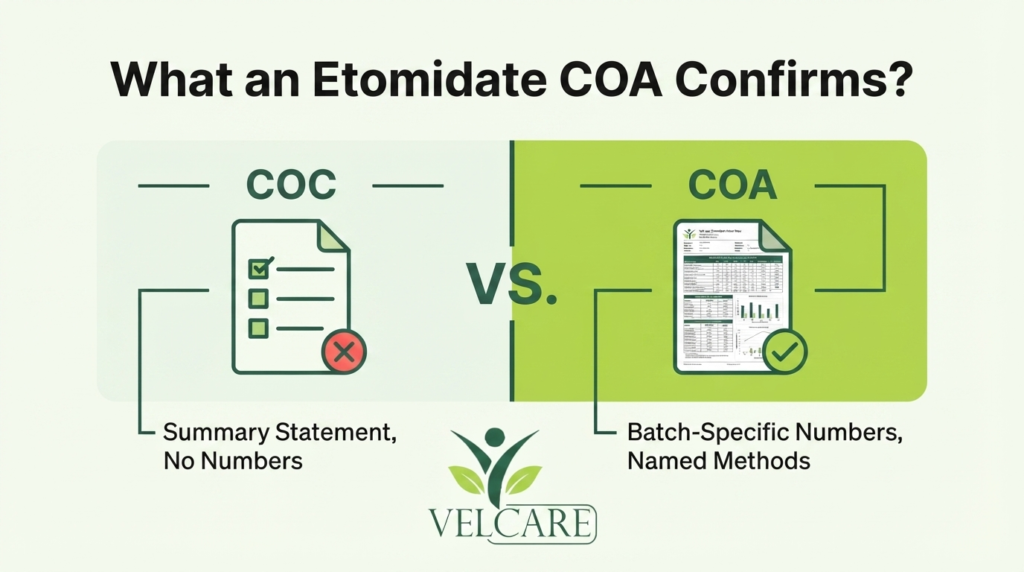
A COA confirms that a specific, identified batch was tested and met each written specification. That is a stronger claim than a conformance statement, and it is why regulators expect a COA for APIs rather than a bare Certificate of Conformance (COC). With that said, here is the difference between a COA and COC:
| Element | Certificate of Conformance (COC) | Certificate of Analysis (COA) |
| What it states | A summary declaration that the batch conforms | Actual measured result for each parameter |
| Numerical data | None or minimal | Batch-specific numbers per test |
| Methods shown | Usually not | Named or referenced per parameter |
| Traceability | Limited | Lot-specific, tied to results |
| Regulatory fit for API | Insufficient on its own | Expected for API release |
Red Flags in an Etomidate COA
If you check or receive an Etomidate COA that has the following mistakes, you need to be careful:
- “Typical”, “conforms” or “meets spec” language instead of batch-specific numbers. A parameter that says “conforms” with no measured value is not verifiable. Assay and impurities must be reported as numbers.
- No signature or no date. An unsigned, undated COA has no accountable author and no release authority behind it.
- Every result landed exactly on the limit. Real analytical data varies. Results that sit precisely on the specification value across parameters or batch after batch suggest fabricated or adjusted figures.
- Missing manufacturer or site identity. If you cannot tell who made and tested the material, you cannot assess GMP status or traceability.
- Methods not named. Results with no stated analytical method cannot be checked against compendial or validated procedures.
- Mismatched or generic lot number. A lot number that does not match the containers, or a recycled generic batch code reused across deliveries, breaks traceability.
- A retest/expiry date that is missing, or an expiry date used where a retest date belongs without explanation.
Importance of a Legitimate COA
A COA is only as good as the organization and laboratory behind it, so verifying legitimacy is part of the job. To confirm the COA and the supplier are legitimate:
- Check ISO/IEC 17025 accreditation of the testing laboratory. ISO/IEC 17025 is the international standard for the competence of testing and calibration laboratories; accreditation gives independent assurance that the lab’s results are technically valid. In pharma it complements, rather than replaces, GMP.
- Confirm the GMP status of the manufacturer and testing site. The material and its data should originate from a site operating under ICH Q7 GMP for APIs, supported by valid GMP certificates or inspection history.
- Request the raw chromatograms and reference-standard documentation. Ask for the HPLC traces behind the assay and impurity numbers and the identity of the reference standard used. A legitimate supplier can provide these.
- Keep a third-party retest option. Retain the right to send a sample to an independent accredited laboratory, especially for supplier qualification, first lots or any suspect COA. As the long-standing QA maxim goes: don’t trust, verify.
About Velcarepharma
Velcarepharma supplies etomidate API with batch-specific Certificates of Analysis that report identity by HPLC, MS and IR, assay and related-substance results, and water content by Karl Fischer, alongside supporting documentation such as chromatograms and reference-standard details on request. For registered pharmaceutical buyers, that documentation package is intended to make incoming QA review and supplier qualification straightforward.
FAQ
Who should do the testing?
Both parties, at different points. The manufacturer’s quality unit performs and reports the batch testing on the COA. Under 21 CFR 211.84, the receiving manufacturer must still conduct at least one specific identity test on the incoming component and establish the reliability of the supplier’s data through periodic validation. For supplier qualification, first lots or any disputed result, use an independent ISO/IEC 17025-accredited laboratory.
Does a COA guarantee it is safe?
No. A COA confirms that a specific batch met its written specification for the tested parameters at the time of testing. It does not by itself guarantee safety: the specification must be the right one for your use, the methods must be valid, storage and the retest date must be respected, and, per 21 CFR 211.84, you must still perform your own identity confirmation.
How to read a certificate of authenticity?
A certificate of authenticity is a different, unrelated document from a COA and should not be confused with one. A certificate of authenticity attests that an item is genuine (it is common for collectibles, luxury goods and branded articles); it does not report analytical test results. For pharmaceutical API release you need a Certificate of Analysis with batch-specific numerical results. If a supplier offers a “certificate of authenticity” in place of a COA for etomidate API, treat that as a red flag and request the proper COA.