
An Etomidate API supplier does not need to change its company name for the approved source to change. A new material source, manufacturing site, test method, equipment train or packaging configuration can alter the technical basis on which the supplier was originally approved.
If the customer learns about such a change only after receiving a revised COA or commercial batch, there may be little time left to assess the material, obtain supporting data or address an affected U.S. regulatory submission. The batch may already be in transit while QA, analytical and regulatory teams are still trying to determine what changed.
For this reason, change control needs to continue throughout the commercial relationship. The supplier assesses a proposed change within its pharmaceutical quality system. The customer then determines what the change means for its approved source, testing program, finished drug product and regulatory application.
Quick Answer: What Should U.S. Customers Require?
A long-term Etomidate API supply arrangement should define:
- Which technical, quality, site and regulatory changes require notification
- Which changes require customer approval before implementation
- When the notice must be provided
- What data and documents must accompany it
- How the first affected batch will be identified
- What happens to batches produced while the assessment remains open
- How post-implementation results and commitments will be reviewed
These requirements normally belong in the quality agreement or another controlled agreement between the parties. They should be settled during Etomidate API supplier qualification, rather than after the first significant change occurs.
Change Control Does Not End With Supplier Approval
Supplier approval confirms that a defined source is acceptable at a particular point in time. That approved state may include the original manufacturer, manufacturing site, process, specification, analytical procedures, packaging and regulatory information reviewed by the customer.
Change control maintains visibility over that state.
The FDA-hosted ICH Q7 guidance recommends a formal system for evaluating changes that could affect the production or control of an API. Its change-control section covers raw materials, specifications, analytical methods, facilities, equipment, processing steps, software, labels and packaging materials. It also recommends notifying current dosage-form manufacturers when changes to established production or process-control procedures can affect API quality.
Four separate activities are involved:
- The API manufacturer evaluates and approves the proposed change internally.
- The supplier or manufacturer notifies the customer according to the agreement.
- The customer performs its own technical and regulatory assessment.
- The application holder determines whether FDA reporting or approval is required.
These activities are connected, but they are not interchangeable. A supplier can approve a change within its own quality system without resolving what that change means for the customer’s application.
Which Etomidate API Changes Should Trigger Customer Notification?
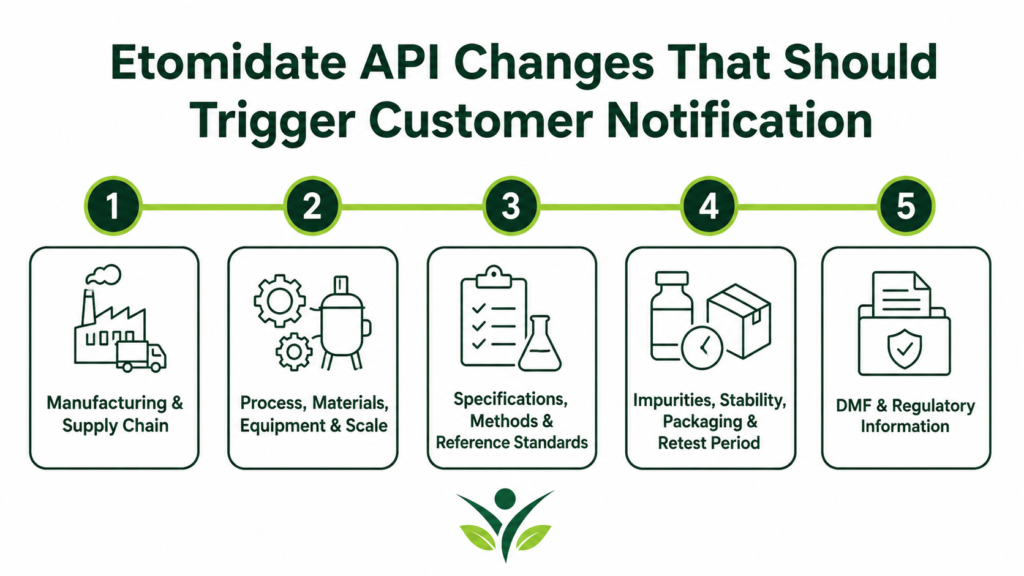
The notification scope should reflect the approved source and the potential effect on the Etomidate API or finished product. It should not be limited to changes visible on the COA.
| Change area | Examples | Possible customer impact |
| Manufacturing and supply chain | Original manufacturer, production site, contract laboratory, milling site, repacker or warehouse | Source qualification, traceability, regulatory filing and comparability |
| Process and materials | Synthetic route, starting-material source, reagents, solvents, catalysts, process parameters, equipment or batch scale | Impurity profile, physical properties and process consistency |
| Specification and testing | Test, limit, analytical procedure, calculation, reference standard or testing laboratory | Method comparability, incoming testing and registered controls |
| Stability and packaging | Container closure, storage condition, transport control, stability method or retest period | Stability support, handling controls and usable period |
| Regulatory information | DMF content, holder, manufacturing site, ownership or Letter of Authorization | Application assessment and regulatory reporting |
Manufacturing Site and Supply-Chain Changes
A customer should know when the original Etomidate manufacturer or a quality-relevant facility changes. This includes sites that perform final purification, drying, milling, micronization, release testing, packaging, repacking or relabeling.
The seller may remain the same even when the material begins coming from another plant. This is why the manufacturer and supplier must be identified separately.
Where several organizations handle the API, the notice should identify which activity is moving and which company will hold the underlying records. The revised arrangement should preserve the supply-chain transparency established during qualification.
Process, Material, Equipment and Scale Changes
Changes to the synthetic route, process sequence or late-stage purification can affect the type or level of impurities in the API. A new starting-material manufacturer, solvent-recovery practice or catalyst source can also introduce a risk that may not be apparent from the assay result alone.
The notification agreement should therefore consider changes involving:
- API starting materials and other quality-relevant material sources
- Reagents, catalysts, solvents and recovered materials
- Process sequence and critical operating conditions
- Major production, purification or drying equipment
- Batch size and manufacturing scale
- Milling, micronization, sieving or other physical processing
- Reprocessing or reworking outside the previously assessed arrangement
The required assessment depends on the proposed change. A route modification close to the final API may need a different level of impurity evidence from the replacement of equivalent equipment under established controls. The supplier should provide its reasoning instead of relying only on the label “minor change.”
Specification, Analytical and Reference-Standard Changes
An Etomidate API specification may change because of a compendial update, process knowledge, a revised control strategy or a customer requirement. The effect cannot be evaluated from the revised limit alone.
The notice should identify any added or removed test, modified acceptance criterion, new analytical procedure, calculation change or reporting-threshold revision. It should also cover the transfer of testing to another laboratory and relevant changes to reference-standard qualification.
Before accepting the revision, the customer may need to compare it with the existing Etomidate API specification and determine whether historical and future results remain comparable. A method with different selectivity or quantitation capability can create a new result pattern even if the material has not changed.
Impurity, Stability, Packaging and Retest Changes
A change that affects impurity formation, detection or reporting should reach the customer before the first affected batch is supplied. Examples include a new recurring unknown peak, revised impurity method, changed solvent use or new elemental-impurity source.
These events require review against the established Etomidate impurity profile, not only the total impurity limit.
Packaging and stability changes need similar attention. A new liner, primary container or storage condition may affect the basis of the assigned retest period. The available Etomidate stability data should represent the changed process and commercial packaging, or the supplier should explain how continued support was established.
The customer should also confirm whether the change affects its approved packaging and storage controls.
DMF and Regulatory-Information Changes
When the Etomidate API is supported through a Drug Master File, the DMF holder has a separate regulatory responsibility. Under 21 CFR 314.420(c), a holder that adds, changes or deletes information in the DMF must notify each person authorized to reference the affected information in writing.
This provision applies to the DMF holder. A distributor that does not own the file cannot satisfy the obligation merely by stating that a DMF exists.
The customer should determine whether the amendment affects its Etomidate USDMF and Letter of Authorization arrangement. The notice also needs enough non-confidential information for the application holder to assess the change. Filing an amendment to the DMF does not, by itself, complete the customer’s regulatory assessment.
Define Notification Categories, Timing and Approval Rights
Not every supplier change requires the same customer action. The agreement can separate changes into four practical categories.
Prior Notification and Customer Approval
Prior approval may be appropriate when the proposed change could affect the API’s quality, impurity profile, physical properties, validated controls, approved manufacturing source or regulatory filing.
The agreement should state that the supplier will not manufacture or ship the first affected commercial batch until the required customer disposition and regulatory conditions are met. Where approval applies, silence should not be treated as automatic acceptance unless the agreement expressly establishes that process.
Advance Notification Without Formal Approval
Some changes require customer assessment without giving the customer a contractual right to approve the supplier’s internal operation. The customer may still need time to update specifications, testing instructions, supplier records or regulatory documentation.
Notification is the transfer of information. Approval is a documented decision. Using these terms separately prevents a supplier from assuming that sending an email authorizes implementation.
Periodic Reporting
Low-risk administrative changes may be included in a periodic change summary. The agreement should define which changes qualify. A technical or regulatory change should not be moved into periodic reporting merely because the supplier considers it minor.
Emergency Changes
An urgent safety, compliance or continuity event may make the usual advance-notice period impossible. In this case, the supplier should escalate the issue promptly, identify affected material and provide the available assessment.
The customer and supplier should then document the remaining review, any temporary controls and the conditions for continued supply. Repeated use of the emergency route needs investigation because it may indicate weak planning or delayed escalation.
There is no single 30-, 60- or 90-day notice period that fits every supplier change. The agreement should define timing relative to the planned implementation date, manufacture of the first affected batch and expected shipment. The notice period needs to allow the work required for that particular change.
What a Complete Supplier Change Notice Should Contain?
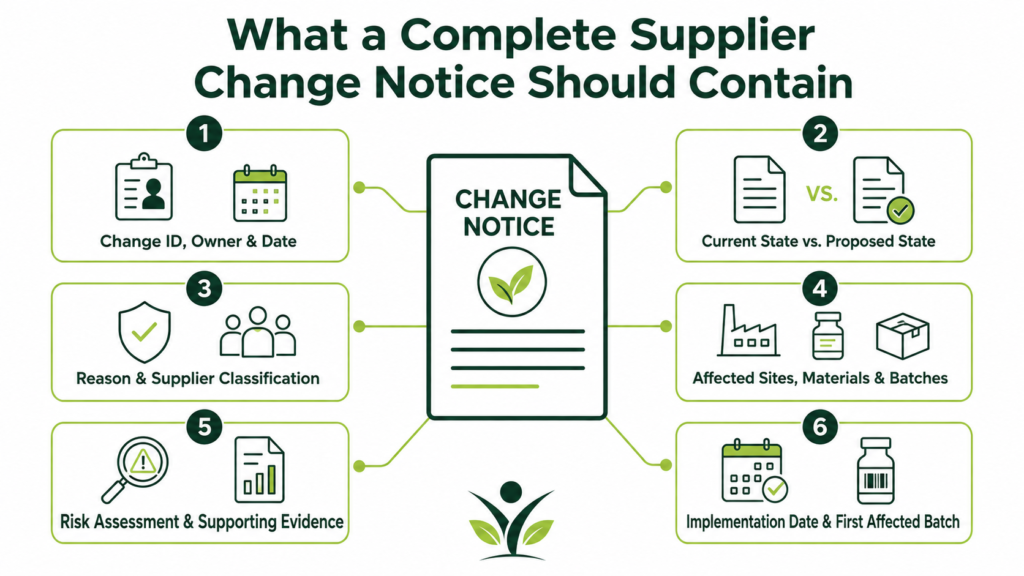
A notice that states “process improved, no impact on quality” does not give the customer a usable basis for review.
A complete change package should normally identify:
- Change-control number and responsible organization
- Current and proposed state
- Reason for the change
- Affected product, process, site and documents
- Supplier classification and supporting rationale
- Assessment of quality attributes, impurities, stability and physical properties
- Planned implementation date
- First affected batch and expected shipment
- Status of existing inventory and previously manufactured batches
- Qualification, validation, comparability or stability evidence
- Updated specifications, procedures, COAs or regulatory documents
- DMF amendment status, where applicable
- Open commitments and post-implementation monitoring
The exact content can vary with risk. However, the customer should be able to understand what is changing, why it is changing, when changed material will enter the supply chain and what evidence supports the supplier’s conclusion.
The controlled document set can be incorporated into the broader list of documents requested from the Etomidate API supplier.
How the U.S. Customer Should Assess the Proposed Change?
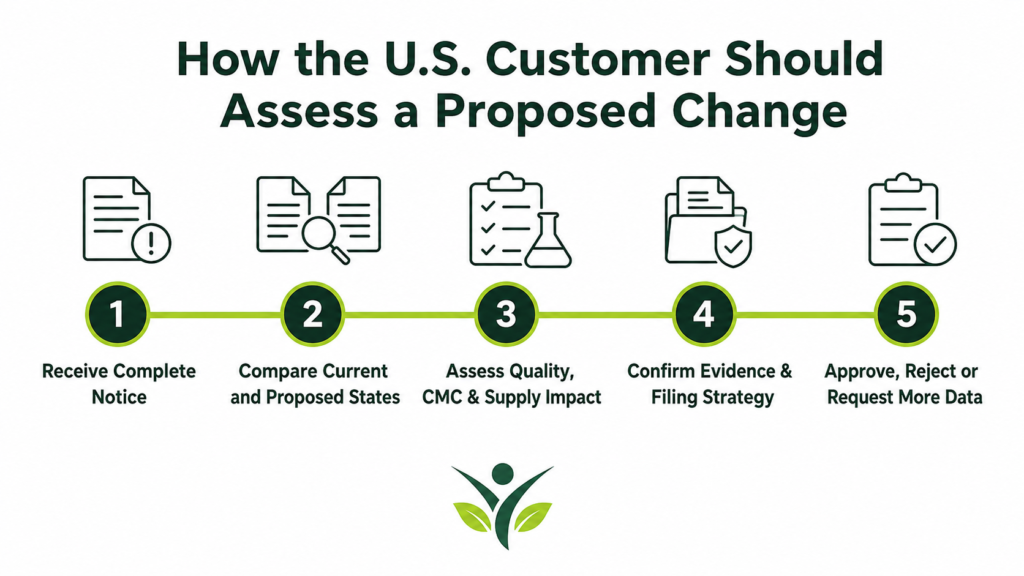
The customer’s review should be cross-functional when the change reaches more than one area. Procurement may coordinate communication, but QA, CMC, regulatory affairs, analytical development and manufacturing should assess the parts they own.
A practical review follows this sequence:
- Confirm that the notice contains enough information to begin the assessment.
- Compare the proposed state with the currently approved manufacturer, site, process, specification, method, packaging and regulatory information.
- Identify possible effects on API quality, the finished product, validated operations and supply continuity.
- Decide whether additional documents, samples, testing, stability data or qualification work are required.
- Determine whether a pending or approved U.S. application is affected.
- Record the decision, conditions, responsible owners and permitted implementation date.
The supplier’s change classification and the customer’s FDA reporting category answer different questions. The FDA guidance on changes to an approved NDA or ANDA addresses post-approval reporting for changes involving sites, processes, specifications and container-closure systems. The application holder must determine which reporting pathway applies to its own submission.
ICH Q12 makes the division of responsibility clearer. The holder of referenced drug-substance information communicates relevant changes to the marketing authorization holder, while the authorization holder assesses the effect on its application and reports the change as required by the applicable region.
For an injectable program, the assessment may also need to consider how the changed API behaves within the customer’s formulation and manufacturing process. These wider controls are discussed in the guide to Etomidate API for U.S. injectable manufacturers.
What Evidence May Be Needed Before the Change Is Accepted?
The evidence should match the nature, uncertainty and possible effect of the change.
| Proposed change | Possible supporting evidence |
| Manufacturing-site transfer | Site information, technology-transfer records, equipment qualification, representative batch data and updated regulatory documents |
| Route or process change | Risk assessment, impurity comparability, process validation or verification and batch-analysis results |
| Material-source change | Revised material controls, source qualification and downstream impurity assessment |
| Specification or method change | Revised documents, validation or method-comparability data and historical-result assessment |
| Scale or equipment change | Process assessment, qualification evidence and representative batch comparison |
| Packaging or retest change | Container information, stability assessment and updated retest justification |
| Testing-laboratory change | Laboratory qualification, method transfer or verification and assigned investigation responsibilities |
No fixed batch count proves that every type of change is acceptable. The manufacturer should justify the dataset based on the process and risk, while the customer determines whether it supports the intended use.
Where batch results form part of the justification, they need to be reviewed using a controlled batch-to-batch comparison. If the change could affect laboratory or formulation performance, the customer may also request a representative quantity for Etomidate API sample evaluation.
Control the Cutover to the First Changed Etomidate API Batch
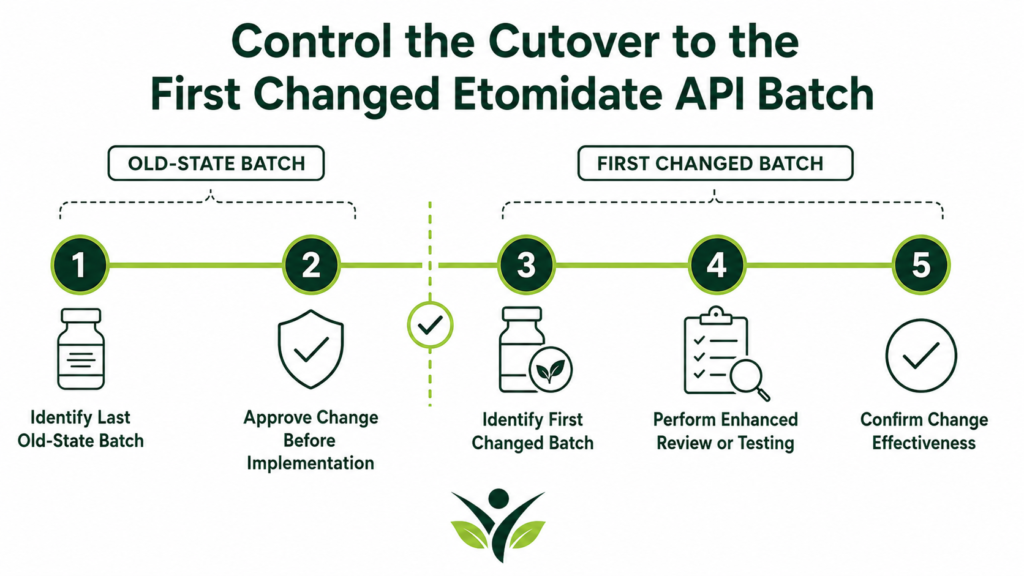
The supplier should identify the last batch made under the previous state and the first batch manufactured or tested after the change. Existing and changed inventory must remain distinguishable through batch numbers, COAs and distribution records.
Before shipment, confirm that:
- Approved specifications, methods and purchasing records have been updated
- The first affected batch is clearly identified
- Any customer approval conditions have been completed
- Required regulatory action has been addressed
- Enhanced testing or monitoring has been assigned
- Stability or validation commitments have owners and due dates
ICH Q7 also recommends evaluating the first batches produced or tested after implementation. Where a change may affect an established retest or expiry date, its potential stability effect should be assessed.
The change can be closed after the agreed implementation activities and effectiveness review are complete. A paper approval issued before implementation cannot show how the changed process actually performed.
Make the Obligation Reach the Original Manufacturer
A customer-facing supplier can promise advance notification only if it receives controlled change information from the original manufacturer.
Where the seller is a distributor or agent, its agreement with the manufacturer should pass through the relevant notification obligations. It should also establish who will provide risk assessments, batch data, regulatory updates and answers to technical questions.
Otherwise, the customer may have an agreement with the commercial supplier while the organization controlling the process has no corresponding obligation to notify either party. This gap should be resolved before relying on the source for commercial supply.
Red Flags in a Supplier’s Change-Control Process
The following situations require follow-up or escalation:
- The notice arrives after implementation or shipment.
- The first affected batch cannot be identified.
- “No impact” is stated without supporting assessment.
- A revised specification or COA appears without a change explanation.
- The supplier cannot obtain information from the original manufacturer.
- Supporting data relate to another site, scale or process.
- Old and changed inventory cannot be distinguished.
- A DMF amendment is presented as customer approval.
- Emergency changes occur repeatedly.
- Post-implementation commitments remain overdue.
One isolated administrative error may be correctable. Repeated late or incomplete notifications raise a wider question about the supplier’s communication system and continued approved status.
Use Change-Control Performance in Ongoing Supplier Review
Change-control performance should form part of the supplier scorecard and periodic review. Useful measures include notification timeliness, completeness of the initial package, number of clarification cycles, overdue commitments and changes implemented before customer disposition.
Post-change deviations, OOS results, complaints and batch trends should also be checked for a possible connection with the change. This evidence contributes to the broader assessment of long-term Etomidate API supplier reliability.
A serious undisclosed change may trigger additional testing, a targeted audit, conditional approval, formal requalification or second-source planning. The response should reflect the actual risk and the customer’s approved supplier-management procedure.
Discuss Your Etomidate API Requirements
U.S. pharmaceutical customers can share their intended use, Etomidate specification, program stage, required documentation and change-notification expectations with Velcare Pharma. Discuss your Etomidate API sourcing requirement and the information needed for initial evaluation or long-term supply.