An Etomidate API supplier is reliable only when acceptable quality, documentation and delivery performance continue across multiple batches and purchase cycles. One approved sample, one compliant certificate of analysis or one successful shipment does not show how the source will perform after a process change, capacity constraint, deviation or supply interruption.
Buyers can make that judgment by trending batch data, verifying certificate reliability, examining change control, testing capacity claims and reviewing continuity arrangements. This article explains the evidence pharmaceutical quality, procurement and supply-chain teams should use to decide whether an approved Etomidate API supplier remains suitable for long-term supply.
Direct Answer
- Review batch quality, deviations, complaints, CAPA effectiveness and delivery performance across a meaningful operating period.
- Confirm that the approved manufacturing site, process, specification, analytical controls and supply chain remain under change control.
- Compare stated capacity with production frequency, utilization, material availability, inventory policy and business-continuity evidence.
- Maintain oversight through a quality agreement, supplier scorecard, periodic review, risk-based audits and formal requalification.
What Does Long-Term Supplier Reliability Mean?
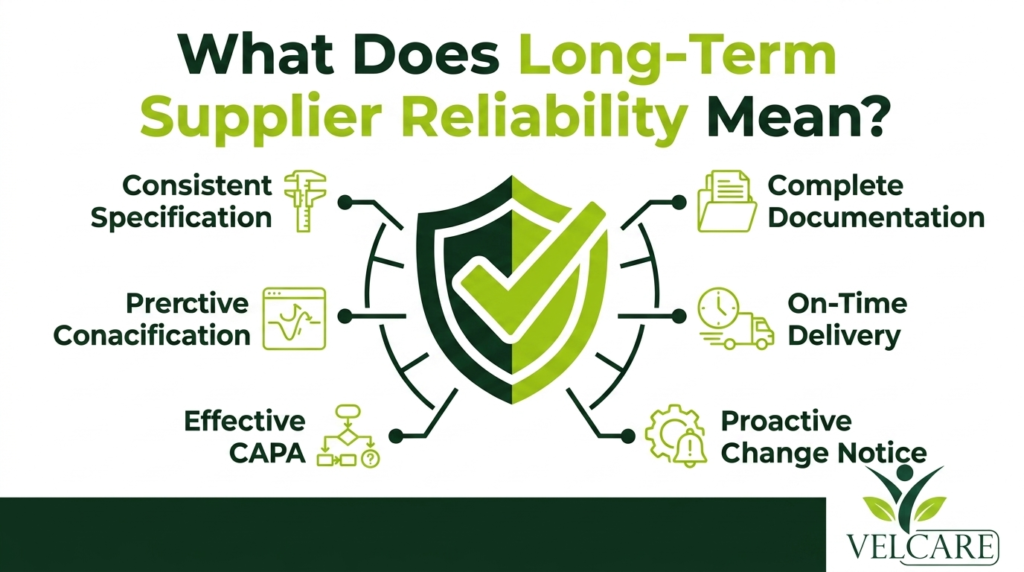
A reliable Etomidate API supplier repeatedly provides material that conforms to the agreed specification, comes from the approved manufacturing chain and arrives with complete batch documentation. It also meets confirmed quantity and delivery commitments, communicates significant changes before implementation, investigates deviations and complaints, closes CAPAs effectively and supports regulatory questions throughout the commercial relationship.
Initial approval establishes whether the source is acceptable at a defined point in time. Long-term reliability asks whether that state of control is being maintained. The earlier approval process is covered in How Pharmaceutical Companies Qualify an Etomidate API Supplier.
How to Evaluate the Long-Term Reliability of an Etomidate API Supplier
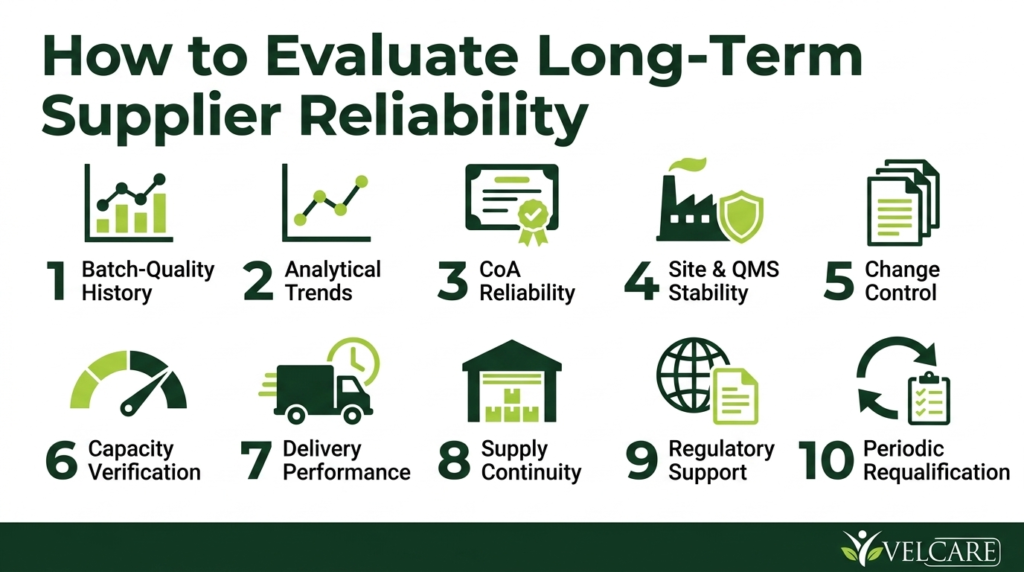
1. Review Historical Batch-Quality Performance
Begin with a defined review period and an identified population of Etomidate batches. The period should contain enough manufacturing and supply activity to reveal recurring behavior. For an infrequently produced API, calendar time alone is not useful unless the number of batches and campaigns is also stated.
The review should account for:
- batches manufactured, released, rejected and supplied;
- out-of-specification and out-of-trend results;
- critical and recurring deviations;
- reprocessing and reworking;
- complaints, returns, recalls and other field actions;
- repeated failures involving the same process stage, impurity or analytical test; and
- CAPA completion time, overdue actions and post-implementation effectiveness checks.
ICH Q7 calls for regular API quality reviews that include critical test results, failed batches, significant deviations, process and method changes, stability results, complaints, recalls and the adequacy of corrective actions. A buyer does not need the supplier’s complete confidential annual review in every case, but should obtain enough approved information to assess these trends.
2. Compare Analytical Results Across Multiple Batches
A pass or fail review can miss early deterioration because every result may remain within specification while moving steadily toward a limit. Record the actual numerical results and evaluate their central tendency, range and movement over time.
The relevant attributes depend on the approved Etomidate specification and intended process. They can include:
- assay;
- specified, unspecified and total related substances;
- residual solvents;
- water content or loss on drying;
- elemental impurities, where included in the control strategy;
- particle-size distribution or another agreed physical property; and
- microbiological attributes, where specified.
Pay particular attention to an impurity that rises across consecutive batches, increased variability in water content, a new recurring unknown peak or a physical attribute that changes after drying or milling modifications. ICH Q7 specifically recommends comparing the API impurity profile with historical or regulatory-submission data at appropriate intervals to detect changes arising from raw materials, equipment parameters or the production process.
Before treating a difference as process drift, confirm that the specification version, test method, calculation basis and reporting threshold are comparable. A method revision can create an apparent trend that does not reflect a change in the material.
3. Confirm the Continued Reliability of Certificates of Analysis
The certificate of analysis is part of the control system, not a substitute for supplier oversight. Supplier results should continue to agree with the buyer’s incoming laboratory data within scientifically justified expectations.
Within its controls for relying on supplier certificates for incoming materials, ICH Q7 recommends full analysis at appropriate intervals and regular checks of certificate reliability. For U.S. finished-drug manufacturing, 21 CFR 211.84 separately requires the manufacturer to establish the reliability of a supplier’s analysis through appropriate validation at appropriate intervals when a supplier report is accepted in place of certain testing. The exact program must follow the buyer’s regulatory role, market requirements and approved procedure.
A recurring difference should not be closed merely because both reported values pass. The buyer should determine whether it comes from sampling, sample preparation, moisture correction, chromatographic integration, reference-standard assignment or genuine batch heterogeneity. The document-level checks are explained further in How to Read an Etomidate Certificate of Analysis.
4. Assess Manufacturing-Site and Quality-System Stability
Long-term performance depends on the operating system behind the batch. Confirm that the manufacturing site, production line and quality unit remain consistent with the approved source. Frequent changes in leadership, experienced analysts, production supervisors or quality personnel can increase execution risk when knowledge transfer and training are weak.
The periodic review should cover:
- inspection history and responses to regulatory observations;
- internal, customer and third-party audit findings;
- recurrence of previously reported deficiencies;
- data-governance and data-integrity controls;
- preventive-maintenance and calibration performance;
- overdue training or qualification;
- personnel turnover in critical production, laboratory and quality roles; and
- management review of quality metrics and recurring risks.
This is where quality-system maturity becomes relevant. FDA’s Quality Management Maturity Program distinguishes mature management practices from baseline CGMP compliance and connects those practices with fewer quality-related failures, better performance during disruptions and a more reliable supply chain. A buyer can apply the same distinction during due diligence without treating a quality-management assessment as a rating of an individual Etomidate batch.
5. Evaluate Change-Control and Notification Practices
An approved source can become a different technical source when a material, process, site or analytical change alters its impurity profile or physical behavior. The supplier’s internal change control should evaluate that risk, while the quality agreement should define which changes reach the buyer and when.
Notification categories normally cover changes to:
- the manufacturing site, building or production area;
- the synthetic route, process sequence or critical process conditions;
- starting-material manufacturers and other critical material sources;
- reagents, catalysts, solvents or recovered-material practices;
- equipment train, batch scale or campaign arrangement;
- in-process controls, specification or analytical method;
- release-testing or contract laboratories;
- drying, milling, micronization, sieving or packaging operations;
- the container-closure system; and
- the labeled retest period or storage condition.
The agreement should state which events require advance notification, the notice period, supporting data, the buyer’s review or approval role and the route for urgent changes. It should also define what happens to batches produced while an assessment is open.
6. Verify Available Capacity and Capacity Commitments
Annual nameplate capacity is not the same as available Etomidate capacity. It can include equipment shared with other products, ideal operating time or expansion that has not yet been commissioned and qualified.
Ask the supplier to explain:
- installed capacity and routinely achieved output;
- current utilization of the relevant equipment and laboratory;
- capacity allocated to Etomidate;
- standard batch size, campaign size and production frequency;
- products competing for the same production or drying equipment;
- order confirmation and production-slot allocation;
- ability to absorb forecast growth or an urgent requirement;
- known bottlenecks in testing, QA release, milling or packaging; and
- qualification status and start date for planned expansion.
These figures should reconcile. A claimed annual output can be checked against batch size, cycle time, campaign frequency and expected yield. The purpose is not to obtain the supplier’s confidential production plan. It is to confirm that the quoted volume fits an executable schedule.
Capacity should also be assigned commercially when continuity is important. A forecast does not necessarily reserve a production slot, and historical purchasing does not necessarily secure allocation during constrained supply. The purchase agreement should distinguish indicative forecasts from firm orders, reserved capacity and minimum purchase commitments.
7. Analyze Delivery and Lead-Time Performance
Measure delivery against the date and milestone the supplier actually committed to. On-time-in-full performance is meaningful only when the required quantity, release status, dispatch point and requested date are defined consistently.
Separate supplier-controlled delay from carrier disruption, customs review or a buyer-requested change. The distinction makes the corrective action useful. Repeated late QA release calls for a different response from a recurring documentation error or missed production slot.
Average lead time alone can conceal unreliable performance. Review the range, the proportion of orders delivered on time and the frequency of major exceptions. A supplier averaging six weeks through a mixture of four-week and ten-week orders is harder to plan around than one consistently delivering in six weeks.
The linked guide on Etomidate API Lead Time explains how to define the start event, material status, testing period, dispatch milestone and door-to-door schedule before ordering.
8. Review Inventory and Supply-Continuity Arrangements
Business continuity should identify specific failure scenarios, available controls and realistic recovery times. A statement that the supplier keeps safety stock is incomplete without the quantity, ownership, release status, replenishment trigger and retest implications.
Review the following areas:
- released Etomidate API safety stock;
- minimum and target inventory of critical starting materials;
- replenishment lead times and reorder triggers;
- retest period remaining on stored API;
- inventory reserved for contracted customers;
- backup utilities, equipment and qualified laboratories;
- disaster recovery and business-continuity procedures;
- estimated recovery time after equipment or site failure;
- allocation rules when available stock cannot meet all orders; and
- alternate manufacturing, testing or packaging sites.
9. Evaluate Regulatory and Documentation Support Over Time
Regulatory support often becomes more demanding after development. The supplier may need to answer deficiency questions, update filing information, assess changes and maintain the documents used to support continued commercial supply.
Evaluate whether it can:
- keep site licences, GMP evidence and legal-entity information current;
- issue controlled specifications and analytical methods with revision history;
- provide consistent batch, testing and manufacturing information;
- support a DMF, ASMF or another applicable regulatory dossier;
- respond to technical or deficiency questions within agreed timelines;
- provide change assessments and updated filing sections;
- supply stability updates supporting the retest period;
- retain records and reference samples for the applicable period; and
- identify the regulatory, quality and commercial contacts responsible for each request.
A DMF number should not be interpreted as an approval of the supplier or its Etomidate API. Filing ownership, reference authorization, technical completeness and the ability to respond during review all need separate confirmation.
Document support can be measured. Record response times, incomplete submissions, repeated version errors and the number of review cycles required to obtain an acceptable package. A supplier that provides an initial document set but cannot maintain it creates a lifecycle risk. The companion article Documents to Request from an Etomidate API Supplier can be used to define the controlled document set.
10. Conduct Periodic Risk-Based Requalification
Supplier approval should have a review date and event-based triggers. The interval and depth should reflect the Etomidate source’s current risk rather than applying the same audit schedule to every material.
ICH Q9(R1) states that the level of effort, formality and documentation in quality risk management should be commensurate with risk. Applied to supplier oversight, that principle supports a focused document review for a stable, well-performing source and a deeper remote or on-site reassessment when the evidence shows increased uncertainty or exposure.
Requalification can combine document renewal, performance trending, a targeted questionnaire, CAPA follow-up, sample or batch testing, a remote assessment and an on-site audit. An ownership change, undisclosed technical change, serious compliance action, recall or sustained loss of control should trigger review before the normal cycle ends.
A supplier scorecard keeps commercial and quality evidence in one controlled view:
| Review Area | Example Measure | Escalation Evidence |
| Batch quality | Rejection, OOS and OOT rate | Recurring impurity or test failure |
| CAPA | Closure time and effectiveness | Overdue action or repeated root cause |
| COA reliability | Agreement with incoming results | Persistent unexplained laboratory bias |
| Change control | Timeliness and completeness of notice | Change implemented before assessment |
| Delivery | On-time-in-full rate | Repeated missed release or dispatch dates |
| Documentation | Complete response within agreed time | Obsolete, inconsistent or missing records |
| Continuity | Stock, capacity and recovery readiness | Uncontrolled single point of failure |
Make the Final Supplier Decision
The final status should follow documented evidence and defined acceptance criteria:
| Status | Decision Basis |
| Reliable | Quality, documentation and delivery remain within agreed limits, changes are controlled and no critical adverse trend is present. |
| Conditionally Reliable | Supply can continue under additional testing, corrective actions, restricted use or closer monitoring. |
| High Risk | Recurring quality, capacity, delivery or transparency problems require escalation and alternate-source planning. |
| Unacceptable | Critical deficiencies, unreliable records or uncontrolled risks prevent continued approval. |
Discuss Your Etomidate API Requirements
Pharmaceutical buyers can share the required Etomidate API specification, target market, quantity, documentation package, delivery schedule and expected long-term demand with Velcare Pharma. These details allow the proposed supply arrangement and available support to be discussed against the buyer’s technical and commercial requirements.
This article provides general supplier-management information and does not replace a company’s approved quality procedures or market-specific regulatory assessment.