Etomidate API lead time is the period required to prepare, release and deliver an order. It can include inventory allocation, production, quality control testing, document preparation, packaging, export procedures and transportation. The quoted figure is useful only when the supplier defines which activities it covers and when the clock starts.
An unclear timeline can leave procurement teams planning around stock that is not yet released, a production slot that has not been confirmed or a dispatch estimate that excludes customs clearance. Buyers can reduce this uncertainty by obtaining a written breakdown tied to the required specification, batch status, Incoterm and delivery location.
This article explains the points to confirm before accepting an Etomidate API lead time or recording a delivery date in the purchase order.
Direct Answer
Before ordering Etomidate API, confirm:
- Whether the required quantity is released stock, stock awaiting QA release or material requiring production.
- The exact event that starts the quoted lead time and the activities included before dispatch.
- The expected QC completion, QA release, document issue and dispatch dates.
- The selected Incoterm, transport estimate and remaining retest period at the projected delivery date.
What Does Etomidate API Lead Time Include?
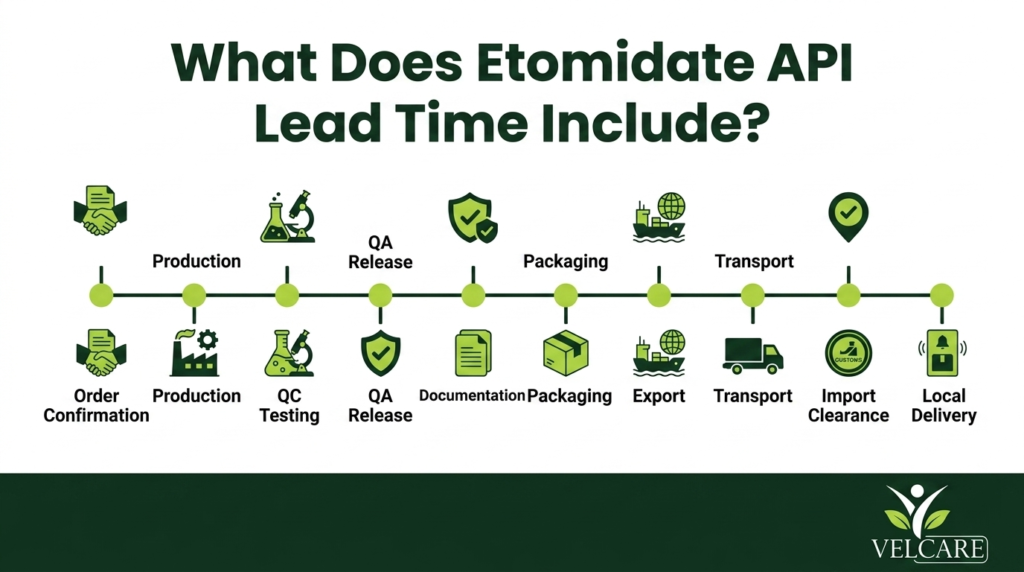
Lead time is not a single universal figure. Its scope changes according to the batch status, specification, packaging requirements, export formalities and delivery basis.
A complete procurement timeline can include:
- Purchase order confirmation
- Inventory allocation or production scheduling
- Manufacturing, where required
- Sampling and laboratory testing
- QA review and batch release
- Document preparation
- Packaging and labelling
- Export processing
- International transportation
- Import clearance
- Local delivery
The supplier’s dispatch lead time covers the period up to shipment readiness or handover to the carrier. The buyer’s total lead time continues until the material reaches the named destination. A statement such as “delivery in four weeks” is therefore incomplete unless it identifies the starting event, end point and applicable delivery term.
Confirm When the Lead Time Clock Starts
The buyer and supplier need to agree on the event that activates the quoted timeline. Depending on the transaction, this may be:
- Acceptance of the RFQ or quotation
- Receipt and acceptance of the purchase order
- Approval of the proforma invoice
- Receipt of an advance payment
- Approval of the technical specification
- Acceptance of quality or regulatory documents
- Completion of an applicable quality agreement
These events can occur several days or weeks apart. A quotation based on payment receipt will not support a delivery calculation from the purchase order date.
The supplier’s written response needs to identify both the triggering event and the period measured from that event. Without these two details, the buyer cannot establish a dependable dispatch or arrival date.
Determine Whether the Material Is in Stock or Requires Production
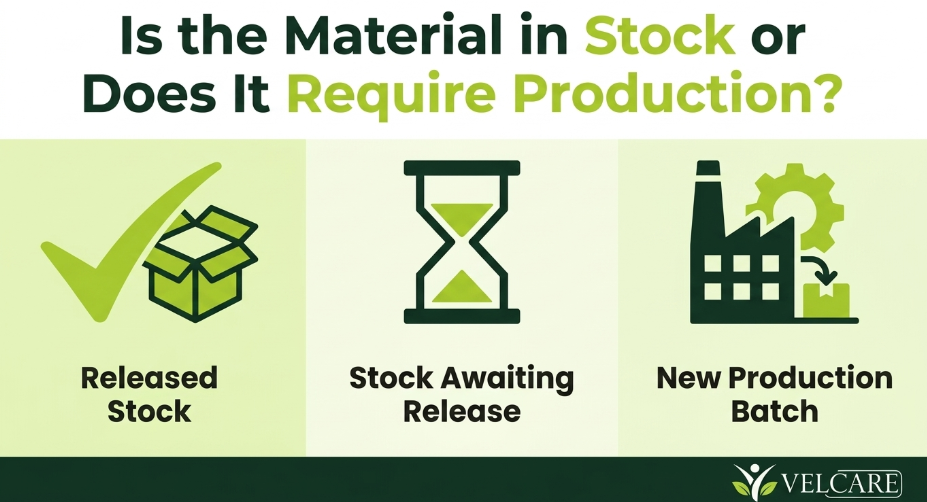
Material status is often the largest determinant of Etomidate API lead time. The terms “available” and “in stock” need further qualification because they do not necessarily mean the batch is released and ready for shipment.
Released Stock
For released material, confirm:
- The quantity physically available
- The batch number
- The manufacturing date
- The retest or expiry date, as applicable
- Completion of QC testing and QA release
- The quantity that will be reserved for the order
Inventory shown in a planning system may already be allocated to another order. The supplier needs to confirm whether the required quantity will be placed on hold for the buyer after order confirmation.
Stock Awaiting Release
A manufactured batch can remain unavailable while sampling, laboratory testing, investigation review or final QA disposition is pending. Buyers need to identify:
- Tests or quality activities still in progress
- The scheduled date for completing those activities
- The planned QA release date
- Any open deviation, out-of-specification result or investigation affecting disposition
A planned release date remains conditional until the quality unit approves the batch. The purchase schedule needs to preserve this distinction.
New Production Batch
When new manufacturing is required, request separate estimates for production queue time and the manufacturing cycle. Confirm:
- The next available production slot
- Availability of starting materials, reagents and other required inputs
- The planned manufacturing start and completion dates
- Whether the quantity fits an established batch size
- Whether a dedicated batch or separate manufacturing campaign is required
- The testing and release period following manufacturing
A short processing cycle does not provide a short lead time if the batch must wait several weeks for a production slot.
Confirm the Required Grade and Specification
The quoted lead time may apply only to the supplier’s standard Etomidate API specification. Buyer-specific requirements can introduce method review, additional testing, sample preparation or external laboratory work.
Confirm whether the order requires:
- Additional impurity controls
- Tighter acceptance criteria
- Buyer-specified analytical methods
- Specific residual solvent limits
- Particle size testing or control
- Additional identification or characterization tests
- Batch-specific statements or declarations
- Data packages beyond the standard release documents
Procurement needs to obtain technical confirmation from the relevant quality or regulatory function before accepting the delivery commitment. The final specification should be agreed in writing and referenced in the purchase order. Otherwise, a timeline based on the standard specification may no longer apply after technical review.
Ask How Long QC Testing and QA Release Will Take
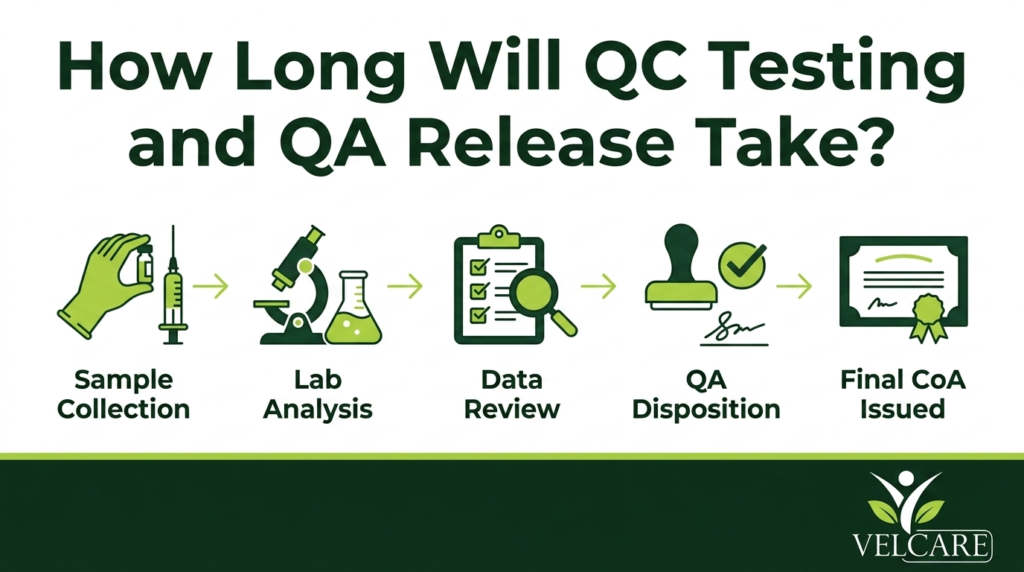
Manufacturing completion is not the same as batch release. After production, the batch may require sampling, laboratory analysis, data review and formal disposition by the quality unit.
Request separate dates or durations for:
- Sample collection and laboratory submission
- Completion of release testing
- Review of raw analytical data
- Resolution of any atypical or invalid result
- QA review and batch disposition
- Issue of the final Certificate of Analysis
Determine whether all tests are performed at the manufacturing site. Outsourced analysis adds sample shipment, laboratory scheduling and result transmission to the timeline. Tests requiring extended preparation or specialized equipment also need to be identified in advance.
ICH Q7 section 11.40 states that an authentic Certificate of Analysis should be issued for each API batch upon request. Sections 11.41 to 11.44 describe information such as the API name, grade where appropriate, batch number, release date, test results, acceptance limits and identification of the manufacturer or testing party.
Before accepting the batch, procurement and quality personnel can use this guide to review an Etomidate API Certificate of Analysis against the specification and shipment details.
Confirm Document Preparation Time
Documents can become a separate critical path even when the material is released. Establish when the supplier can issue each document required for internal approval, shipment, customs clearance and goods receipt.
The document package may include:
- Final Certificate of Analysis
- Safety Data Sheet
- Packing list
- Commercial invoice
- Certificate of origin
- GMP or manufacturing documentation
- Batch-specific declarations
- Export documents
- Transport documents
- Insurance certificate, if included in the agreed delivery term
Classify each document by availability. Some documents can be provided during supplier qualification, while batch-specific and shipping documents may only be generated after release, packing or carrier booking.
The buyer also needs to specify which documents require review before dispatch and which may accompany the consignment. If legalization, notarization or certification is needed for the destination market, its processing time belongs in the pre-dispatch schedule.
Verify Packaging and Labelling Readiness
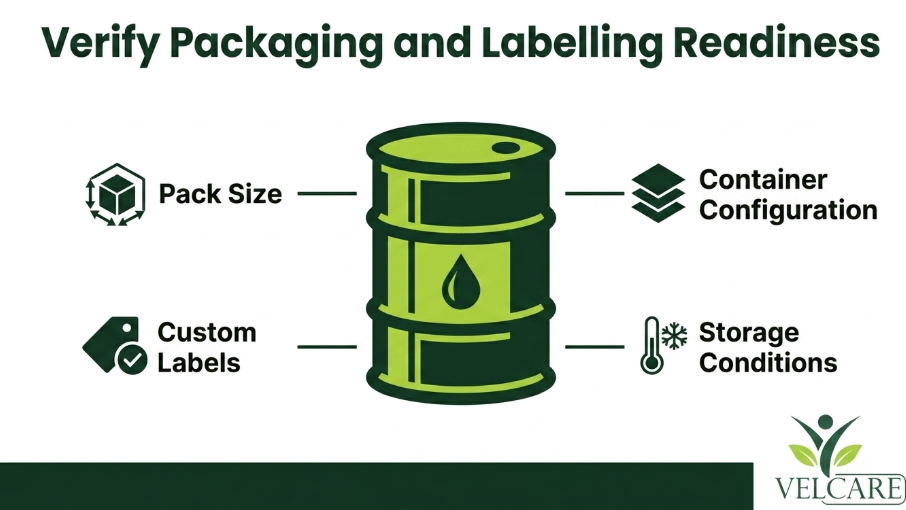
Packaging preparation can delay dispatch when the ordered quantity does not match the standard pack size or when customized labels are required.
Confirm:
- The standard pack size
- The number and net weight of containers
- Whether the material requires subdivision or repacking
- The primary and secondary packaging configuration
- Any buyer-specific label, mark or tamper-evident seal
- Storage and transportation conditions
- The need for additional protective or temperature-controlled packaging
Under ICH Q7, API container labels should identify the material and batch and state storage conditions when these are critical to maintaining quality. Depending on the circumstances, the label may also need the manufacturer’s details, quantity, special transport conditions and expiry or retest information.
Packaging and label preparation need to be included in the committed dispatch date, particularly where buyer approval of artwork or label content is required.
Confirm the Applicable Incoterm
The Incoterm defines where specified costs, risks and operational responsibilities transfer between the seller and buyer. It also determines what the supplier’s quoted delivery milestone represents.
Clarify who will arrange or bear responsibility for:
- Export clearance
- Main freight
- Cargo insurance
- Import clearance
- Customs duties and taxes
- Local transportation
- Delivery to the final receiving site
The quotation and purchase order need to record the named Incoterm and location, not merely the three-letter rule. For example, the stated location distinguishes delivery at a supplier’s facility from delivery at a named port, airport or buyer location.
An EXW or FOB dispatch estimate is not equivalent to a door-delivery estimate. The first may end before the main international movement, while the second includes additional transport and clearance stages.
Account for Export and Import Clearance
Export and import procedures need their own time estimates. Before dispatch, determine whether the supplier requires:
- An export permit
- Product-specific export documentation
- A certificate of origin
- Document legalization or chamber certification
- Destination-specific declarations
- Prior approval from a regulatory or customs authority
On the buyer’s side, confirm the import licence, customs classification, consignee information and clearance documentation. The destination country may require additional technical review before the material can be released from customs.
Responsibility for responding to customs, carrier or regulatory queries should be assigned before shipment. Clearance time is best recorded as a separate planning estimate because it can be affected by inspection, document discrepancies and authority review.
Confirm Remaining Shelf Life at Delivery
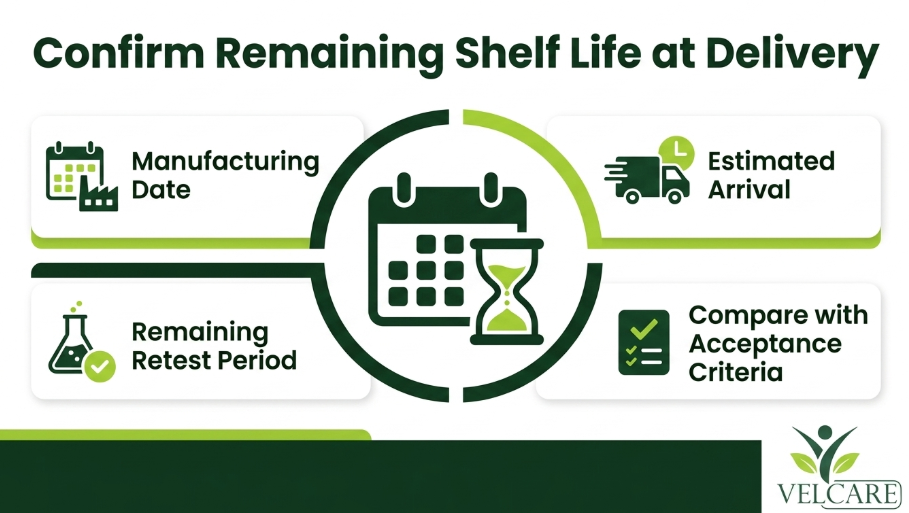
An immediately available batch may provide the shortest dispatch lead time but less usable life after arrival. Buyers therefore need to assess inventory status and remaining retest period together.
For each proposed batch:
- Obtain the manufacturing date and retest or expiry date.
- Estimate the arrival date using the complete transport and clearance timeline.
- Calculate the expected remaining period on arrival.
- Compare it with the buyer’s internal acceptance criterion and planned consumption schedule.
- Record the minimum acceptable remaining period in the purchase order.
Waiting for a new batch may provide a longer retest period but delay development, validation or production activities. Conversely, an older released batch may be operationally preferable when it provides enough time for incoming testing, manufacture and inventory consumption.
If the supplier plans to retest the batch before dispatch, confirm the testing scope, expected revised retest date and effect on the shipment schedule.
Ask Whether Partial Shipment Is Available
A split delivery may be useful when part of the required quantity is already released and the balance requires production or QA release.
Before accepting this structure, evaluate:
- The quantity and batch assigned to each shipment
- The dispatch date for each portion
- Additional freight and insurance charges
- Separate customs clearance and receiving costs
- Availability of batch-specific documents
- Effect on unit price and payment milestones
- Internal capacity to receive and test multiple batches
Each shipment needs documents corresponding to the batch supplied. The purchase order should also state whether partial shipment is permitted and whether the supplier requires written authorization before dividing the order.
Check the Supplier’s Record for Meeting Lead Times
A lead time supported by confirmed inventory, capacity and shipping arrangements carries more planning value than an initial commercial estimate.
Ask the supplier to identify:
- Whether the production slot is confirmed or provisional
- Which activities remain dependent on technical or commercial approval
- How order status will be reported
- How frequently updates will be issued
- When the buyer will be notified of a likely delay
- The commercial and quality contacts responsible for escalation
Information Buyers Should Obtain in Writing
The lead time breakdown should contain enough detail for procurement, quality, regulatory and logistics teams to work from the same schedule.
| Item to Confirm | Required Response |
| Material status | Released stock, under testing or new production |
| Available quantity | Physical quantity available and quantity reserved |
| Lead time start | Exact triggering event |
| Production slot | Confirmed or provisional date, where manufacturing is required |
| QC completion | Expected testing completion date |
| QA release | Expected batch release date |
| Documentation | Documents available and planned issue dates |
| Packaging | Standard or customized configuration |
| Dispatch | Confirmed date or current estimate |
| Transport | Mode, route and estimated duration |
| Delivery basis | Named Incoterm and location |
| Shelf life | Expected remaining retest or expiry period at delivery |
| Delay handling | Notification timeframe and escalation contacts |
How to State Lead Time Requirements in the Purchase Order?
The purchase order should convert the agreed quotation and technical review into clear supply conditions. Include:
- The approved Etomidate API specification and document reference
- The ordered quantity
- Whether partial shipment is permitted
- The agreed batch structure, where known
- The named Incoterm and location
- The required dispatch or delivery date
- The minimum remaining retest or expiry period at delivery
- Documents required for review before shipment
- Packaging and labelling instructions
- Required notice of production, testing or dispatch delays
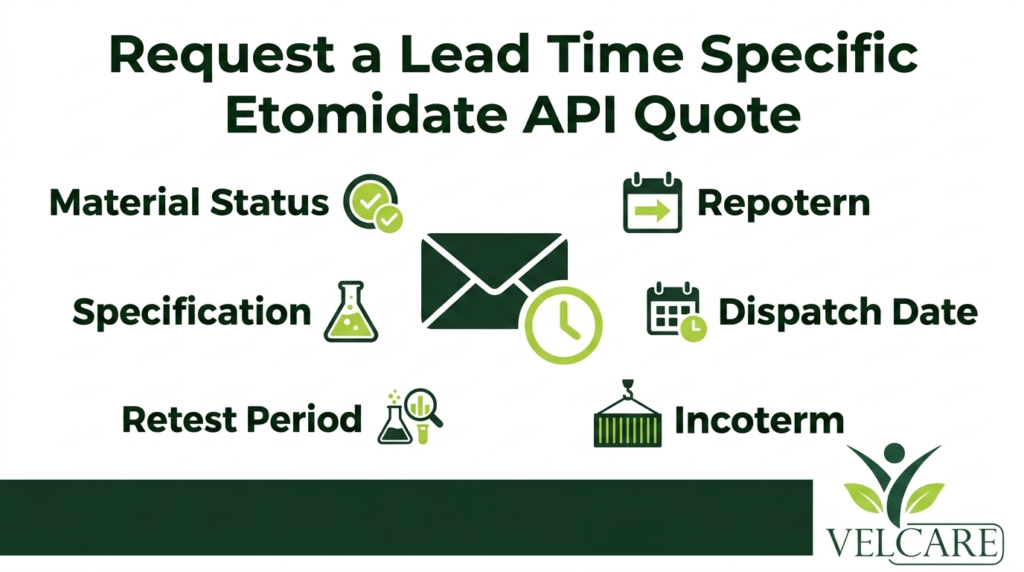
Request a Lead Time Specific Etomidate API Quote
A useful quotation states more than the unit price. It identifies the material status, available quantity, specification, release schedule, packaging, dispatch date, Incoterm, documentation and expected remaining retest period.
Buyers can submit these requirements through Velcare Pharma’s Etomidate API quotation request page. Before comparing offers, review the commercial and technical factors that influence an Etomidate API price quotation.