Etomidate API price has an indicative source-level cost of approximately USD 2,600 – 2,900 per kilogram. When the material is prepared for export and delivered to the United States, a broader procurement budget of around USD 3,000 – 4,500 per kilogram provides a more realistic starting point.
This is not a fixed market price. The final amount depends on the quantity, specification, documentation, packaging, U.S. destination and delivery term. This article explains how the indicative range was established, what can move a quotation above or below it and which details make two offers comparable. Buyers can also submit their requirements through Velcare’s Etomidate API product page to receive a current quotation.
How Much Does Etomidate API Cost per Kilogram?
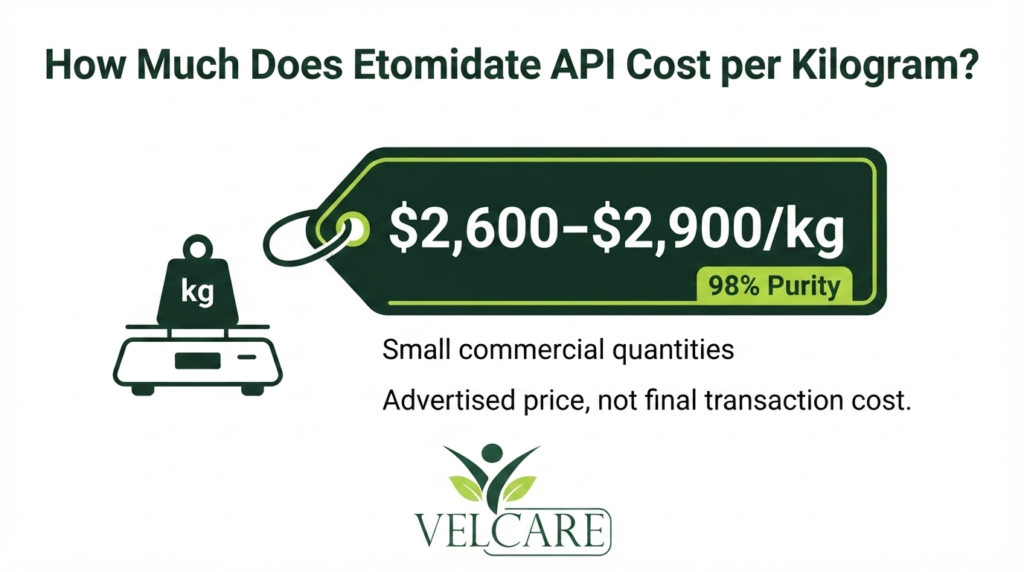
Etomidate API cost is approximately USD 2,600–2,900 per kilogram for small commercial quantities of Etomidate API. This price is for the chemical that offers 98% purity.
These figures are advertised prices rather than completed export transactions. They represent the approximate material cost and do not include the full cost of supplying the API to a U.S. destination.
Research-Grade and Commercial API Etomidate Prices Are Not Comparable
Public listings for commercial-grade Etomidate API may range from about USD 41 for 5 mg to USD 590 for 1 gram. Other research suppliers list 100 mg or 500 mg packs for several hundred dollars.
A simple conversion of these prices into a kilogram rate produces an extremely high number. That calculation is mathematically correct but commercially misleading.
Research material is sold in very small, premeasured packs. Its price can include catalogue management, specialized packaging, internal characterization and small-order handling. It may also carry a label stating that the product is intended only for research and not for human or veterinary use.
A commercial API quotation covers a different purchasing context. It normally concerns a larger quantity, a defined pharmaceutical specification, batch documentation and packaging suitable for transport and manufacturing. The intended use and regulatory basis are also different.
Finished Etomidate injection prices are another separate category. A hospital or pharmacy price covers a sterile formulated dosage form, not one kilogram of the active pharmaceutical ingredient. It cannot be used to calculate the commercial API price.
Why Published Etomidate Prices Vary So Widely?
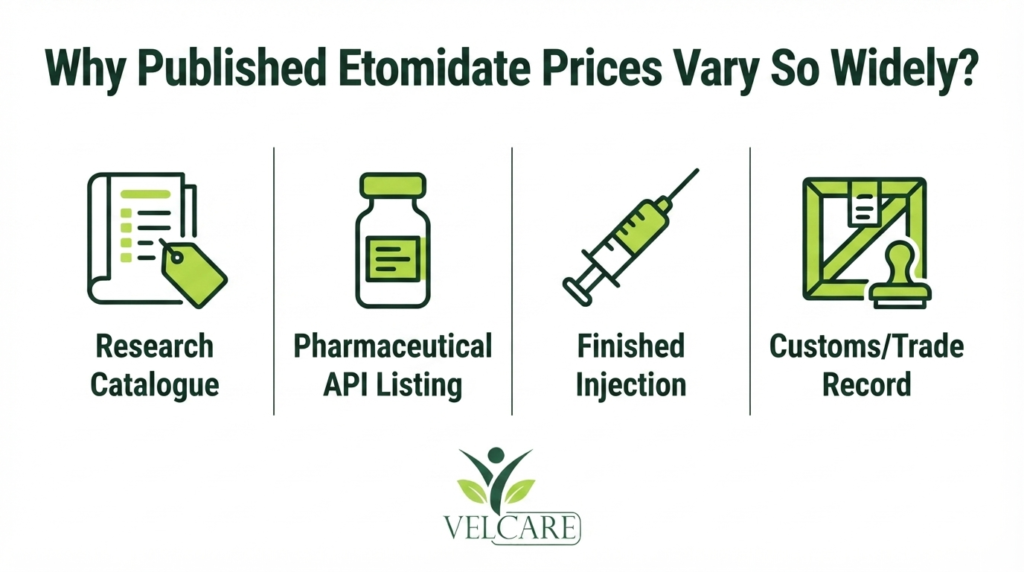
A public result for “Etomidate price” may refer to four substantially different products or transactions.
| Published price type | What is being sold | Relevance to an API buyer |
| Research catalogue | Milligrams or grams for laboratory research | Limited; the unit price is inflated by small-pack costs |
| Pharmaceutical API listing | Bulk powder with a stated or claimed specification | Useful as an initial reference if quantity and grade are defined |
| Finished injection | Sterile Etomidate formulation in vials | Not an API price |
| Customs or trade record | Declared shipment value divided by weight | Directional only unless the product, grade and transaction terms are known |
Is There a Standard Price for Etomidate API?
There is no regulated or universally accepted list price for Etomidate API. The commercial price is established for each inquiry or supply arrangement.
“Price per kilogram” standardizes the unit of weight, but it does not standardize the offer. A complete price basis also identifies:
- API grade and specification
- Actual manufacturer and manufacturing site
- Order quantity
- Pack size and number of containers
- Included quality and regulatory documents
- Stock or production status
- Origin and destination
- Incoterm and named delivery point
- Payment terms
- Currency and quotation validity
U.S. Import Requirements Connected with the Price
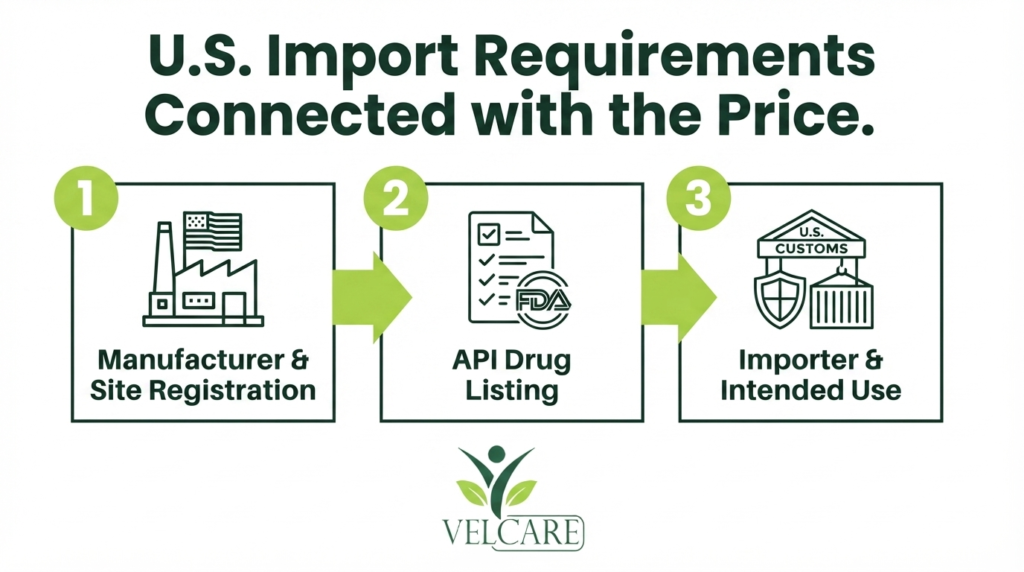
To import Etomidate API to the USA, the buyers have to consider the FDA’s information on importing active pharmaceutical ingredients, which identifies several requirements that can affect the transaction.
1. Actual Manufacturer and Manufacturing Site
Foreign establishments that manufacture, repack, relabel or salvage APIs offered for U.S. import generally require FDA establishment registration. The manufacturer identified in the import entry needs to correspond with the establishment connected to the supplied API.
A quotation from a trader or commercial supplier does not remove the need to identify the actual manufacturing establishment.
2. API Drug Listing
Commercially distributed APIs generally require drug listing with FDA. At importation, the listing information needs to relate to the actual API manufacturer rather than an unrelated trader or supplier.
FDA registration and drug listing are not the same as FDA approval. Registration indicates that information has been submitted to FDA; it does not mean that FDA has approved the site or every material associated with it.
3. Importer and Intended Use
The U.S. entry identifies the importer or consignee and describes the intended use of the API. FDA may also review application information, such as an NDA, ANDA or IND, where relevant to the shipment.
The FDA’s human-drug import overview explains that entry reviewers compare the declared manufacturer, importer, product description, intended-use code and other entry data against FDA systems. Incomplete or conflicting information can result in additional review or detention.
These matters affect price because they can determine which documents are needed, which party handles entry preparation and who bears costs arising from an examination or clearance delay.
Factors That Determine an Etomidate API Quote
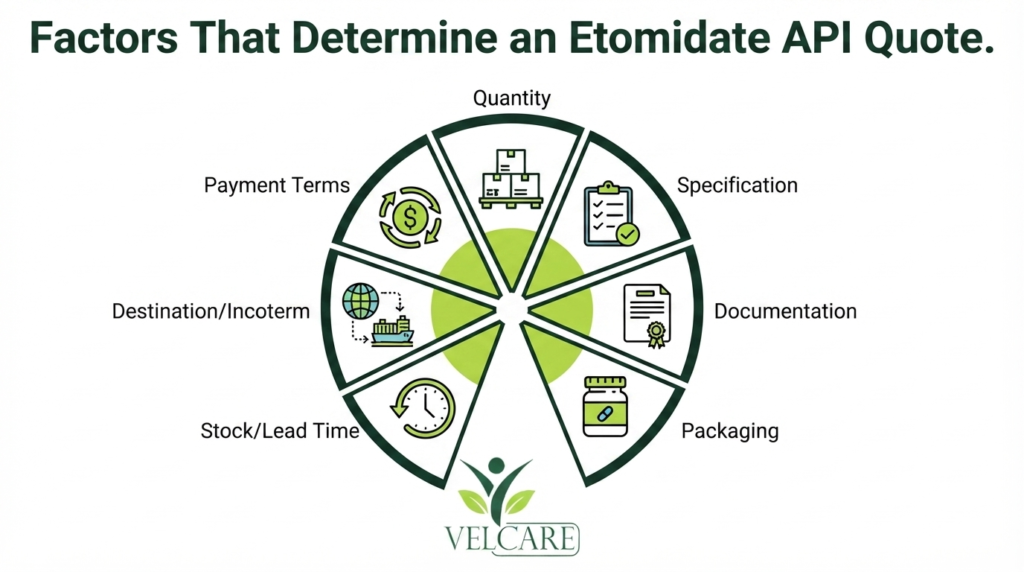
1. Required Quantity
The order quantity affects how manufacturing, testing, release and packaging expenses are distributed. A smaller quantity generally carries a higher price per kilogram because the same batch-related work is allocated across less material.
A scheduled annual requirement creates a different price basis. The supplier can consider the expected total volume, shipment frequency and production planning rather than pricing each order as an isolated purchase.
2. Specification and Quality Requirements
“Etomidate API” identifies the substance but does not fully define the material. A quotation may cover a pharmacopoeial specification, an internal manufacturer specification or additional buyer-specific requirements.
The price basis may include limits or testing for:
- Assay
- Identification
- Related substances
- Named and unspecified impurities
- Residual solvents
- Water or loss on drying
- Residue on ignition
- Specific optical rotation
- Additional physical or analytical characteristics
Velcare’s Etomidate certificate of analysis guide explains how the reported batch results are compared with the specification. Two prices are not technically equivalent where the corresponding specifications differ.
3. Regulatory Documentation
A standard CoA and safety data sheet represent a different document package from one containing stability information, analytical methods, impurity statements or DMF-related support.
Document availability also depends on its holder. A trader may be able to share a representative CoA but may not control the manufacturer’s regulatory files or authorize access to them.
4. Packaging Configuration
The required pack size affects the number of inner and outer containers used for the order. Smaller individual packs can increase packaging, handling and shipping costs.
The quotation may also describe the product-contact material, secondary packaging, sealing arrangement and any protection from moisture, light or physical damage.
5. Stock Status and Lead Time
A price for released stock can differ from a quotation based on a new manufacturing campaign. Ready stock has already passed release testing, while newly produced material requires manufacturing, sampling, analysis and final quality approval.
A quoted lead time may begin from order confirmation, receipt of payment or approval of the required specification. These starting points are not commercially identical.
6. Delivery Destination and Incoterm
Shipping from Gujarat, India, to a U.S. airport is different from delivery to a pharmaceutical facility in New Jersey, Illinois or California. The final delivery location affects the freight route, domestic transport and time in transit.
Incoterms determine how delivery responsibilities, costs and risks are divided. A useful quotation identifies the three-letter term, the named place and the applicable version, such as:
- FCA named location in India
- CIP named U.S. airport
- DAP named U.S. delivery address
- DDP named U.S. location
The phrase “delivered to the USA” is not specific enough to establish the cost allocation.
7. Payment Terms, Currency and Validity
Advance payment, a letter of credit and deferred payment create different commercial and banking costs. International transfers can also involve intermediary-bank charges.
A USD quotation protects the buyer from direct INR conversion calculations, but the supplier may still limit the offer’s validity because of exchange-rate and input-cost movements.
Information Required for an Accurate Quote
A complete Etomidate API request for quotation usually contains the following information:
- Product name: Etomidate API
- Required specification or standard
- Immediate order quantity
- Estimated annual requirement
- Development, validation or commercial-use stage
- Intended use
- Required pack size
- Destination country: United States
- Named airport, port or delivery address
- Requested Incoterm
- Required quality and regulatory documents
- Sample requirement
- Desired delivery date
- Preferred quotation currency
- Preferred payment terms
- Known importer or consignee information
- Any destination-specific import requirements
This information allows the supplier to determine the price at the correct quantity and delivery basis. It also establishes whether the required material, documents and shipping arrangement are commercially available.
How to Compare Etomidate API Quotes Correctly
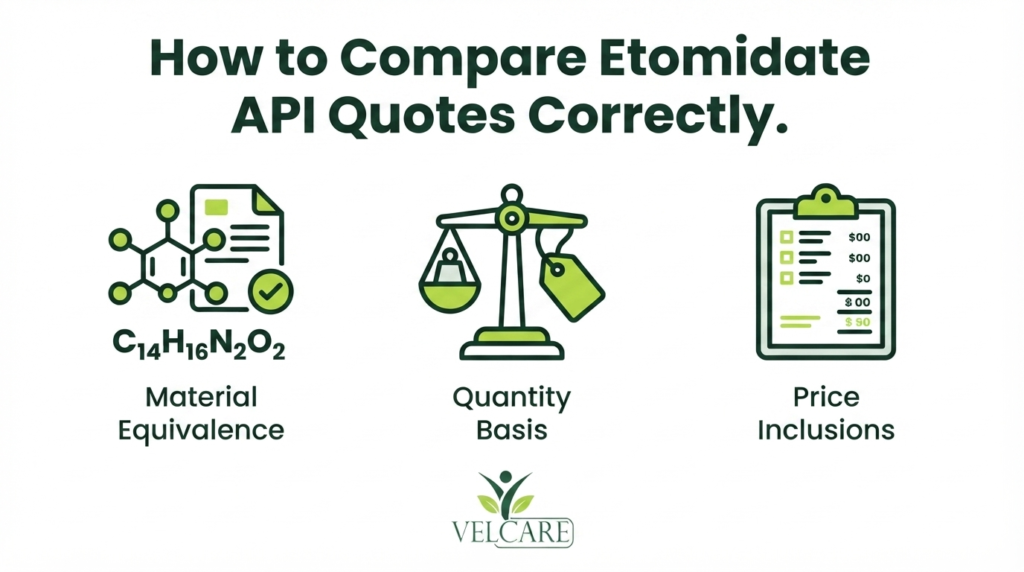
Confirm That the Material Is Equivalent
A direct comparison uses the same API identity, manufacturer, manufacturing site, specification and intended use. The CAS number alone does not establish equivalence.
The CoA provides further detail through the assay, impurity results and other batch tests. The quoted manufacturer also needs to correspond with the manufacturer identified on the technical and applicable regulatory documents.
Confirm the Quantity Basis
A quotation may state the net API quantity, gross shipment weight or number of packs. These are different measurements.
For example, a 1 kg order divided into several small packs may cost more than one 1 kg pack. The unit price can therefore change even when the net quantity remains the same.
Identify What the Price Includes
The following are possible cost items rather than standard charges on every shipment:
| Potential cost | Possible treatment |
| API and standard packaging | Included in the material price |
| Additional documents | Included or charged separately |
| Export packaging | Included or separately stated |
| International freight | Included under some Incoterms |
| Insurance | Included, optional or excluded |
| Customs brokerage | Assigned to either party |
| Import duties and government fees | Included or payable at destination |
| FDA examination or sampling expenses | Assigned if the shipment is selected |
| Storage during a clearance delay | Normally dependent on the circumstances and contract |
| Return, re-export or destruction | Assigned if entry is refused |
Warning Signs in an Etomidate API Quotation
A quotation becomes difficult to evaluate when it contains any of the following:
- No manufacturer or manufacturing-site identification
- A price without a defined specification
- Missing quantity or unit of measure
- No Incoterm or named delivery point
- Unclear treatment of freight, insurance or customs costs
- Regulatory documentation promised without naming the documents or their holder
- No quotation-validity period
- Lead time stated without identifying stock or production status
- Banking details that do not correspond with the contracting entity
- A price substantially outside the indicative range without a technical or commercial explanation
For U.S. transactions, further inconsistencies include:
- A different manufacturer on the quotation, CoA and FDA records
- Use of a supplier’s registration instead of the actual manufacturer’s information
- A statement that FDA registration means “FDA approved”
- No clearly identified U.S. importer of record
- A guarantee of FDA or customs clearance
- Different product identities, origins or intended uses across the documents
- No access to the actual manufacturer’s API listing information when required
These points relate specifically to the completeness and consistency of the quotation. A full supplier assessment covers a wider set of manufacturing, quality and commercial records.
Disclaimer
This article provides general pricing, procurement and import information. It does not constitute a binding quotation, contractual offer, regulatory determination or guarantee of FDA or customs clearance.
The USD 2,600–2,900/kg source-level range is based on public asking-price information available in July 2026. The USD 3,000–4,500/kg range is an indicative procurement budget, not a published Velcare price or confirmed landed cost.
Prices, availability, sample terms, documentation and delivery conditions vary by inquiry. U.S. buyers may need to review the manufacturer’s registration and API listing, import-alert status, intended use, application requirements and entry documents with their regulatory, quality, legal and customs professionals.
Request an Etomidate API Quotation for U.S. Delivery
For a current quotation, submit the required Etomidate specification, quantity, U.S. destination, document package and preferred Incoterm through Velcare’s contact page.
Email: Info@velcare.com
Phone: +91 89306 10565
Supply origin: India