If you are buying Etomidate API for a U.S. injectable program, start with one rule: “Etomidate powder” is not a usable purchasing specification.
That phrase leaves the hardest questions unanswered. Is the offer pharmaceutical API or research material? Who made it? Does the document package support your filing? Are the quoted site, batch and CoA connected?
Define those points before you compare price. A clear RFQ brings procurement, CMC, QA, QC and regulatory teams onto the same page and screens out unsuitable offers early.
Below, you will find what to specify, what to verify and what to lock into the supply agreement. The focus is Etomidate drug substance for injectable manufacturing, not clinical use or hospital purchasing of finished injection vials.
Define the Etomidate API Requirement Before Requesting a Quote
First, state the intended use. Price per kilogram means little if suppliers are quoting different grades, manufacturing sources, document packages or delivery terms.
A useful RFQ should include:
| RFQ Field | Information to Provide |
|---|---|
| Material | Etomidate drug substance/API |
| Identity | Etomidate, CAS 33125-97-2 |
| Intended use | Manufacture of an injectable drug product |
| Target market | United States |
| Program stage | Development, registration, validation or commercial |
| Specification | Applicable compendial and customer requirements |
| Quantity | Sample, development, validation or commercial quantity |
| Forecast | Estimated annual demand and campaign schedule |
| Regulatory support | Type II DMF and Letter of Authorization needs |
| Supply source | Original manufacturer or authorized distributor |
| Delivery | Destination, date, packaging and remaining retest period |
The USP Etomidate monograph is a logical starting point for the drug-substance specification. However, a compendial claim does not answer every question tied to your formulation, process and filing.
In practice, CMC, QA, QC, regulatory affairs, manufacturing and supply chain should agree on the requirement before procurement asks for a final commercial quote.
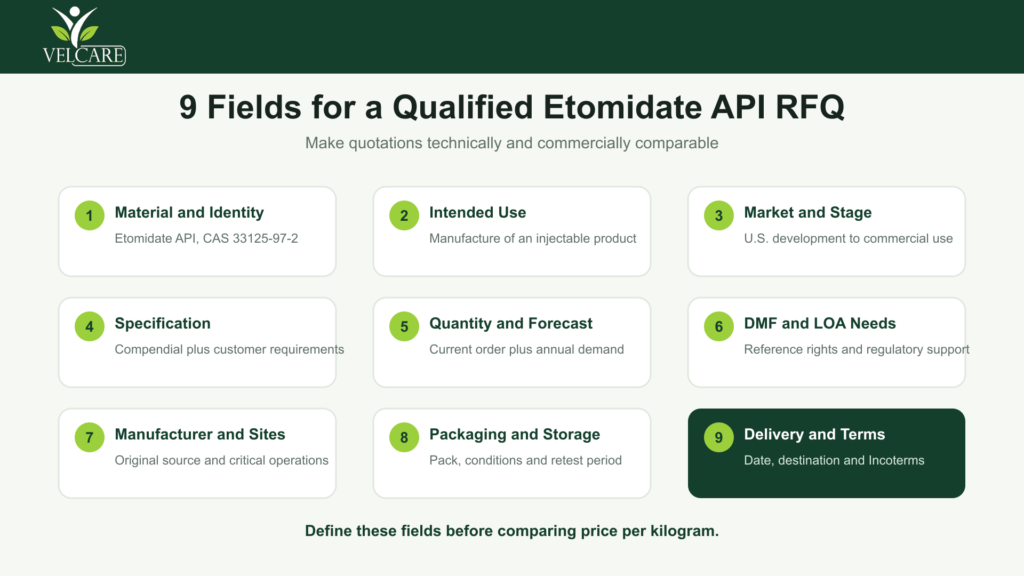
Infographic: Nine fields that make Etomidate API quotations technically and commercially comparable.
Distinguish Etomidate API from Finished Etomidate Injection
Etomidate API is the drug substance used in pharmaceutical manufacturing. Etomidate injection is a formulated, sterile finished drug product.
That distinction sounds basic, but it changes the entire purchasing package.
The cited U.S. DailyMed label describes a sterile intravenous solution containing Etomidate 2 mg/mL, propylene glycol and water. An API quotation does not cover those excipients, sterile processing, filling, container closure or finished-product release.
Instead, the API package should address:
- Drug-substance identity
- Manufacturing and testing sites
- Release specification
- Batch-specific Certificate of Analysis
- Analytical methods
- Impurity controls
- Stability and retest period
- Packaging and storage
- GMP and regulatory documentation
- Supply-chain traceability
So, a request such as “Please quote Etomidate injection powder” creates avoidable ambiguity.
A stronger request would read:
Please quote Etomidate drug substance for evaluation in a U.S. injectable program. The proposed source will be assessed against the attached specification and regulatory-document requirements.
Sterility also needs precise wording. Etomidate API may be offered under a sterile or nonsterile specification, depending on the source and control strategy.
A nonsterile API is not automatically unsuitable for a sterile drug product. Suitability depends on the finished-product manufacturer’s validated process, microbial and endotoxin controls, sterilization strategy and regulatory filing.
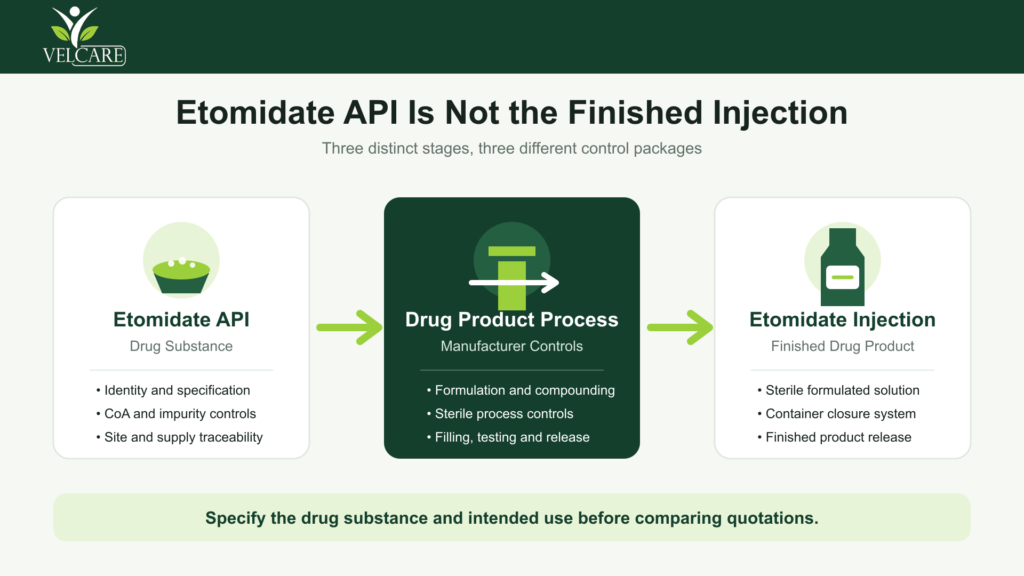
Infographic: Etomidate drug substance, drug-product manufacturing and finished Etomidate injection are separate stages with different controls.
Build the Specification Around the Intended Injectable Process
The supplier’s release specification is evidence, not an automatic customer specification. Your technical team still needs to decide whether it controls the drug substance and supports the intended formulation process.
Confirm Identity, Assay and Stereochemical Control
Start with the correct chemical identity, compendial designation and CAS number. The identification methods should distinguish Etomidate from related compounds, salts, intermediates and reference materials.
Etomidate is chiral. Therefore, the control strategy should address stereochemical identity or purity when required by the applicable monograph, manufacturing process or customer specification.
Assay should use an agreed analytical method and basis of calculation. FDA’s ICH Q6A guidance explains how tests, procedures and acceptance criteria fit together in a drug-substance specification.
Review the Impurity Profile, Not Just the Assay
A high assay result does not describe the complete quality profile. Two batches can show similar assay values and still have different impurity patterns.
Ask for information on:
- Specified process impurities
- Unspecified impurities
- Total related substances
- Starting-material or intermediate carryover
- Degradation products
- Reprocessing or rework controls
- Batch-to-batch impurity trends
Next, compare recent representative CoAs with the proposed specification. For quantitative tests, numerical results tell QC and CMC teams more than a simple “complies” entry.
Assess Residual Solvents and Elemental Impurities
Residual-solvent information should reflect the actual synthetic route. A general declaration has limited value if it does not address the solvents used or potentially introduced during processing.
ICH Q3C(R8) sets out the residual-solvent classification and control approach.
For elemental impurities, consider catalysts, raw materials, equipment and other credible sources. Under ICH Q3D(R2), the final exposure assessment sits at drug-product level.
That means the API supplier provides contribution data, while the finished-product manufacturer assesses the complete formulation against the applicable control strategy.
Request Process-Specific Mutagenic and Nitrosamine Assessments
Where the synthetic route presents a relevant risk, request an assessment of DNA-reactive impurities under ICH M7(R2).
Apply the same logic to nitrosamines. A useful assessment considers the real process, raw materials, reagents, recovered solvents, degradation pathways and cross-contamination risks.
FDA’s nitrosamine guidance covers risk assessment, confirmatory testing when risk is identified and suitable controls.
Do not stop at a “nitrosamine-free” statement. Ask how the risk was assessed and which evidence supports the conclusion.
Identify Formulation-Relevant Physical Attributes
Some physical properties matter only when they affect your process. Depending on the formulation, these can include particle-size distribution, polymorphic form, solubility, dissolution during compounding, filtration behavior and solution hold time.
Each test needs a technical reason. Adding controls by default can create analytical work and change obligations without improving control of the finished product.
Microbiological and endotoxin requirements should also match the proposed process. The decision depends on the API specification, its isolation and packaging, and the finished-product manufacturer’s validated controls.
Velcare’s article on evaluating an Etomidate API sample covers the practical comparison of supplier data, customer testing and formulation performance.
Verify Type II DMF and Regulatory Support
For a U.S. program, confirm whether the proposed source is supported by a Type II drug-substance DMF. Then establish whether the holder can authorize your application to reference it.
These checks are not interchangeable. FDA does not independently approve or disapprove a DMF. The Agency reviews its technical content when an application relies on the file.
Likewise, an active public status does not prove that the file is available for your application to reference or adequate for your submission. A GDUFA completeness assessment, where relevant to a Type II API DMF supporting an ANDA, is also not full scientific approval.
Verify:
- DMF number, type and subject
- Holder’s exact legal name
- Current public activity status
- Relationship between holder and manufacturer
- Availability for reference, where applicable
- Annual maintenance
- Letter of Authorization process
- Responsibility for FDA information requests
Use FDA’s current DMF list for public checks and record the date. The public list does not show every confidential manufacturing detail, so confirm site coverage through the holder’s controlled package.
A DMF number alone gives the applicant no right of reference. The holder must issue an appropriate Letter of Authorization that identifies the DMF, holder, authorized applicant and scope.
Alongside that review, request the current specification, representative CoAs, methods, stability summary, impurity assessments and GMP evidence. Velcare’s articles on Etomidate regulatory documents and documents to request from an API supplier take those records one by one.
Qualify the Manufacturer, Sites and Representative Material
The company sending the quote is not always the company making the API. It may be the original manufacturer, DMF holder, distributor, exporter or trader.
First, identify each party and its role. Then map the sites responsible for synthesis, purification, drying, milling, testing, release, packaging, relabeling and storage.
GMP evidence should match the exact entity, address and activity. A certificate for another plant in the same corporate group does not cover the proposed Etomidate operation.
Review the available inspection scope, inspection classification, warning letters, import alerts, unresolved actions and audit findings. ICH Q7 is the recognized FDA guidance for API GMP activities, but citing it is not proof that a particular site complies.
The sample needs the same source discipline. Confirm its manufacturer, site, batch, process, scale, packaging and relationship to the future commercial material.
After that, customer testing can compare identity, assay, impurity profile and other approved attributes. Formulation work can assess how the material behaves in your process.
A sample from another site or process may pass laboratory testing. It still cannot demonstrate consistency for the commercial source you intend to approve.
For practical screening steps, see Velcare’s articles on manufacturer versus supplier identity and supplier verification before an RFQ.
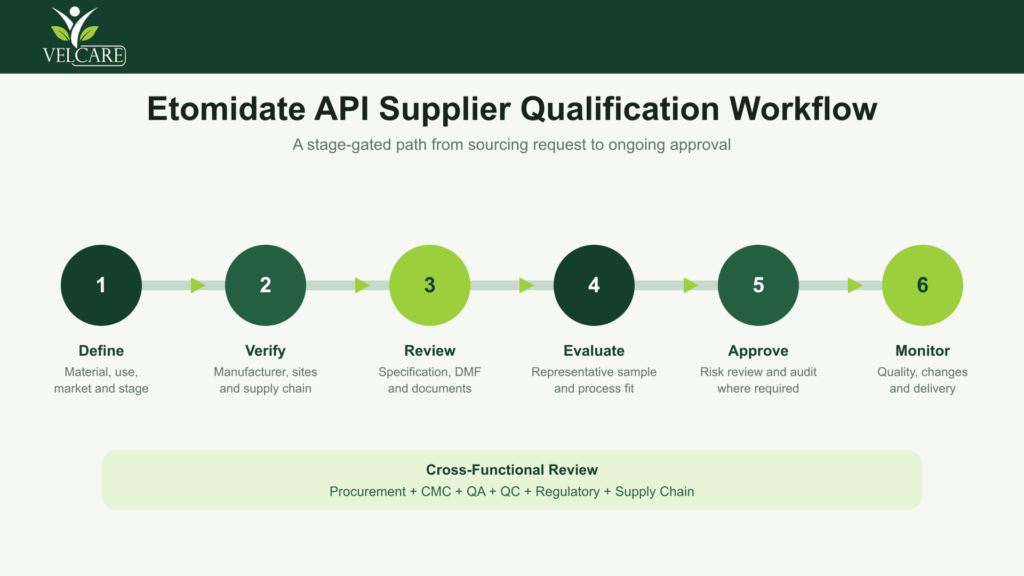
Infographic: A six-stage qualification path shared by procurement, CMC, QA, QC, regulatory affairs and supply chain.
Confirm Stability, Packaging and Shipping Conditions
Storage conditions and retest periods should come from the proposed source’s stability program, not a public listing.
Ask for:
- Long-term and accelerated stability data
- Stability-indicating methods
- Proposed retest period
- Ongoing stability commitments
- Primary container and outer drum details
- Tamper-evident features
- Light or moisture protection
- Permitted transport excursions
- Shipment-monitoring requirements
- Remaining retest period at delivery
Stability batches should use the proposed commercial container closure, or a system that simulates it under the applicable stability program.
ICH Q1A(R2) covers the general approach to drug-substance stability and retest periods. Velcare’s Etomidate packaging and storage guide expands on the purchasing checks.
Confirm U.S. Import Readiness
Once the technical source is defined, check the shipment data needed for U.S. entry.
Depending on their activities, foreign establishments involved with APIs offered for U.S. import can be subject to registration and listing requirements. Registration, listing, an FEI assignment or a previous inspection does not mean FDA has approved the site or API.
Before dispatch, align:
- Legal manufacturer name and site address
- Importer or consignee
- U.S. agent information
- API listing information
- Product description
- Applicable application information
- Commercial invoice and packing list
- Batch and release documents
FDA’s page on importing active pharmaceutical ingredients summarizes the applicable import considerations.
Also check current registration records, import alerts and available compliance information against the exact entity and site. Similar corporate names can point reviewers to the wrong record.
Finally, review the entry documents before shipment. A mismatch in company name, address, product description or importer details can delay entry even when the API itself is acceptable.
Lock Commercial Supply and Change-Control Terms
Technical approval tells you whether the source can meet the material requirement. Procurement still needs to know whether it can support the production plan on agreed terms.
Cover:
- Sample and development quantities
- MOQ and standard batch size
- Campaign frequency and annual capacity
- Forecast horizon
- Routine and surge lead times
- Price basis and validity
- Incoterms and import responsibilities
- Minimum remaining retest period
- Safety stock and allocation policy
- Return and replacement terms
- Business-continuity arrangements
Break lead time into manufacturing, testing, batch release, document preparation, export clearance and transport. That gives you a usable schedule instead of one headline number.
Stock can shorten the first order, but it may say little about repeat commercial supply. Velcare’s Etomidate API lead-time guide explains the individual time components.
Next, define which changes require advance notice. Relevant examples include the site, ownership, synthetic route, starting materials, critical suppliers, scale, equipment, solvents, methods, specifications, packaging, storage, retest period and DMF status.
Keep the agreements separate. The purchase agreement covers price, quantity and delivery. The quality agreement assigns GMP and technical responsibilities. The confidentiality agreement controls access to protected information.
Finally, treat an alternate source as a qualification project, not an instant substitute. A second source can require analytical comparison, process assessment, validation and regulatory work before use.
Submit a Qualified Etomidate API Requirement
A useful enquiry gives the supplier enough detail to assess material fit, document support and delivery feasibility.
Include your target market, program stage, dosage form, specification, requested quantity, annual forecast, delivery date, DMF and LOA needs, required documents, packaging conditions and audit expectations.
Buyers can submit an Etomidate API requirement to Velcare with those details for an initial review.