A quotation for Etomidate API may come from the company that synthesizes the material, a distributor appointed by that company, an exporter, or a trader. All can appear as the “supplier” on purchasing documents. They do not, however, have the same control over manufacturing records, analytical data, change notifications or investigations.
For a pharmaceutical buyer, the practical question is not simply whether the seller calls itself a manufacturer or supplier. The buyer needs to establish who made the batch, which sites performed testing and release, whether any party repacked or relabeled it and how technical information will move through the supply chain.
This distinction affects the scope of qualification and the records needed before Etomidate API enters development or commercial manufacturing. It also prevents a common sourcing error: approving the company that issued the quotation without adequately assessing the facility responsible for the API.
Quick Answer
An Etomidate API manufacturer performs one or more manufacturing operations and is responsible for the controls attached to those operations. The manufacturer named in a regulatory file may synthesize the API itself or use other qualified facilities for defined steps.
An Etomidate API supplier is the company from which the buyer purchases the material. That company may also be the original manufacturer. It may instead be an authorized distributor, exporter or trader handling material made elsewhere.
What is an Etomidate API Manufacturer?
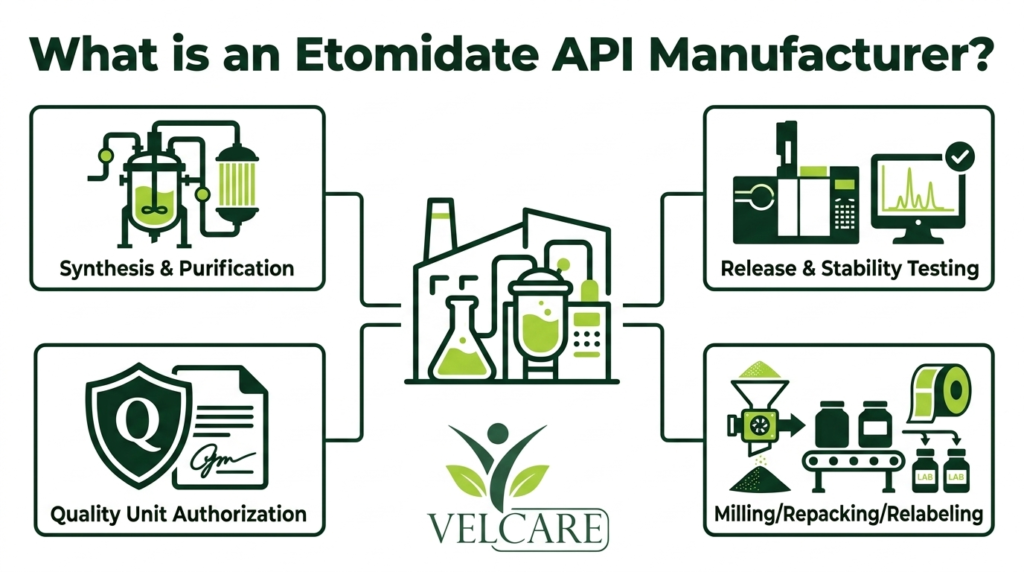
Manufacturing extends beyond the chemical reaction used to produce Etomidate. ICH Q7 treats manufacture broadly, covering operations such as production, packaging, repackaging, labeling, relabeling, quality control, release, storage and distribution, together with the associated controls. A company involved in one of these operations may therefore have a manufacturing responsibility even when another site carries out the synthesis.
For source qualification, it helps to identify the original API manufacturer: the facility that produces the Etomidate drug substance and assigns its manufacturing batch number. Separate sites may perform micronization, testing, packaging or release. Contract arrangements can add another layer, because the company presented commercially as the manufacturer may own the product while another facility performs the physical operation.
The manufacturing-site map should answer four points:
- Where is the final Etomidate drug substance synthesized and purified?
- Which facility performs release and stability testing?
- Does any other site mill, repack or relabel the API?
- Which quality unit authorizes release of the batch?
What is an Etomidate API Supplier?
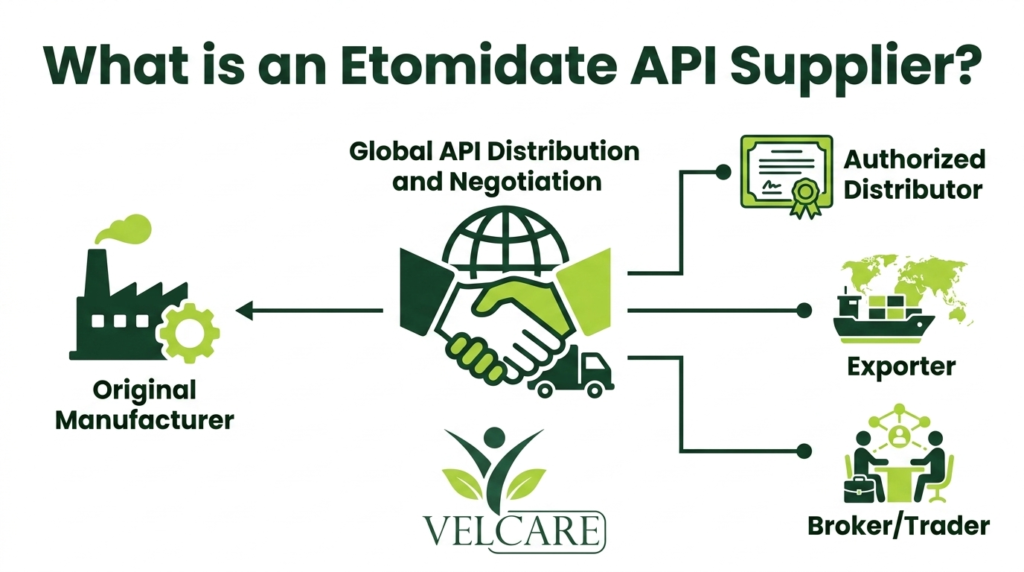
“Supplier” describes a commercial relationship. It is the organization that accepts the purchase order and provides the material to the customer. A supplier may be the manufacturer, but the term does not prove that it operates the production facility.
Non-manufacturing suppliers commonly work as authorized distributors, export companies, brokers or traders. Some keep stock and ship from their own warehouse. Others arrange a direct shipment from the original manufacturer. A supplier may also repackage the API into a smaller quantity, in which case it assumes responsibilities for the controls applied to that operation.
ICH Q7 does not place distributors and traders outside the pharmaceutical quality system. Its section on agents, brokers, traders, distributors, repackers and relabelers calls for complete API traceability. Records include the identity and address of the original manufacturer, the manufacturer’s batch number, authentic Certificates of Analysis, purchase and receipt documents, transport records and the retest or expiry date. The same guidance calls for quality and regulatory information to pass from the original manufacturer to the customer, and from the customer back to the manufacturer.
This makes the distinction quite practical. The supplier does not need to possess the reactor used for synthesis, but it does need a controlled and transparent link to the organization that does.
Etomidate API Manufacturer vs. Supplier: A Comparison
| Area | Original API manufacturer | Non-manufacturing supplier |
| Main role | Produces the drug substance and controls its assigned manufacturing operations | Purchases, markets, exports or distributes API made by another organization |
| Process knowledge | Holds the source manufacturing and batch records | Obtains permitted technical information from the manufacturer |
| Certificate of Analysis | Generates the original batch data or authorizes testing through a controlled arrangement | Transmits an authentic manufacturer’s CoA; may issue an additional CoA if it performs testing or repackaging |
| Complaint investigation | Holds the production and laboratory records needed for root-cause work | Receives the complaint and coordinates access to the manufacturer |
| Commercial support | Usually supplies from its own production program | May provide export coordination, local communication, smaller packs or held inventory |
Why Do You Need to Understand The Difference Between a Supplier and a Manufacturer?
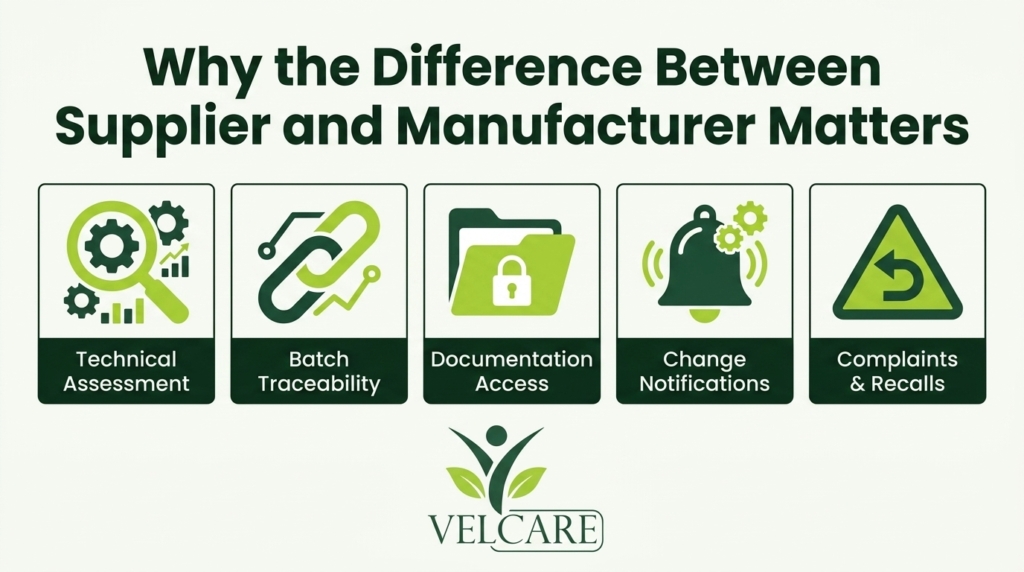
1. It identifies the source that requires technical assessment
Supplier onboarding and manufacturer qualification are related, but they are not interchangeable. A commercial supplier can be assessed for order handling, storage, transport and communication. The original manufacturing site needs a product- and process-focused review covering the quality system, production controls, laboratory controls, deviation handling and inspection history.
ICH Q10 describes supplier selection as a defined activity. Before an organization outsources an operation or selects a material supplier, it calls for assessment of the other party’s suitability and competence through tools such as audits, material evaluation and qualification. It also places responsibility on the pharmaceutical company to control outsourced activities and purchased materials.
If the seller and original manufacturer are different organizations, the qualification plan may need to cover both. The depth will depend on the API’s intended use, development phase, supply-chain complexity and the buyer’s quality-risk assessment.
2. It protects batch traceability
The batch number on the Etomidate containers should reconcile with the number on the original manufacturer’s CoA, packing documents and distribution records. A secondary supplier can add its own order or lot reference, but that reference should not replace the original manufacturing batch identity.
Repacking deserves particular attention. Once material is transferred into a new container, the buyer needs the repacker’s site, repacking record, container-closure information, label controls and the link between the new pack and original batch. ICH Q7 also addresses stability support where repacking changes the container type used by the manufacturer.
Traceability is not satisfied by a supplier-branded CoA that removes the source. FDA has previously cited a distributor for replacing the original manufacturers’ information with its own letterhead and failing to transfer required quality information.
3. It controls access to the right documentation
A supplier may deliver the full document package, but the origin of each document still matters. The API specification, original CoA, manufacturing declaration, stability summary and change notification normally originate with the manufacturer or the responsible quality unit. Warehouse records, export documents and distribution temperature records may originate with the supplier.
During evaluation, buyers commonly request:
- the legal name and address of the original manufacturing site;
- a current product specification and representative CoA;
- evidence relevant to the site’s GMP status and inspection history;
- analytical method information and method-validation support, as required for the intended use;
- impurity, residual-solvent, elemental-impurity and nitrosamine risk information, where relevant;
- retest-period and storage-condition support;
- a supply-chain diagram identifying testing, release, repacking and storage locations;
- a letter showing the supplier’s relationship with the manufacturer when authorization is claimed;
- procedures or written terms covering change notification, complaints and recalls.
4. It determines how changes reach the buyer
A relevant process change begins at the manufacturing level. It may concern the manufacturing site, route of synthesis, starting-material source, process solvent, equipment train, batch scale, specification, analytical method or primary packaging. The supplier is often responsible for communicating the notice, but it cannot assess the manufacturing impact without adequate information from the source.
This point becomes more sensitive after the API is included in a registered product. FDA has noted that a move from one drug-substance manufacturer to another can involve changes in route, solvents, equipment, impurity profile and physical properties, rather than being only an address change. The reporting and supporting-data requirements depend on the approved application and the change involved.
The purchasing or quality agreement should state which changes require notice, who sends it, the notice period and what supporting assessment will be supplied. Where the seller is an intermediary, the same obligation needs to exist between that seller and the original manufacturer; otherwise the customer-facing agreement may promise information the supplier has no contractual right to receive.
5. It affects complaints, OOS results and recalls
An atypical incoming result can be reported to the commercial supplier, but the investigation may require the manufacturer’s chromatograms, raw analytical data, batch-production record, deviation history and retain sample. The route for obtaining those records should be agreed before a disputed batch appears.
The same applies to a recall. The supplier controls customer and distribution records, while the original manufacturer holds production information and may know which other customers received the batch. ICH Q7 expects distributors and similar parties to retain complaint and recall records and, where warranted, review the matter with the original manufacturer.
A useful complaint arrangement identifies the intake contact, initial-response period, sample-handling procedure, investigation owner and method for transmitting the final report. It should also distinguish a transport or warehouse complaint from a manufacturing-quality complaint because the supporting records come from different parties.
Is Buying Etomidate Directly from the Manufacturer Always Preferable?
For commercial quantities linked to a regulatory submission, direct contact can simplify audits, technical questions, quality agreements and long-range production planning. It may also reduce the number of organizations through which confidential information and change notifications pass.
There are sound reasons to use a non-manufacturing supplier. The original manufacturer may not export directly to the buyer’s market or may impose an order quantity that is unsuitable for early development. An authorized supplier may hold qualified inventory, arrange export documents, manage freight or provide a commercial contact in the required time zone. None of these functions replaces manufacturer qualification, but they can make a defined supply route workable.
The decision is therefore based on the complete arrangement: disclosed origin, documented authorization, technical access, quality responsibilities, order size, lead time and logistics. A direct quotation that omits those details is no stronger than a distributor quotation that omits them.
Comparing Manufacturer and Supplier Quotations
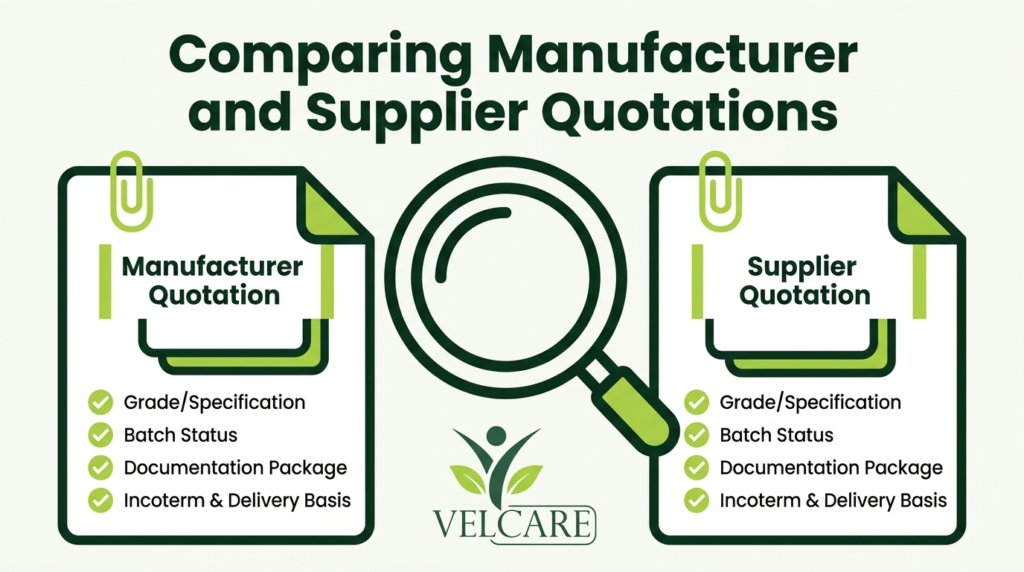
The manufacturer named in the offer is one part of a like-for-like quotation review. The buyer also needs the Etomidate grade or specification, batch status, pack size, quantity, documentation package, lead time, storage conditions and delivery basis.
When international shipment is involved, the quotation should state an Incoterm, named place and Incoterms version. An EXW manufacturing-site price cannot be compared directly with a delivered offer that includes export handling, freight and a longer chain of custody. Any importer-of-record, customs or destination charges outside the quoted term should be identified separately.
Technical and commercial differences can then be evaluated without confusing a lower unit price with a shorter or better-controlled supply chain. For example, one offer may cover original sealed drums and manufacturer-issued documents, while another includes repacking into a development quantity and air shipment. The material might originate from the same plant, yet the scope, risk and landed cost are different.
Discuss an Etomidate API Requirement with Velcare Pharma
Velcare Pharma supplies Etomidate API from India and provides a product page with an indicative specification and sample batch information. Buyers can review the available Etomidate API information before sending an inquiry.
For a relevant response, submit the required grade or specification, immediate quantity, estimated annual demand, intended market, documentation requirements, delivery location and requested date through the Velcare Pharma contact page. The inquiry can also ask Velcare to identify the manufacturing, testing, release and supply roles applicable to the offered batch.
This article provides general technical and procurement information. It does not establish the suitability, regulatory acceptability or approval status of a particular Etomidate API, manufacturer or supplier. Each buyer remains responsible for qualification against its intended use, quality system, registered application and applicable market requirements.