An Etomidate API sample should be evaluated through a controlled sequence: confirm its source and commercial representativeness, review the supporting technical package, test it against the buyer’s acceptance criteria and assess its behavior in the intended formulation process.
A sample can produce acceptable laboratory results without representing routine commercial production. It may originate from a development batch, a different site or a specially prepared laboratory lot. Differences in analytical methods, reference standards, storage conditions or final processing can also make the supplier’s results difficult to reproduce.
A written evaluation protocol connects the sample to a defined batch, specifies the tests and decision rules and separates API conformance from formulation suitability. This guide explains the evidence pharmaceutical buyers should review before using a sample result to support commercial procurement.
Direct Answer
- Confirm that the sample comes from the stated manufacturing site, process and batch type proposed for commercial supply.
- Review the batch COA, specification, analytical methods and supporting quality documents before testing begins.
- Test identity, assay, related substances, stereochemical quality and other attributes required by the buyer’s approved specification.
- Compare the independent results with the supplier’s batch data and assess suitability for the intended formulation before approving the source.
What Can an Etomidate API Sample Evaluation Establish?
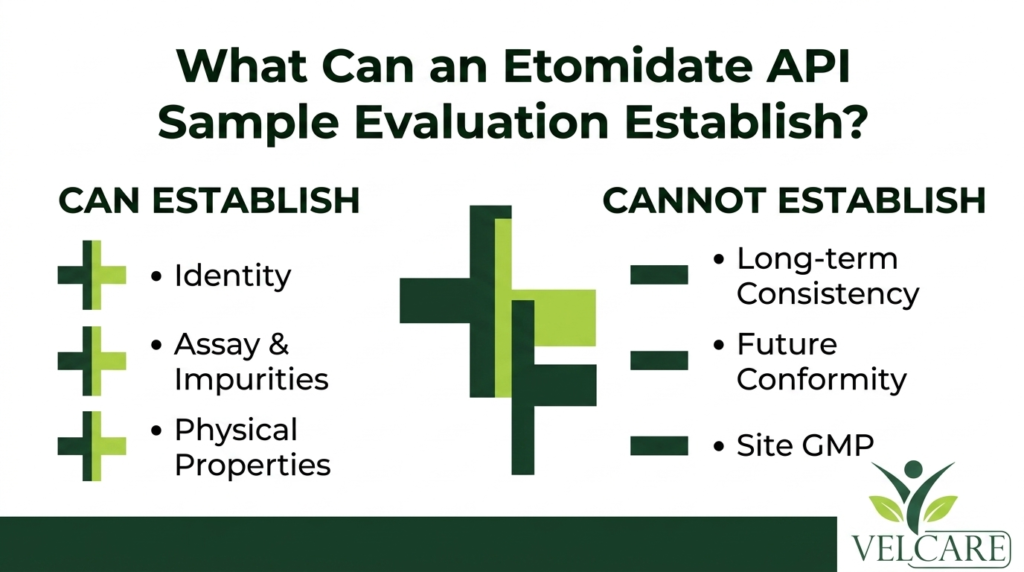
| A Controlled Evaluation Can Help Establish | One Sample Cannot Establish |
| Whether the material is chemically identified as Etomidate | Long-term consistency across multiple batches |
| Whether assay and impurity results meet the applicable specification | The supplier’s performance across future orders |
| Whether relevant physical properties support laboratory handling and development work | Conformity of a commercial batch that has not yet been manufactured |
| Whether the supplier’s numerical results are scientifically comparable with independent results | GMP compliance of the manufacturing site |
| Whether further analytical or formulation work is required | Adequacy of the complete supply chain |
Sample evaluation therefore supports, but does not replace, the broader process used to qualify an Etomidate API supplier.
How to Evaluate an Etomidate API Sample?
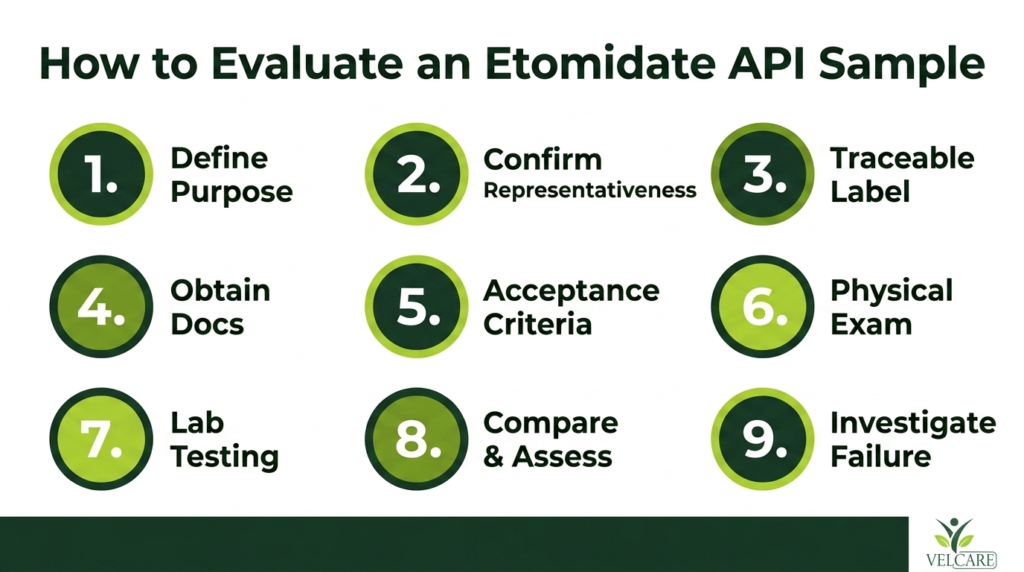
1. Define the Purpose of the Sample Before Requesting It
The intended evaluation determines the required quantity, documentation and test plan. A sample requested only for preliminary identification does not require the same package as material intended for method transfer or formulation development.
Possible purposes include:
- Preliminary identity and quality screening
- Analytical-method verification or transfer
- Comparison of supplier and buyer specifications
- Formulation-development experiments
- Small-scale process trials
- Technical comparison of potential sources
- Quality or regulatory assessment
Calculate the requested quantity after defining the analytical work. The amount should cover sample preparation, required replicates, formulation trials, justified confirmatory work and an appropriate retained portion. Requesting an arbitrary quantity before the protocol is written can leave too little material for a complete assessment.
2. Confirm That the Sample Represents the Intended Commercial Material
The supplier should state how the sample was produced and from which batch it was taken. “Representative sample” is not sufficiently specific for a procurement decision.
| Sample Origin | What It Indicates | Main Limitation |
| Released commercial-scale batch | Current output from an established production batch | Future batches still require individual control |
| Development or pilot batch | Preliminary process capability and material characteristics | Scale, equipment or final processing may differ |
| Laboratory-prepared sample | Early chemical or analytical feasibility | May not represent routine manufacturing |
| Batch currently available for sale | Direct link to a potential purchase lot | The purchased containers must still match the evaluated batch |
| Sample intended to represent a future batch | Target specification and proposed process | It cannot prove the quality of material not yet manufactured |
For a development or pilot batch, obtain a written explanation of its relationship to the proposed commercial process. ICH Q7 permits preliminary API retest or expiry dating from pilot-scale data only when the pilot process simulates the intended commercial process and produces material representative of commercial output. The same comparability principle is relevant when deciding how much weight to place on a pilot sample. FDA’s ICH Q7 guidance provides the underlying framework.
Confirm whether commercial supply will use the same:
- Original API manufacturer and manufacturing site
- Synthesis and purification process
- Batch scale or scientifically comparable scale
- Drying, milling, sieving or micronization operations
- Specification and analytical procedures
- Release-testing laboratory
- Quality-unit release system
- Primary container-closure configuration
A specially purified or selectively packaged sample can pass evaluation while concealing variability present in routine production. Any difference between the sample and proposed commercial material needs a documented technical assessment.
3. Request a Traceable and Properly Labelled Sample
The sample identity must remain traceable from dispatch through receipt, testing and retention. The label or accompanying controlled documentation should provide:
- Material name and grade
- Original manufacturer
- Manufacturing site, where relevant
- Batch or lot number
- Sample quantity
- Manufacturing date
- Retest or expiry date
- Storage conditions
- Sampling or packaging date
- Applicable handling precautions
Upon receipt, reconcile the batch number across the container label, COA, packing document and sample correspondence. Record any internal receipt or laboratory number without obscuring the supplier’s original identifier.
Check whether the container is sealed, clean and suitable for the material. Evidence of a broken seal, damaged liner, moisture exposure, poor closure or unexplained relabelling should be documented before the container is opened. Where transport conditions are critical, review the shipment history or available monitoring data before releasing the sample to the laboratory.
ICH Q7 states that API containers transferred outside the manufacturer’s control should be sealed so that a breached or missing seal alerts the recipient to possible alteration. It also identifies the material name, batch number and critical storage conditions as core label information.
4. Obtain the Required Documents Before Testing
Testing should not begin until the laboratory knows which specification, procedures and reference materials apply.
| Document | Point to Confirm |
| Batch-specific COA | Batch identity, actual numerical results, limits, methods, release status and authorization |
| Current API specification | Test list, acceptance criteria, units, calculation basis and revision number |
| Analytical procedures | Complete instructions for compendial and in-house tests |
| Method-validation or verification information | Suitability of each procedure for its stated purpose |
| Method-transfer package | Instruments, columns, reagents, system suitability and transfer criteria |
| Safety data sheet | Laboratory handling, exposure and disposal controls |
| Storage and stability information | Supported storage conditions and retest period |
| Impurity information | Named impurities, relative retention information and available impurity standards |
| Residual-solvent declaration | Solvents used or reasonably expected from the process |
| Elemental-impurity assessment | Process, catalyst, equipment and material-related sources |
| GMP and release statement | Whether the batch was GMP-manufactured and released by the responsible quality unit |
A nitrosamine risk assessment is relevant when the manufacturing route, raw materials, recovered solvents, processing water, packaging or degradation pathway presents a credible risk. A general declaration should not replace a process-specific assessment. FDA’s nitrosamine guidance describes risk assessment and control considerations for APIs and drug products.
The COA should identify the batch and list each test performed, its acceptance limit and the numerical result when the test is quantitative. It should also identify the original manufacturer and any separate testing party. These requirements are addressed in ICH Q7, while Velcare’s guide on reviewing an Etomidate Certificate of Analysis explains the document-level checks in more detail.
The broader qualification file can be organized using the document categories covered in Documents to Request from an Etomidate API Supplier.
5. Establish the Buyer’s Acceptance Criteria
The supplier’s specification is an input to the assessment. It should not automatically become the buyer’s material standard.
Evaluate the sample against the requirement governing its intended use:
- The buyer’s approved Etomidate API specification
- The applicable pharmacopoeial monograph
- The specification registered for an existing drug product
- Development criteria established for a new formulation
- Additional attributes identified through process or formulation risk assessment
Before testing, define:
- Tests to be performed
- Approved analytical procedure for each test
- Current method and specification revisions
- Reference and impurity standards
- Acceptance limits
- Calculation basis, such as as-is or dried basis
- Reporting units and rounding conventions
- System-suitability requirements
- Rules for confirmatory testing
- Handling of OOS, atypical or conflicting results
ICH Q6A defines a specification as the combination of tests, references to analytical procedures and acceptance criteria. It is not simply the limit column reproduced from a supplier’s COA. The ICH Q6A guideline also places the specification within a wider control strategy that includes process control, validated procedures, stability work and GMP.
For an in-house procedure, confirm that the available evidence supports its intended measurement. ICH Q2(R2) treats fitness for intended purpose as the objective of analytical-procedure validation and covers identity, assay, purity and impurity measurements.
6. Conduct an Initial Physical Examination
Inspect the unopened sample before consuming material for analysis. Record:
- Container and seal condition
- Label completeness
- Received quantity
- Appearance and color
- Visible contamination or foreign matter
- Lumps or agglomeration
- Evidence of moisture exposure
- Differences from the supplier’s stated description
Photographs can support the receipt record when damage, unusual appearance or labelling discrepancies are present.
Physical examination may reveal packaging, handling or transport concerns. It does not confirm identity, assay, stereochemical composition or chemical purity. Those conclusions require appropriate analytical testing.
This review should also be read with How to Compare Etomidate API Specifications Between Suppliers, particularly where suppliers use different descriptions, methods or reporting conventions.
7. Perform the Planned Laboratory Testing
Testing should be conducted by a qualified internal or independent laboratory using controlled procedures and suitably characterized reference materials.
Etomidate is chemically defined as an R-configured compound. The FDA-approved product labelling identifies it as (R)-(+)-ethyl-1-(1-phenylethyl)-1H-imidazole-5-carboxylate. Stereochemical control is therefore relevant to confirming that the sample has the required chiral quality. FDA product labelling provides the chemical identification.
| Attribute | Evaluation Focus |
| Identity | Confirmation that the sample is Etomidate using the specific procedure or procedures required by the applicable specification |
| Assay | API content on the stated calculation basis using a qualified reference standard |
| Related substances | Named impurities, unspecified impurities, total impurities and the overall chromatographic profile |
| Stereochemical quality | Required optical rotation or direct enantiomeric purity, according to the approved control strategy |
| Water or loss on drying | Moisture or volatile content and its effect on assay calculations and material handling |
| Residual solvents | Solvents associated with the synthesis, purification, cleaning or recovery process |
| Inorganic or elemental impurities | Process-related catalysts, reagents, equipment sources or other identified risks |
| Physical properties | Particle-size distribution, bulk density or solid-state characteristics when they affect processing |
| Microbiological attributes | Testing only where included in the specification or justified by the intended use and contamination risk |
8. Compare Results and Assess Formulation Suitability
Compare the Independent and Supplier Results
Place the buyer’s results beside the supplier’s actual batch values. A simple pass against separate specifications is not enough when the purpose is to verify the supplier’s analytical data.
Before interpreting a difference, compare:
- Sample and batch identifiers
- Analytical procedures and method revisions
- Reference-standard source, lot and assigned potency
- Sample preparation and calculation basis
- Chromatographic integration and impurity identification
- System-suitability criteria
- Units, significant figures and rounding rules
- Water or loss-on-drying correction
- Date of testing and sample-storage history
Assess Behavior in the Intended Formulation
Chemical conformance does not by itself establish process suitability. Development work should examine the attributes that affect the proposed dosage-form process.
For an Etomidate API intended for a solution formulation, relevant work may include:
- Dissolution behavior in the intended solvent or vehicle system
- Solution clarity and precipitation risk
- pH response during preparation
- Filtration time and API recovery
- Adsorption to filters, tubing or processing surfaces
- Short-term solution and hold-time stability
- Compatibility with intended excipients
- Compatibility with the proposed container-contact materials
- Formation of degradation products under expected preparation conditions
9. Investigate Any Failure or Unexpected Result
An OOS, atypical or conflicting result should remain visible in the evaluation record until a documented investigation establishes its cause and effect on the sample decision.
The initial review should confirm:
- Sample identity and chain of custody
- Condition of the received container
- Correct specification and method revision
- Calculations, dilution factors and transcription
- Instrument status and system suitability
- Reagent and reference-standard suitability
- Sample and standard preparation
- Chromatographic integration
- Analyst adherence to the procedure
Retesting should follow a documented procedure and a scientifically justified investigation plan. It should not be used to replace an unexplained failing value with a passing result. FDA’s OOS guidance states that a result should be invalidated only when clear evidence of laboratory error exists. When the cause remains uncertain, the investigation needs to continue.
A replacement sample may be appropriate when the original container, transport history or chain of custody was compromised. Testing a new sample does not erase an unresolved result from the first one.
Sample Approval Does Not Equal Commercial-Batch Approval
An acceptable sample supports the sourcing decision for one identified material and batch. It does not authorize automatic acceptance of later shipments. Each commercial batch must remain traceable to the approved source, meet the agreed specification and pass the incoming controls required by the buyer’s quality system.
For U.S. drug-product manufacturers, 21 CFR 211.84 requires at least one specific identity test for each component and permits reliance on other supplier results only after the reliability of those analyses has been established at appropriate intervals. ICH Q7 applies a comparable supplier-evaluation principle to incoming production materials within API manufacturing, including identity testing and periodic comparison of complete analyses with supplier COAs.
Discuss Your Etomidate API Requirements
Pharmaceutical buyers can contact Velcare to discuss Etomidate API sample availability, batch documentation, proposed specifications and requirements for development or commercial procurement.
An enquiry should identify the intended use, required grade or specification, sample quantity, destination, requested technical documents, expected commercial quantity and target procurement stage. This allows the sample request to be assessed against a defined technical requirement.
Disclaimer
This article provides general technical information for pharmaceutical procurement and quality evaluation. Sample testing, supplier approval and commercial-batch acceptance should follow the buyer’s approved procedures, registered requirements and applicable regulations.