To successfully approve an Etomidate API source, quality assurance and procurement teams must meticulously align the supplier release specification with the United States Pharmacopeia baseline and the buyer product-specific criteria. An unnoticed technical gap will halt incoming lot release, complicate method transfer, and delay regulatory submissions after commercial procurement has already advanced.
Evaluating Etomidate API for a U.S. pharmaceutical program? Share your intended use and controlled specification requirements with Velcare to request the current Etomidate API specification and discuss test method alignment for your qualification process.
First Establish Which Specification Has Decision Authority
Separate The USP Baseline, The Supplier Release Specification, And The Buyer Specification
A specification is not merely a purity figure on a certificate of analysis. Under FDA and ICH Q6A guidance, a specification consists of a list of tests, references to analytical procedures, and appropriate acceptance criteria that collectively define the acceptability of a drug substance for its intended use. The official USP and NF standard includes the substance monograph, the applicable General Notices, and all referenced general chapters.
The supplier release specification records the set of tests and limits the API manufacturer utilizes to disposition its commercial batches. It may include legitimate process specific or site specific controls beyond the compendial baseline. For example, Velcare, operating from its manufacturing base in India, establishes internal release controls that may feature tighter limits on specific synthetic route impurities to support international export requirements.
| Source | Controlled by | What it establishes | What it does not establish |
| Current USP and NF text | USP | Official compendial standard and procedures | A particular buyer complete product specific control strategy |
| Supplier release specification | API manufacturer | Routine release tests, methods, limits, and frequencies | Automatic acceptance under the buyer application |
| Buyer drug substance specification | Applicant or drug product manufacturer | Attributes and criteria required for the intended product | Proof that a particular supplier can meet them consistently |
| Certificate of analysis | Batch releaser | Results for one released lot against a stated specification | The complete design or justification of the specification |
Explain The U.S. Legal And Quality Control Context
The FDA states that official USP and NF standards can support adulteration or misbranding actions under the Food, Drug, and Cosmetic Act. USP General Notices explain that a recognized article must meet applicable monograph requirements regardless of whether the letters USP appear beside the chemical name on the commercial label.
Under 21 CFR 211.160, the quality unit must approve scientifically sound specifications, standards, sampling plans, and test procedures. Furthermore, under 21 CFR 211.84(d), the drug product manufacturer must perform at least one specific identity test on each component lot and may rely on a supplier report of analysis for other testing only after establishing supplier test reliability at appropriate intervals. The buyer cannot outsource its acceptance decision merely by accepting the supplier label claim or the printed certificate of analysis.
It is also vital to understand the limits of international harmonization. The Pharmacopeial Discussion Group, which includes representatives from the European Directorate for the Quality of Medicines, the USP, and the Japanese Pharmacopoeia, works to harmonize specific excipient monographs and general chapters. However, the group does not harmonize active pharmaceutical ingredient monographs. Therefore, an Etomidate API specification designed solely around the European Pharmacopoeia cannot be assumed to be fully interchangeable with the USP requirement.
Lock The Etomidate Article Identity Before Comparing Any Limits
Normalize The Name, Chemical Identifiers, Form, And Stereochemical Designation
Before analyzing assay limits or impurity profiles, the analytical reviewer must construct an identity header for the evaluation matrix. This header normalizes the chemical baseline to ensure both the supplier and the buyer are evaluating the exact same material. The header must contain the official article title used by the current USP and NF, the CAS number 33125-97-2, the molecular formula C14H16N2O2, and the molecular weight 244.29. It must explicitly state the free base, salt, or solvate status as actually supplied, the stereochemical designation used in the source specification, and the official date of the USP and NF text reviewed.
Etomidate API, an etomidate impurity reference standard, and Etomidate Injection are entirely different articles. The Etomidate Injection monograph is a finished product standard and must never be applied to the bulk API comparison. Chemical databases confirm Etomidate is a white crystalline powder with a melting point between 72 and 74 degrees Celsius and a pKa of 4.24, soluble in propylene glycol and alcohol but insoluble in water at neutral pH. Stop the comparison and resolve any discrepancy in article name, form, CAS number, molecular formula, or stereochemical designation before looking at the assay criteria. A numerical match is meaningless if the parties are specifying different bases or chemical forms.
Treat Stereochemistry As An Identity Issue As Well As A Quantitative Control
Etomidate possesses one chiral center. PubChem represents it as the R configured compound, and NIH educational literature explains that the marketed anesthetic is the optically active R(+) form. The specific chemical name is 1H-Imidazole-5-carboxylic acid, 1-(1-phenylethyl)-, ethyl ester, (+)-. ICH Q6A dictates that a single enantiomer drug substance may need identity testing capable of distinguishing the two enantiomers and the racemate. The guidance also notes that enantioselective content can be established by a chiral assay or by an achiral assay combined with appropriate control of the opposite enantiomer.
This creates a critical practical distinction for the incoming laboratory. An achiral HPLC assay can quantify total etomidate but cannot by itself prove the enantiomeric composition. Optical rotation can support stereochemical identity but often lacks the sensitivity or selectivity needed to accurately quantify a low level opposite enantiomer impurity. A validated chiral chromatographic procedure can directly quantify the enantiomeric impurity when that represents the chosen control strategy. Do not publish an acceptance limit for the S enantiomer unless the current controlled monograph or an approved buyer specification supplies it. Do not derive an enantiomer limit from general ICH Q3A thresholds, because ICH Q6A notes special toxicological and pharmacological considerations apply for the opposite enantiomer.
Build A Comparison Matrix That Makes Hidden Differences Visible
Use One Row Per Quality Attribute, Not One Row Per Supplier Document
Each row of the evaluation matrix must preserve the source wording exactly before it is normalized into a comparative format. Do not silently convert terms like complies or conforms into numerical boundaries, and do not alter percentages, parts per million, or calculation bases during the initial transcription. Add a footnote field for the exact source and effective date. Citing the USP without a specific edition, issue, or current online check remains insufficient for strict version control.
Capture whether the test is performed on every batch, periodically, by skip testing, or not at all. ICH Q6A dictates that non-batch testing frequencies should be identified and scientifically justified, while every batch is still expected to meet the criterion if tested. Mark buyer-specific tests as additional to compendial baseline rather than USP gaps. This prevents false claims that the supplier fails the USP merely because it does not perform a buyer product-specific test.
Classify Differences Before Deciding Whether They Are Acceptable
A difference between documents is not automatically a failure. The quality assurance team must determine whether a difference changes the accept or reject decision, leaves a buyer required attribute uncontrolled, or prevents the buyer laboratory from successfully reproducing the result. Apply the following gap taxonomy in narrative form during the review.
An identity gap occurs when there is a different article, form, stereochemical designation, or inadequate specificity. A missing test gap means an attribute required by the current monograph or buyer specification is entirely absent from the supplier release document. A limit gap indicates the supplier criterion is wider, narrower, or expressed in a mathematical way that cannot be directly compared. A basis gap reveals that the dried basis, anhydrous basis, solvent free basis, or as is result calculation is not aligned.
A method gap shows that compendial and in house procedures target the same attribute but their selectivity, range, or equivalence remains unestablished. A reporting gap highlights that the limit of quantitation, rounding rules, relative response factors, disregarded peaks, or total impurity calculation rules differ. A frequency gap shows the attribute is periodic or skip tested when the buyer explicitly expects batch-by-batch data. Finally, a version gap reveals the supplier cites an obsolete USP issue, a former method, or an uncontrolled copy.
Compare Additional Tests Only When Their Basis Is Relevant To The Intended Product
Loss On Drying, Water Content, And Moisture Related Controls
Loss on drying and water by Karl Fischer are not interchangeable analytical labels. Loss on drying can include water and other volatile matter, whereas Karl Fischer is specifically targeted to water content. ICH Q6A prefers a water specific method when moisture itself matters and calls for criteria supported by hydration or moisture effect data. For Etomidate, the assay requirement calculated on the dried basis makes the linked drying test and the calculation rule highly important even when moisture is not otherwise a critical material attribute. Confirm which result corrects the assay, whether the supplier and buyer use the exact same drying conditions and equation, and whether a separate water limit is product and process relevant.
Residual Solvents And Inorganic Process Derived Residues
A supplier residual solvent list should precisely reflect the actual manufacturing and purification route. A generic statement indicating compliance with USP Chapter 467 or ICH Q3C does not show which solvents are routinely controlled or how they are tested. ICH Q3C classifies solvents based on their inherent toxicity. Class 2 solvents, such as acetonitrile which is widely used in chromatography and synthesis, carry strict concentration limits based on permitted daily exposure values. Compare the named solvent, the class and basis, the numerical limit, the specific head space gas chromatography method, the limit of quantitation, and whether the testing is routine or periodic.
For inorganic residues or metallic catalysts, ICH Q6A and ICH Q3D dictate that the need for tests should be deeply informed by process knowledge. Avoid the obsolete shorthand test for heavy metals as a substitute for a scientifically justified elemental control approach utilizing inductively coupled plasma techniques. Do not claim that every ICH Q3D element requires a full panel API release test. ICH Q3D is a drug product risk based framework, and API controls represent just one part of that overarching strategy. Determine whether an omitted solvent or catalyst is absent by route and appropriately controlled upstream, covered by periodic skip testing, or simply not assessed at all.
Physicochemical And Solid State Attributes
Potential rows for physicochemical properties can include solubility, melting range, pH of a defined solution, particle size distribution, and solid state polymorphic form. ICH Q6A treats these as case by case tests. Particle size or polymorphic form belongs in the routine release specification only when development data connect it directly to processing, stability, bioavailability, or drug product performance.
Because Etomidate is commonly formulated as a solution for intravenous injection, do not assume that oral solid style particle size limits are automatically critical for bioavailability. However, a buyer could still need a physical property control for dissolution speed during bulk compounding, filtration efficiency, or overall process consistency. That claim must come from the actual formulation and manufacturing process data. For each proposed extra test, determine exactly what the attribute affects in the downstream drug product process. If evidence linking the attribute to product performance is lacking, classify the test for characterization monitoring rather than automatically placing it in routine release.
Microbial Limits, Endotoxin, And Sterility Avoid The Injectable API Shortcut
An API intended for an injectable drug product is not automatically supplied as a sterile API. ICH Q6A states that microbial tests depend heavily on the nature of the drug substance, the manufacturing method, and the intended use. Sterility testing may be appropriate for a drug substance manufactured and packaged as sterile, while endotoxin testing may be appropriate for a bulk substance used for an injectable product.
The buyer must clearly distinguish a nonsterile API that is later subjected to a validated drug product terminal sterilization or aseptic filtration process from an API that is claimed and released as sterile by the supplier. Endotoxin and bioburden controls are justified as part of the buyer overall process control strategy to prevent pre sterilization microbial loads from exceeding validated limits. Require a clear intended use and process rationale before adding, accepting, or deleting these microbiological tests. Do not state that USP grade Etomidate API must be sterile unless the current official text and the actual supply claim establish that rigorous requirement.
Determine Whether The Analytical Procedures Can Support The Limits
A compendial procedure used for the very first time in a laboratory should be verified under actual conditions of use. USP Chapter 1226 describes selected verification rather than requiring the laboratory to repeat the entire method validation. Conversely, a noncompendial or in house procedure needs comprehensive evidence proving that it is fit for its intended purpose.
The FDA and ICH Q2(R2) frame this fitness through analytical performance characteristics such as specificity, selectivity, accuracy, precision, response, and reportable range. ICH Q14 adds development and lifecycle understanding, including an analytical target profile, procedure parameters, robustness, system suitability, and change management controls. Method transfer to the buyer laboratory may involve comparative testing, partial or full revalidation, or another justified transfer strategy under the ICH Q2(R2) framework.
| Method statement | What the buyer should establish | Common false shortcut |
| USP method | Current official procedure, permitted adjustments, laboratory verification | Assuming citation alone proves local suitability |
| In house validated | Intended purpose, validation summary, range, selectivity, precision and accuracy and current version | Accepting validated with no link to the specific limit or analyte |
| Equivalent to USP | Comparative evidence showing comparable or greater assurance and consistent accept or reject outcome | Comparing only passing samples |
| Transferred | Defined transfer protocol and acceptance criteria and representative results | Treating method SOP receipt as transfer completion |
Interpret Limits And Results On The Same Mathematical And Operational Basis
Normalize Units, Basis, And Inequality Language Without Altering Meaning
Convert ranges, parts per million, percent, and micrograms per gram into comparison friendly forms only after preserving the original wording and units in the reference documentation. Record whether percent means weight by weight, area percent, normalized area percent, or another defined calculation. Do not treat the word conforms as a numeric result, and do not assume a result shown as below the limit of quantitation mathematically equals zero. Preserve rounding rules because a reported result near an acceptance boundary can be easily changed by premature or incorrect rounding.
Keep Specification Limits Separate From Internal Targets And Observed Capability
A specification is the formal accept or reject contractual criterion. A supplier may operate to a tighter internal target or alert limit without placing that tighter limit on the commercial release specification. Historical batch results demonstrate observed process performance capability but do not automatically redefine the contractual or regulatory acceptance criterion. ICH Q6A states that acceptance criteria should be justified using development, stability, manufacturing, and analytical variability data. Criteria should not be set simply to tightly enclose a small number of early development batches. Do not add analytical uncertainty to a compendial limit in an attempt to make a failing result pass. If the organization applies decision rules or guard bands, they must be predefined within its quality system and deeply consistent with the approved control strategy.
Make Testing Frequency Part Of The Acceptance Decision
Separate batch by batch routine release testing from periodic skip testing and tests controlled upstream or in process. ICH Q6A allows justified periodic or skip testing in appropriate cases with prior regulatory acceptance where relevant. The untested batches are still fully expected to comply if tested. The buyer specification and the supplier quality agreement must align exactly on who tests a periodic attribute and what specific event returns it to routine testing. Events triggering a return to routine testing normally include a manufacturing process change, an atypical analytical result, an adverse trend, or a site change.
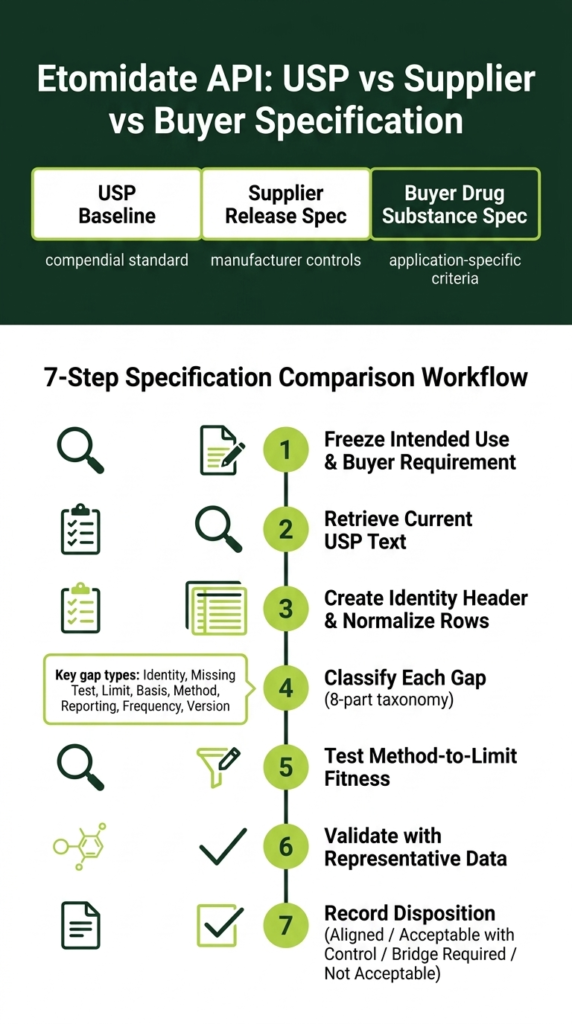
Use a Seven-Step Specification Comparison Workflow
Step 1: Freeze The Intended Use And Controlling Buyer Requirement
Identify the drug product, the application and development stage, the clinical route, the manufacturing process, and whether the buyer already has an approved drug substance specification. If an approved specification exists, do not silently replace it with the supplier version. Route any proposed change through the formal CMC and regulatory change control process.
Step 2: Retrieve The Current Official Compendial Text
Record the exact USP and NF issue version, the official date, the applicable General Notices, general chapters, and any revision bulletins. Use the public USP preview strictly as a discovery aid. A qualified reviewer must work from the authorized current text to capture all recent harmonization updates.
Step 3: Create The Identity Header And Normalize Every Row
Confirm the article, the chemical form, and the stereochemistry first. Transcribe each test, method reference, limit, basis, and testing frequency exactly. Then add a normalized comparison column to standardize the units and bases for review.
Step 4: Classify Each Difference
Apply the eight part gap taxonomy covering identity gaps, missing tests, limits, basis differences, methods, reporting rules, frequencies, or versions. Strictly separate compendial gaps from buyer specific additions to avoid improperly failing a supplier for missing a non compendial requirement.
Step 5: Test Method To Limit Fitness
For the rows that drive the sourcing decision, which typically include identity, assay, related substances, and chiral control, verify the method selectivity, the reportable range, the limit of quantitation, the system suitability parameters, and the overall procedure status. If the supplier and buyer methods differ, define the comparability and analytical transfer work needed before routine laboratory acceptance can begin.
Step 6: Use Representative Data To Test The Paper Comparison
Review multi batch analytical data and stability data only to determine whether the proposed limits and methods are practically supported by the manufacturing process. Evaluate this against the laboratory evaluation sequence to ensure the paper limits match the physical reality of the material.
Step 7: Record One Of Four Dispositions For Every Gap
Aligned indicates the supplier test, method basis, limit, and frequency completely meet the controlling requirement. Acceptable with buyer control indicates the supplier does not report a buyer specific attribute, but the buyer has a justified approved incoming or downstream manufacturing control. Technical bridge required indicates method equivalence, verification, basis conversion, naming reconciliation, or additional data is needed before a final decision can be rendered. Not acceptable indicates the wrong article identity, the limit outright fails the controlling requirement, a required attribute is completely uncontrolled, or the analytical method cannot support the decision.
Evaluating Etomidate API for a U.S. pharmaceutical program? Share your intended use and controlled specification requirements with Velcare to request the current Etomidate API specification and discuss test method alignment for your qualification process.