One Etomidate API certificate of analysis tells you whether one batch reportedly met its specification. It does not tell you whether the supplier has delivered similar results over time.
That distinction matters during supplier qualification. Five batches may all pass while showing a gradual increase in one impurity, a sudden change in assay, or inconsistent reporting that prevents a reliable comparison. Conversely, a modest difference between two passing results may be normal analytical or manufacturing variation rather than evidence of a quality problem.
Buyers therefore need to answer two questions:
- Are the COAs sufficiently comparable?
- Do the results show a pattern that requires supplier follow-up?
If the immediate task is to review the identity, authorization, dates, methods, and acceptance criteria on one document, start with how to read an Etomidate API COA. A multi-COA review begins after those document-level checks have been completed.
Conformance, Consistency, and Capability Are Different Decisions
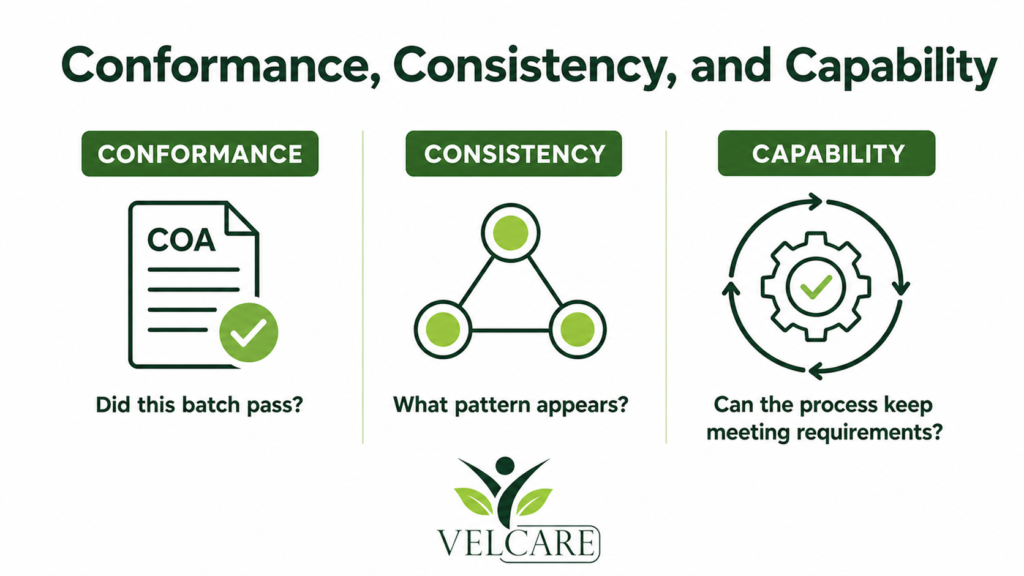
A batch conforms when its results meet the applicable acceptance criteria. This is a batch-level decision.
Consistency concerns what happens across batches. Are results distributed within a similar range? Is one attribute moving steadily in one direction? Did the profile change after a particular manufacturing date? These questions can be relevant even when every result remains within specification.
Process capability is a broader manufacturer-level conclusion. It requires more than a few selected COAs because the assessment depends on representative manufacturing data, process history, analytical variability, deviations, changes, and knowledge of the control strategy.
For this reason, a buyer should not treat three or five passing COAs as proof that the manufacturing process is capable. The documents can support an initial consistency review, but they represent only one part of the evidence.
The specification also needs to be settled before the results are interpreted. The USP baseline, supplier release specification, and buyer-approved specification may not be identical. Velcare’s guide to comparing Etomidate API specifications explains how to resolve those differences without confusing a buyer-specific requirement with a compendial failure.
ICH Q7 states that an API COA should identify the material and batch, list the tests performed and their acceptance limits, and provide numerical results when the tests are numerical. The same guidance calls for regular API quality reviews that examine critical test results, failed batches, deviations, analytical or process changes, and stability information to verify process consistency.
A buyer’s COA comparison is not a substitute for that manufacturer-level quality review.
Start With Batches That Can Actually Be Compared
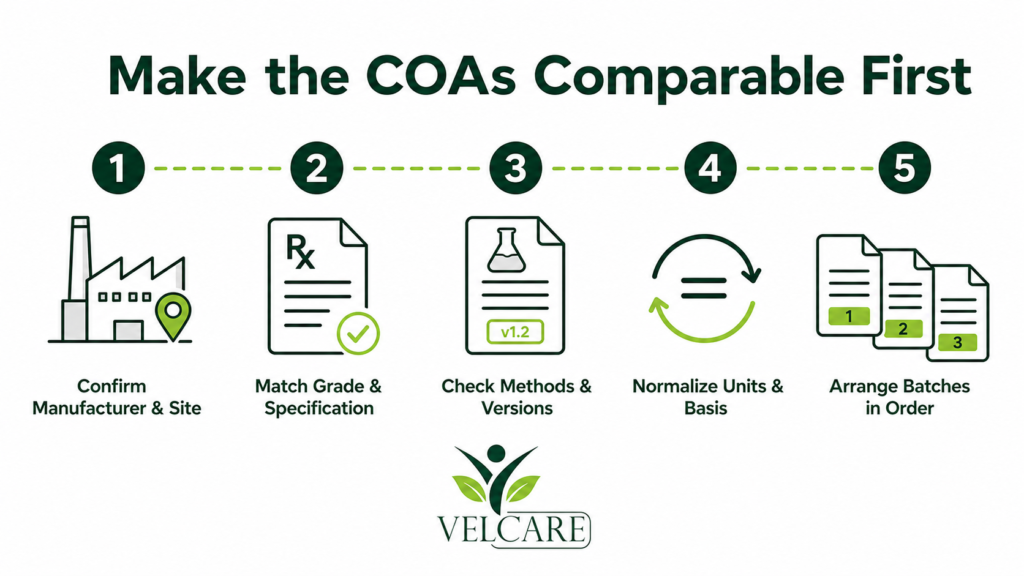
The number of COAs needed depends on the decision.
Three recent COAs may be a practical starting example during preliminary screening. A validation or commercial sourcing decision may justify a longer history. This is a contextual recommendation, not a regulatory minimum, and no fixed number by itself establishes consistency.
Representation matters more than collecting an arbitrary document count. Ask whether the COAs cover:
- Recent and preferably consecutive batches
- The proposed original manufacturer and manufacturing site
- The same Etomidate grade and chemical form
- The process intended for future supply
- Commercial or commercially representative scale
- The same specification revision
- Comparable analytical methods and reporting conventions
A development batch, pilot batch, and routine commercial batch may each be useful, but they should not be combined without identifying the differences. A sample can pass testing while remaining unrepresentative of the material proposed for commercial orders. That distinction should also be checked when evaluating an Etomidate API sample.
Request the batch size or scale classification separately if it does not appear on the COA. Also capture the manufacturing date, release date, and retest date. Release dates alone may not reveal the true manufacturing sequence.
A broader Etomidate API document request can include the controlled specification, representative COAs, analytical procedures, validation summaries, batch-analysis data, stability information, and relevant change records. Procurement may coordinate the request, but QA and analytical reviewers should decide whether the dataset is technically comparable.
Build One Comparison Matrix Before Judging the Results
Reading several PDFs side by side makes it easy to miss changes in units, methods, or calculation bases. Transfer the information into one controlled comparison matrix.
| Comparison field | What to record |
| Batch information | Batch number, manufacture date, release date, batch size or scale |
| Source | Original manufacturer, manufacturing site, testing laboratory |
| Quality standard | Grade, pharmacopoeial basis, specification number and revision |
| Test | Exact attribute name used on the COA |
| Method | Compendial or in-house reference and method version |
| Acceptance criterion | Original limit, range, unit, and calculation basis |
| Result | Exact numerical result or reported wording |
| Reporting status | Numerical, <LOQ, not detected, complies, periodic, or missing |
| Buyer observation | Similar range, directional movement, abrupt change, or unresolved gap |
| Follow-up | Question, document, or testing needed before disposition |
Preserve the original entry before normalizing it. For example, <LOQ does not mean zero. “Complies” confirms a reported pass but does not provide a numerical value for trending. Similarly, dried-basis, anhydrous-basis, and as-is results should not be placed in one column as though they were equivalent.
If methods changed, note where the change occurred. ICH Q2(R2) explains that an analytical procedure’s reportable range depends on suitable accuracy and precision. Two methods aimed at the same attribute may still differ in selectivity, quantitation limit, calculation, or reportable result.
Prioritize the Etomidate Attributes That Drive the Decision
Do not create a generic list and demand that every possible test appear on every COA. Start with the controlling specification, the intended use, and the attributes that can reveal meaningful changes.
Assay and its calculation basis
The public USP Etomidate monograph preview defines Etomidate content on the dried basis. Therefore, assay results should be compared together with the stated basis and the linked loss-on-drying result.
A change in assay may mean something different if the drying result also changed. Check the equation and reporting basis before treating the movement as a process shift.
Organic-impurity results
Compare individual specified impurities, recurring unspecified impurities, and total impurities separately. A stable total can conceal a rise in one component if another component decreases.
Etomidate acid and metomidate are relevant analytical reference points. FDA’s GSRS records desethyl-etomidate, also called Etomidate acid, while the USP Etomidate monograph lists a metomidate reference standard. PubChem identifies metomidate as the corresponding methyl ester and includes its relationship to Etomidate impurity nomenclature.
Their analytical relevance does not mean both must be present in every batch. The buyer should compare the actual numerical results, reporting thresholds, method version, and recurrence pattern. The dedicated Etomidate API impurity-profile guide covers the chemical and control questions in greater depth.
Loss on drying
Compare the numerical result and test conditions. Loss on drying measures volatile matter removed under the stated conditions; it should not automatically be relabelled as water content.
The result becomes especially important when it is used to correct the assay to a dried basis.
Specific optical rotation, where applicable
Etomidate has defined stereochemistry. Where specific optical rotation appears in the controlling supplier or pharmacopoeial specification, compare results only under equivalent solvent, concentration, temperature, and calculation conditions.
Optical rotation can support a consistency review, but it should not be presented as a universal substitute for a suitably specific chiral control. The buyer’s approved specification and analytical control strategy determine its role.
Additional buyer- or route-specific controls
Residual solvents, elemental impurities, microbiological attributes, or physical properties should be compared when they are part of the applicable supplier or buyer control strategy.
Their absence from a routine COA is not automatically a failure. First establish whether the attribute is tested on every batch, tested periodically, controlled elsewhere, or omitted without justification.
Read the Pattern, Not Just the Highest Result
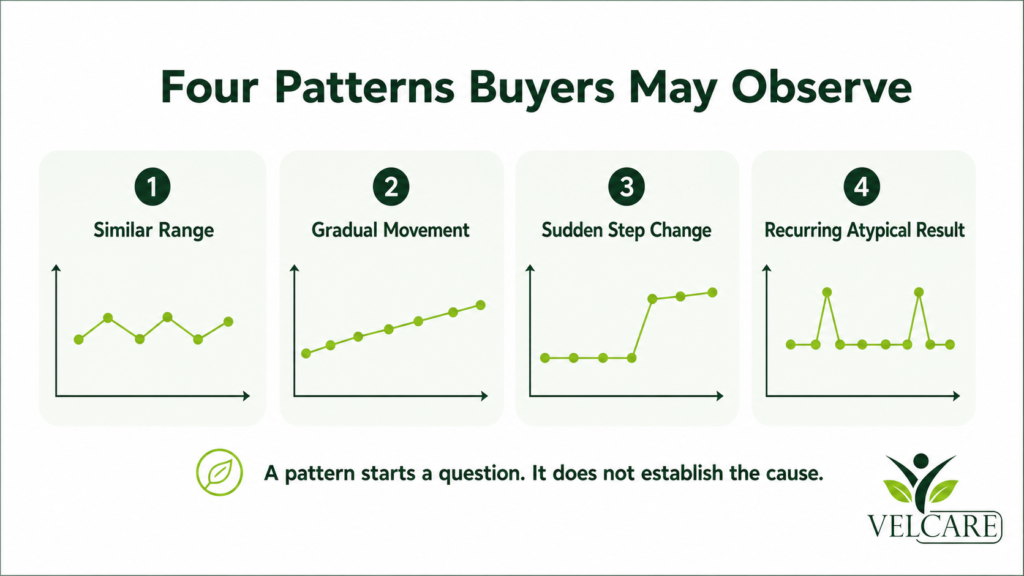
Once the data are aligned, look at them in manufacturing sequence.
A simple chronological table or plot is often enough for an initial buyer review. The objective is not to build a statistical-process-control model from a small external dataset. It is to identify observations that need explanation.
Margin to the limit
A passing result near its acceptance limit is still a passing result. However, repeated results with little margin may justify questions about longer-term performance, analytical variability, stability behavior, or the supplier’s internal alert system.
Do not create an unofficial tighter specification during this review. The formal acceptance criterion remains separate from observed performance and internal operating targets.
Directional movement
Several consecutive increases or decreases deserve attention when the attribute is relevant to quality. One movement may be ordinary variation. Repeated movement in the same direction can justify a longer batch history or supplier explanation.
The ICH Q7 Q&A states that trend analysis is usually an important part of verifying process consistency during an API product-quality review.
Abrupt changes
A sudden step between batches may correspond to a change in:
- Raw material or starting-material source
- Manufacturing scale or equipment
- Process or purification conditions
- Manufacturing or testing site
- Analytical method or integration practice
- Specification revision
- Packaging, storage, or sample age
The COAs show when the discontinuity occurred. They do not establish its cause. Check the relevant quality and regulatory change documents before reaching a conclusion.
Reporting changes
A move from numerical results to “complies,” a different number of decimal places, a changed LOQ, or the disappearance of a test can create a false trend or hide a real one.
Similarly, repeated identical values are not automatic proof of data manipulation. They may result from rounding, fixed reporting conventions, or results below a reporting threshold. They still deserve clarification when the pattern is improbable or prevents meaningful comparison.
Avoid Turning a Small COA Set Into a Capability Claim
Statistical tools are valuable when the dataset and decision support them. ICH Q9(R1) lists tools such as control charts, histograms, weighted moving averages, and process-capability analysis, but it does not require one tool for every review.
A prospective buyer normally does not possess the supplier’s complete process dataset. For this reason:
- Do not calculate control limits from a few selected COAs.
- Do not present a capability index from a small dataset as proof of manufacturing control.
- Do not interpret every individual difference as a meaningful trend.
- Do not conclude that no risk exists merely because no pattern appears in the supplied documents.
FDA’s process-validation guidance places process stability and capability analysis within a structured manufacturer program using sufficient data and appropriately trained personnel. A buyer can use COAs to identify questions, but the supplier needs broader process knowledge to answer them.
Turn Each Pattern Into a Supplier Follow-Up
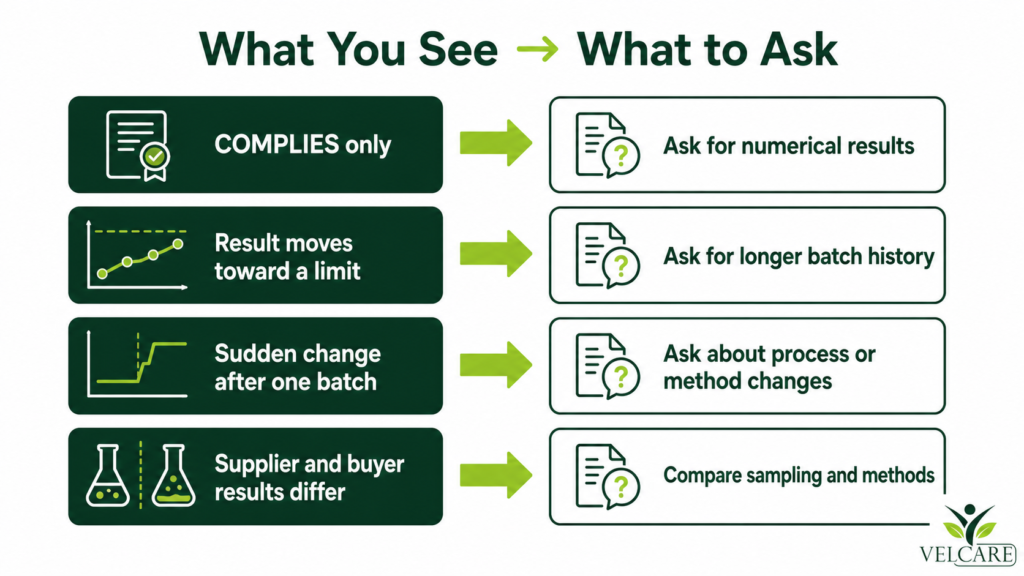
The most useful outcome of a multi-COA review is a precise request. Avoid sending the supplier a general statement that the batches “look inconsistent.” State what changed and what evidence would resolve the question.
| What you see | What to ask |
| Quantitative tests reported only as “complies” | Can numerical results, reporting thresholds, and rounding rules be provided for the reviewed batches? |
| Assay changes while loss on drying also changes | Were all assay results calculated on the same basis, and can the uncorrected result or calculation method be confirmed? |
| One impurity rises across consecutive batches but remains within specification | Is the pattern visible in the longer batch history or stability program, and did it cross an internal alert or investigation threshold? |
| A sudden shift begins with one batch | Were there changes to the site, scale, process, materials, equipment, specification, method, or laboratory at that point? |
| A new or recurring unspecified peak appears | How is the peak tracked, what is its relative retention time and identification status, and did the method or LOQ change? |
| Several COAs report identical numerical values | What rounding and transcription rules apply, and are underlying batch-analysis records available for controlled review if needed? |
| A test appears on some COAs but not others | Is it routine, periodic, skip tested, controlled elsewhere, or missing? What is the approved rationale and reversion trigger? |
| Supplier and buyer laboratory results differ | Have sampling, method versions, reference standards, calculations, system suitability, and laboratory investigations been compared? |
Some supporting information may be confidential. A summary, controlled data-room review, audit, or exchange under a confidentiality agreement can still allow the buyer’s quality unit to evaluate the issue without requiring unrestricted disclosure of proprietary manufacturing information.
Verify Supplier Results Through the Buyer’s Quality System
A document review does not remove the buyer’s testing and release responsibilities.
For a U.S. drug-product manufacturer, 21 CFR 211.84 permits reliance on a supplier’s report of analysis for certain component testing only when the manufacturer establishes the reliability of those results at appropriate intervals and conducts the required identity testing.
This requirement should not be generalized as identical law in every jurisdiction. Each buyer must apply the regulations, approved dossier, and quality procedures governing its product and market.
When supplier and buyer results differ, investigate before deciding which result is correct. Sampling, sample handling, method differences, reference standards, calculation bases, and ordinary inter-laboratory variation can all contribute. An unexpected result should not be discarded simply because a retest is more favorable. FDA’s OOS guidance provides the applicable investigation principles.
These activities belong within the wider process used to qualify an Etomidate API supplier, not within procurement’s commercial comparison alone.
Convert the Review Into a Sourcing Decision
A multi-COA review should end with a documented disposition.
Proceed
Proceed when the batches are representative and comparable, the numerical data show no unresolved adverse pattern, and the supplier evidence aligns with buyer verification and the intended control strategy.
Proceed with defined conditions
Conditional acceptance may be appropriate when a specific gap has a realistic closure plan. Conditions might include:
- Additional representative commercial-batch data
- Targeted incoming testing
- Method comparison or transfer work
- A change-history explanation
- Closure of an analytical reporting gap
- Review of the next agreed number of commercial batches
State who owns each action and when it must be completed.
Hold or escalate
Hold the decision when the documents refer to different sites, processes, grades, or specifications without explanation; numerical data remain unavailable; an adverse pattern lacks investigation; or supplier and buyer results cannot be reconciled.
Procurement should not solve an unresolved technical gap through price negotiation. QA, QC, CMC, and regulatory personnel need to determine whether the evidence supports the intended use.
After approval, the same matrix can support periodic monitoring. Add newly received batches and compare them with the qualified baseline, alongside deviations, complaints, change notifications, and delivery performance. This connects the COA review with the broader assessment of long-term Etomidate API supplier reliability.
Request Comparable Etomidate API Batch Information
Multiple COAs are useful only when they represent the source and material proposed for supply.
Review the Velcare Etomidate API page and contact Velcare with your intended market, required grade, development or commercial stage, quantity, applicable buyer specification, and requested batch documentation.
Ask about the availability of recent representative COAs, the current specification, and any supporting analytical information needed for your qualification process. Document availability and confidentiality conditions should be confirmed for the specific inquiry.