International procurement can give pharmaceutical companies access to additional manufacturing capacity, specialised API producers and commercially competitive sources of Etomidate. However, purchasing an active pharmaceutical ingredient across borders involves more than comparing its specification, price per kilogram and quoted lead time.
The buyer must establish who actually manufactures the material, whether the relevant manufacturing site is appropriately qualified, whether the regulatory documentation can support the intended market and whether commercial batches will remain consistent with the material originally evaluated. Packaging, international transport, customs handling and supplier responsiveness can introduce further risks after the API leaves the manufacturing facility.
These risks should be assessed collectively. An unclear manufacturing source can create both a quality and regulatory risk, while a delayed shipment can become a quality issue when storage conditions or container integrity cannot be adequately verified.
What Are the Main Risks When Importing Etomidate API?
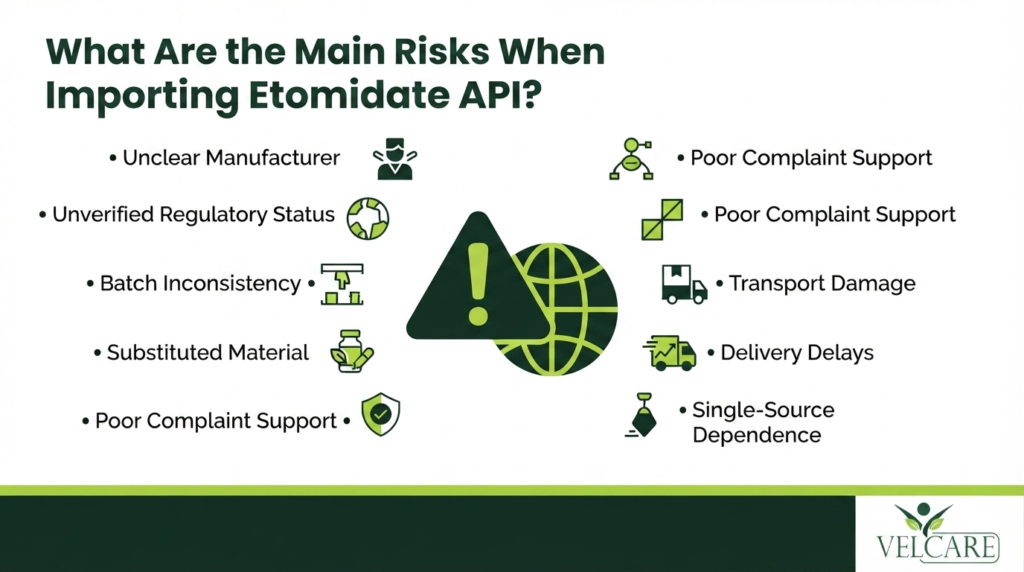
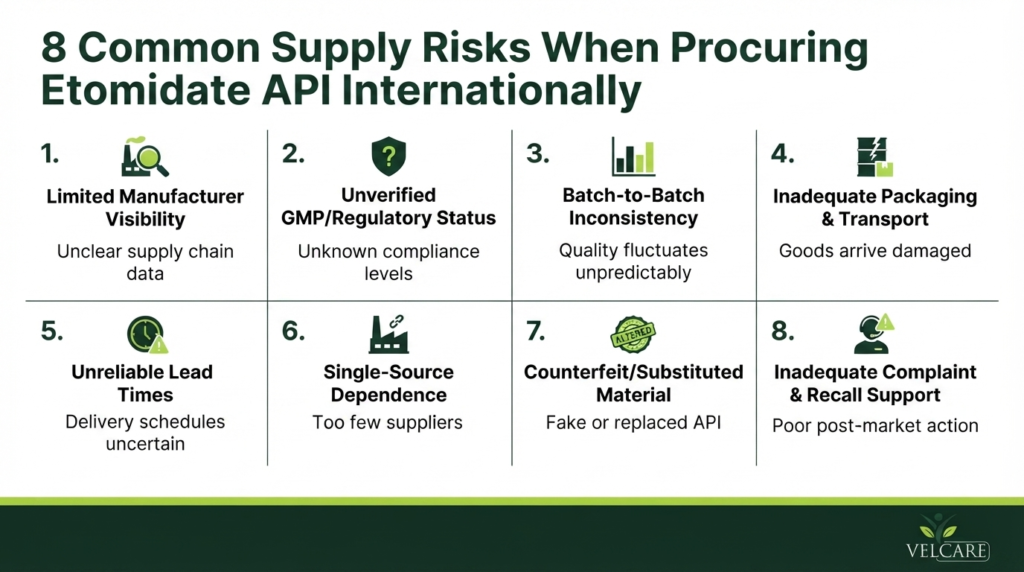
The most common international procurement risks include:
- purchasing through a trader without visibility of the actual manufacturer;
- receiving material from an unapproved manufacturing or testing site;
- relying on incomplete, outdated or market-inappropriate regulatory documents;
- evaluating a sample that does not represent routine commercial production;
- receiving inconsistent quality across batches;
- experiencing contamination, deterioration or packaging damage during transport;
- facing longer production, release, freight or customs timelines than expected;
- depending on one manufacturer without a qualified contingency source;
- receiving mislabelled, substituted or otherwise untraceable material; and
- receiving inadequate support when a batch deviation, complaint or recall occurs.
The importance of each risk depends on the buyer’s intended market, regulatory pathway, dosage-form development stage, required order volume and ability to absorb supply interruptions. However, unresolved questions about manufacturing identity, GMP status and API quality should normally take priority over pricing considerations.
1. Limited Visibility of the Actual Manufacturer
How the Risk Arises
The organisation issuing a quotation may be a manufacturer, authorised distributor, exporter, sourcing agent or independent trader. When several commercial intermediaries are involved, the buyer may find it difficult to determine:
- the manufacturer’s complete legal identity;
- the physical address of the production facility;
- which site performs synthesis, purification and drying;
- whether testing and batch release occur at the same facility;
- whether contract laboratories or subcontractors are used;
- who stores or repackages the API before export; and
- whether the offered batch originates from the disclosed manufacturer.
The World Health Organization’s guidance on pharmaceutical starting-material distribution applies to parties involved in trading, storing, repackaging, relabelling and distributing APIs and other starting materials. This reflects the need to maintain traceability beyond the original manufacturing operation.
Why It Matters
Qualifying the commercial supplier is not the same as qualifying the company responsible for manufacturing the API. A distributor may have suitable commercial systems but limited control over the manufacturer’s process, analytical methods, deviations or site changes.
Poor transparency can also prevent the buyer from confirming whether:
- the GMP certificate covers the relevant facility;
- the site listed in regulatory documents is the actual source;
- the inspection history belongs to the correct legal entity;
- the sample and commercial order come from the same site;
- a change in manufacturer will be communicated in advance; or
- the supplier is authorised to share and reference the manufacturer’s regulatory information.
The problem becomes more significant when the supplier cannot arrange direct technical communication with the manufacturer or provide a documented chain of custody.
How Buyers Can Reduce the Risk
Before approving the source, the buyer should request a supply-chain map identifying every organisation that will manufacture, test, release, store, relabel, distribute or export the Etomidate API.
The following details should be confirmed in writing:
| Information to confirm | Why it is needed |
| Manufacturer’s legal name | Matches certificates, filings and commercial records |
| Manufacturing-site address | Confirms where the proposed API is produced |
| Testing and release sites | Identifies laboratories responsible for reported results |
| Distributor or exporter’s role | Clarifies whether it takes possession or repackages the material |
| Subcontracted activities | Identifies additional facilities requiring assessment |
| Batch traceability process | Connects the delivered container to the original manufacturer |
| Change-notification obligation | Prevents an undisclosed switch to another source |
The supply or quality agreement should prevent the supplier from introducing another manufacturer, production site, testing laboratory or repackaging facility without prior notification and, where appropriate, the buyer’s approval.
2. Unverified GMP and Regulatory Status
How the Risk Arises
A supplier may provide a GMP certificate, manufacturing licence, registration number or Drug Master File number without demonstrating that the document:
- belongs to the correct manufacturer;
- covers the proposed manufacturing site;
- includes the relevant API operations;
- remains valid and current;
- corresponds to Etomidate;
- reflects the commercial manufacturing process; or
- is suitable for the buyer’s destination market.
A document’s existence should not be treated as evidence that the complete regulatory package is usable. The buyer must evaluate the document’s scope, issuing authority, validity, site details and relationship to the offered material.
For supply to the United States, the FDA explains in its guidance on importing active pharmaceutical ingredients that foreign establishments performing specified activities for APIs imported or offered for import into the country are subject to applicable registration requirements. FDA registration status can also be reviewed through the agency’s Drug Establishments Current Registration Site, although registration should not be interpreted as FDA approval of a facility or its products.
Similarly, possessing a DMF number does not by itself give the buyer or applicant access to the information contained in the file. Under the FDA’s Drug Master File guidelines, a Letter of Authorization permits the agency to refer to information in a DMF in support of another party’s submission.
Why It Matters
An API can pass the buyer’s laboratory tests but remain unsuitable for the intended regulatory pathway. Incomplete or unusable documentation can delay:
- supplier approval;
- formulation-development decisions;
- submission of an application;
- response to regulatory questions;
- validation or commercial manufacturing;
- import clearance; and
- approval of a new or alternate API source.
The risk is particularly high when the supplier presents documents that belong to a related company, another site or an earlier process.
How Buyers Can Reduce the Risk
Regulatory verification should be conducted before the buyer becomes dependent on the source. The review should confirm that the API, manufacturing site, legal entity and intended market are aligned.
Where relevant, buyers should verify:
- the GMP certificate with the issuing authority;
- the facility’s registration or inspection status;
- the DMF holder and current DMF status;
- the availability of a Letter of Authorization;
- whether the manufacturing site is included in the relevant filing;
- the manufacturing licence and authorised operations;
- document revision dates and validity periods; and
- the supplier’s process for maintaining and updating the documents.
No single certificate establishes complete regulatory suitability. Regulatory documents should therefore be reviewed as a connected package rather than as isolated evidence.
3. Batch-to-Batch Quality Inconsistency
How the Risk Arises
API quality can vary when the manufacturer does not consistently control its starting materials, synthesis, purification, drying, testing or deviation-management processes.
Possible causes include:
- variable starting-material quality;
- changes in starting-material suppliers;
- inconsistent reaction or purification parameters;
- insufficiently controlled drying conditions;
- differences between manufacturing lines;
- poorly transferred analytical methods;
- inadequate investigation of atypical results;
- inappropriate reprocessing practices; or
- limited experience with routine commercial production.
The ICH Q7 Good Manufacturing Practice Guideline for Active Pharmaceutical Ingredients establishes a quality-system framework intended to help ensure that APIs possess the quality and purity characteristics they claim to have. Its scope includes production, laboratory controls, materials management, packaging, labelling, change control, rejection, reuse and distribution.
Why It Matters
An API batch may meet its headline assay limit while differing in attributes that influence the buyer’s manufacturing process or finished product.
Depending on the process and agreed specification, meaningful differences can occur in:
- related substances;
- specified and unspecified impurities;
- residual solvents;
- water content;
- inorganic impurities;
- particle-size distribution;
- polymorphic or solid-state form;
- bulk density; and
- stability or retest behaviour.
Such differences may affect solubility, filtration, formulation behaviour, process reproducibility, stability results or finished-product release. The exact attributes that require control should be determined through the buyer’s development knowledge, risk assessment and regulatory requirements.
The Sample-to-Commercial-Batch Risk
A related concern is that the supplier’s evaluation sample may not represent normal commercial production. It could have been produced:
- at laboratory or pilot scale;
- on different equipment;
- through an earlier process version;
- using another starting-material source;
- at a different facility; or
- from a specially selected batch.
A satisfactory sample therefore cannot, on its own, demonstrate consistent commercial capability.
How Buyers Can Reduce the Risk
Buyers should avoid qualifying a source from one Certificate of Analysis or one small sample. A stronger assessment compares results across several representative, preferably commercial-scale, batches.
The review should normally include:
- identification;
- assay;
- related substances and impurity profile;
- residual solvents;
- water content;
- relevant physical characteristics;
- stability or retest information;
- supplier-reported results;
- buyer or third-party laboratory results; and
- trends or unexplained shifts between batches.
The buyer should also confirm that the evaluated material was produced at the proposed commercial site using the intended commercial process. Where critical, the supplier should provide confirmation of batch scale, manufacturing location and process status.
4. Inadequate Packaging and Transport Controls
How the Risk Arises
International API shipments may pass through the manufacturer’s warehouse, an exporter, freight forwarders, cargo terminals, customs facilities, temporary warehouses and local transport providers before reaching the buyer.
During this journey, the material may be exposed to:
- damaged drums or inner liners;
- broken or disturbed seals;
- moisture;
- unsuitable temperature or humidity;
- contamination;
- incorrect or detached labels;
- unauthorised opening during inspection;
- prolonged storage at a port or airport; and
- mishandling during loading, unloading or repacking.
The WHO’s good storage and distribution practices for medical products recognise that products may be exposed to risks during purchasing, storage, repackaging, relabelling, transportation and distribution. The guidance also stresses that transport conditions should remain consistent with the conditions specified for the product.
Why It Matters
Transport-related deterioration is not always immediately visible. An outer drum can appear acceptable even when an inner liner has been punctured, a seal has been disturbed or the material has experienced unsuitable storage conditions.
Possible consequences include:
- quarantine of the complete shipment;
- additional sampling and testing;
- investigation of a temperature or humidity excursion;
- rejection due to damaged packaging;
- uncertainty about contamination or tampering;
- shortened usable retest period; and
- disruption of the buyer’s production schedule.
How Buyers Can Reduce the Risk
Packaging and logistics requirements should be agreed before the purchase order is issued, not after the shipment has been dispatched.
Buyers should review:
- Container configuration: drum material, inner liners, closure system and suitability for the agreed quantity.
- Seal controls: tamper-evident seals, seal numbering and documentation.
- Labelling: API name, batch number, net weight, storage conditions, manufacturer and retest or expiry information.
- Storage requirements: permissible temperature, humidity and handling conditions.
- Shipping route: transfers, expected transit time and temporary storage points.
- Logistics providers: responsibilities and experience in handling pharmaceutical materials.
- Excursion management: required records, notification timing and disposition responsibilities.
- Receipt inspection: examination of seals, labels, liners, drums and shipping records before sampling.
Photographs taken before dispatch can also help the buyer compare the original packaging condition with the condition observed on receipt.
5. Unreliable Lead Times and Delivery Schedules
How the Risk Arises
The lead time stated in a quotation may refer only to the period required for manufacturing. It may exclude several activities that must occur before the API reaches the buyer.
A complete order-to-delivery timeline can include:
| Stage | Possible source of delay |
| Starting-material procurement | Shortages or supplier delays |
| Production scheduling | Limited campaign slots or capacity |
| API manufacturing | Deviations, equipment failure or batch failure |
| Quality-control testing | Laboratory backlog or repeat testing |
| Batch release | Documentation review or unresolved results |
| Export preparation | Permits, invoices and certificates |
| Freight booking | Limited cargo availability or route disruption |
| Customs clearance | Document discrepancies or inspection |
| Local delivery | Port release and inland transportation |
As a result, a quoted four- or six-week manufacturing period may not represent the actual time between placing the order and receiving releasable material.
Why It Matters
Delayed API delivery can interrupt:
- analytical-method work;
- formulation development;
- engineering or exhibit batches;
- validation campaigns;
- stability programmes;
- routine finished-product manufacturing; and
- contractual supply commitments.
The financial effect may extend beyond expedited freight charges. A delay can leave production equipment unused, force the buyer to revise campaign schedules or consume safety stock intended for other orders.
How Buyers Can Reduce the Risk
Procurement planning should be based on the complete order-to-release cycle.
Before placing an order, confirm:
- standard and maximum production lead times;
- whether the API is produced to stock or to order;
- availability of the required batch size;
- the next available manufacturing slot;
- expected testing and release time;
- export-document preparation time;
- likely freight routes and transit times;
- previous on-time delivery performance;
- availability of safety stock; and
- the escalation process for a delayed order.
The purchase order should also identify which event starts the agreed lead time. For example, it may begin on order acceptance, receipt of advance payment, technical approval or confirmation of the production slot.
6. Dependence on a Single Source
How the Risk Arises
A buyer relying on one Etomidate API manufacturer can be affected by events beyond the procurement team’s immediate control, including:
- equipment breakdown;
- unsuccessful inspection outcomes;
- regulatory restrictions;
- temporary or permanent facility closure;
- shortage of a critical starting material;
- loss of a key subcontractor;
- financial instability;
- trade or export restrictions;
- regional transport disruption; and
- natural disasters or utility failures.
Concentration risk can also exist where two commercial suppliers obtain the API from the same underlying manufacturer or depend on the same starting-material source.
Why It Matters
Changing an API source is rarely an immediate purchasing substitution. Before material from another manufacturer can be routinely used, the buyer may need to complete:
- supplier and site qualification;
- sample testing;
- analytical-method verification or transfer;
- impurity-profile comparison;
- formulation or process assessment;
- stability studies;
- validation work; and
- regulatory notification, variation or approval.
The time required to complete these activities means that identifying an alternative supplier only after the original source fails may be too late to prevent interruption.
How Buyers Can Reduce the Risk
Where technically, commercially and regulatorily practical, buyers should qualify a secondary source before it is urgently needed.
Where dual sourcing is not immediately feasible, the continuity plan can include:
- defined safety-stock levels;
- reserved manufacturing capacity;
- longer-term supply agreements;
- visibility of critical starting-material dependencies;
- periodic capacity reviews;
- access to updated business-continuity plans;
- advance notice of extended shutdowns; and
- a technically assessed contingency supplier.
The buyer should also determine whether the apparent secondary supplier represents a genuinely independent manufacturing source.
7. Counterfeit, Mislabelled or Substituted Material
How the Risk Arises
Long or poorly documented supply chains can create opportunities for material or records to be altered between the manufacturer and buyer.
Examples include:
- falsified Certificates of Analysis;
- relabelled batches;
- reuse of documentation from a genuine batch;
- substitution with material from another manufacturer;
- altered retest or expiry dates;
- unauthorised repackaging;
- replacement of original seals; and
- delivery of non-pharmaceutical or otherwise unsuitable material under the expected API name.
The WHO identifies substandard and falsified medical products as a global health problem affecting countries and multiple categories of medical products.
Why It Matters
The buyer may receive material whose identity, quality or manufacturing origin does not match the approved source. Even when the material passes an initial identity test, it may have an unsuitable impurity profile, altered history or unverified chain of custody.
Substitution can also invalidate supplier qualification and regulatory documentation because the delivered material is not connected to the manufacturer, site and process that were originally assessed.
How Buyers Can Reduce the Risk
Buyers should procure through traceable and authorised commercial channels.
Controls should include:
- obtaining batch documentation directly from or verifiable with the manufacturer;
- matching the manufacturer, batch number and manufacturing site across all records;
- checking seal numbers and packaging details;
- reviewing unexplained label alterations;
- confirming whether repackaging has occurred;
- documenting the full chain of custody;
- performing identity testing before release; and
- conducting additional testing where authenticity or integrity is uncertain.
Unexpected changes in packaging style, document format, manufacturer details or normal shipping routes should be investigated rather than accepted as routine administrative differences.
8. Inadequate Complaint, Deviation and Recall Support
How the Risk Arises
Some suppliers respond promptly during quotation and qualification but provide limited technical or quality support after a problem occurs.
Potential weaknesses include:
- slow acknowledgement of complaints;
- incomplete or delayed investigations;
- vague root-cause conclusions;
- corrective actions that do not address the identified cause;
- refusal to provide relevant supporting information;
- failure to assess whether other batches are affected;
- unclear recall communication;
- disagreement over replacement material; and
- uncertainty about responsibility for testing, freight or disposal costs.
Why It Matters
An unresolved investigation can prevent the buyer from deciding whether to release, reject, return or destroy a batch. It may also leave the buyer unable to determine whether material already used in development or production was affected by the same problem.
Poor supplier support becomes especially serious when the issue involves:
- an unexpected impurity;
- a confirmed out-of-specification result;
- possible cross-contamination;
- incorrect labelling;
- damaged or compromised containers;
- an undisclosed manufacturing change; or
- a regulatory inspection finding.
How Buyers Can Reduce the Risk
Complaint and recall responsibilities should be defined contractually before commercial supply begins.
The quality agreement should establish:
- complaint-acknowledgement timelines;
- investigation and final-response timelines;
- required investigation content;
- responsibilities for confirmatory testing;
- access to relevant records;
- assessment of other potentially affected batches;
- corrective and preventive action expectations;
- escalation contacts;
- recall and regulatory-notification responsibilities; and
- responsibility for replacement, return, disposal and associated costs.
The FDA’s guidance on quality agreements for contract manufacturing arrangements describes quality agreements as a means of defining and documenting the parties’ manufacturing and quality responsibilities. Although the exact agreement should reflect the commercial relationship, the principle is relevant whenever different organisations share responsibility for API manufacture, testing, release or supply.
How to Assess International Supply Risk Before Placing an Order?
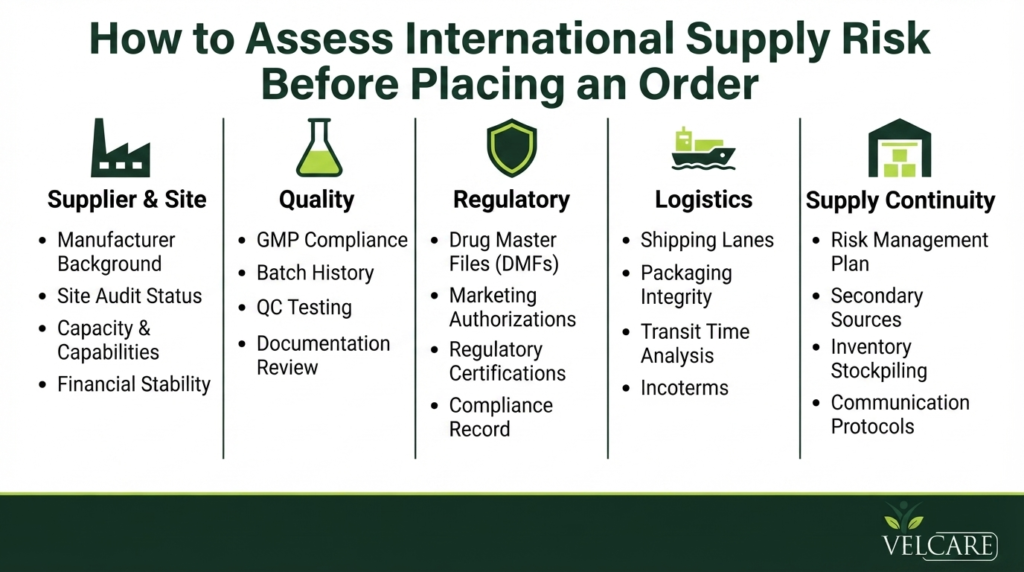
A pre-order assessment should cover the source, material, regulatory package, logistics arrangements and continuity plan.
Supplier and Manufacturing Site
- Has the actual API manufacturer been identified?
- Is the manufacturer’s legal name consistent across all documents?
- Are the synthesis, purification, testing, release and storage sites disclosed?
- Are subcontractors or contract laboratories involved?
- Was the evaluated sample produced at the intended commercial site?
- Can each delivered batch be traced to the original manufacturer?
Quality
- Have representative commercial-scale batches been evaluated?
- Do multiple Certificates of Analysis show consistent results?
- Has the buyer or a qualified laboratory independently tested the material?
- Are the analytical methods suitable for the intended specification?
- Are deviations, complaints and changes governed by written procedures?
- Does the supplier provide adequate stability or retest support?
Regulatory
- Are the regulatory documents current?
- Do they cover the correct legal entity and site?
- Are they relevant to Etomidate and the proposed manufacturing operations?
- Are they acceptable for the destination market?
- Can the required DMF or other file be referenced?
- Are the applicable manufacturer and importer registrations complete?
Logistics
- Are the packaging and container-closure requirements defined?
- Are storage and transport conditions clearly stated?
- Is the freight route suitable for the required controls?
- Are the exporter and logistics providers identified?
- Is the import-document package reviewed before dispatch?
- Is there a procedure for handling damaged containers or excursions?
Supply Continuity
- Does the supplier have sufficient capacity for the forecast volume?
- Are critical starting materials dependent on one source?
- Is safety stock available?
- Is production capacity reserved?
- Does the supplier maintain a business-continuity plan?
- Has a secondary or contingency source been considered?
Choose Velcare Pharma for Affordable Etomidate API Sourcing
Companies evaluating an international source can contact Velcare Pharma regarding Etomidate API to discuss manufacturer information, available regulatory-document support, representative sample evaluation and commercial supply planning. Product suitability and documentation requirements should be independently evaluated against the buyer’s intended application and destination-market requirements.
Disclaimer: This article provides general procurement and supplier-qualification information. It does not constitute legal, regulatory or quality-assurance advice. Buyers should conduct their own technical, GMP, regulatory and import assessments with appropriately qualified professionals before approving or purchasing an API.