Etomidate API should be purchased against a defined, stability-supported packaging and storage configuration. The procurement risk is not limited to visibly damaged containers. A substituted liner, unqualified smaller pack, vague “room temperature” instruction, breached seal, or undocumented transit excursion can leave the buyer’s quality unit without enough evidence to release the batch.
This article explains the packaging information pharmaceutical buyers should request, how storage and shipment conditions should be assessed, and which documents should support the supplier’s statements. Read on to learn more.
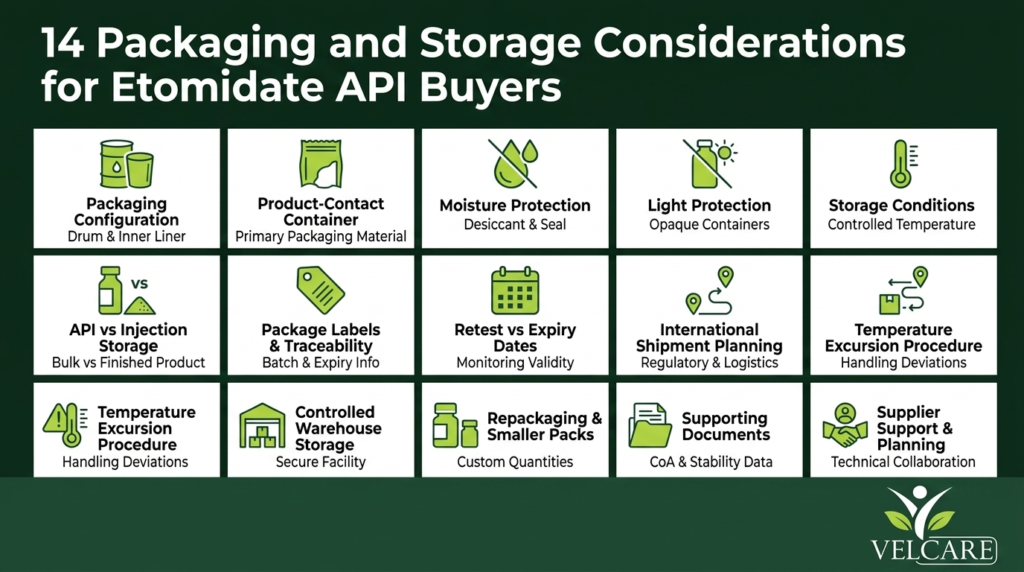
1. Confirm the Supplier’s Standard Packaging Configuration
Request the complete packaging configuration before approving the quotation. The outer drum is only one component. In many configurations, the product-contact package is an inner bag or liner, while the drum provides mechanical, environmental, and transport protection.
The quotation or technical package should identify:
- The material that directly contacts the etomidate API
- The number and arrangement of inner liners
- The liner thickness or material specification, where disclosed
- Whether each liner is independently heat-sealed, tied, clipped, or otherwise closed
- The secondary protective layer, if used
- The outer container material
- The net API weight per package
- Tamper-evident seals or numbered security features
- Any inert-gas purging or controlled-atmosphere sealing
- Desiccant use, where supported
- Whether the package is intended for one-time use
- Packaging differences between commercial and smaller quantities
2. Evaluate the Product-Contact Container and Inner Liner
The most important packaging component is the one touching the API. Its suitability cannot be established from the outer drum description or from a general statement that the liner is “pharmaceutical grade.”
Procurement and quality teams should request the exact polymer, film, or container material and determine whether it is controlled under an approved packaging-material specification. The supplier should also disclose whether the contact material or sealing method has changed since the relevant stability batches were placed on study.
The technical assessment should consider:
- Chemical compatibility: The contact material should not react with the API, promote degradation, or introduce substances that cause the batch to exceed its specification.
- Moisture and gas permeability: Plastic films provide different barrier performance depending on polymer type, thickness, construction, seal quality, and storage duration.
- Extractables and leachables risk: A detailed study is not automatically required for every dry API package. However, the risk should be considered when the material composition, storage duration, contact area, or processing conditions make migration technically relevant.
- Particle shedding and cleanliness: Liners, closures, ties, and sealing operations should not introduce visible or subvisible foreign material.
- Static behavior: Powder handling can generate static charge. The packaging and dispensing arrangement should be compatible with the buyer’s occupational safety and material-transfer controls.
- Seal integrity: A double-liner configuration provides limited benefit if only the outer liner is securely closed or if the inner closure can reopen during handling.
- Dispensing suitability: The package should allow controlled sampling and transfer without unnecessary exposure, liner tearing, or contamination of the remaining material.
3. Determine Whether Moisture Protection Is Adequate
Moisture protection should be based on etomidate API data rather than the assumption that every powdered API needs a desiccant or double liner.
The supplier’s package assessment should be supported by relevant information such as:
- Hygroscopicity or moisture-sensitivity data
- Water content or loss-on-drying specification
- Moisture-related stability trends
- Barrier properties of the proposed liner system
- Seal configuration
- Post-opening storage instructions
- Maximum acceptable exposure during sampling or dispensing
- Recommended handling humidity, where necessary
4. Assess Light-Protection Requirements
A general instruction to “protect from light” is incomplete unless the supplier can explain what exposure is being controlled and which packaging component provides the barrier.
The assessment should determine:
- Whether etomidate API has been evaluated through photostability or related stress studies
- Whether the product-contact liner is transparent, translucent, or opaque
- Whether light protection depends on the outer drum
- Whether the API must remain in its original package
- Whether sampling and retained-sample containers require light protection
- Whether clear internal containers are acceptable
- Whether exposure limits apply during dispensing, weighing, or laboratory testing
5. Verify Stability-Supported Storage Conditions
The storage statement should be specific enough for warehouse personnel to implement and for the quality unit to investigate a deviation. Terms such as “ambient conditions,” “normal temperature,” or “store in a cool place” do not provide an adequate operating range.
Obtain written confirmation of:
- The recommended storage temperature
- The permitted temperature range
- Any short-term excursion limits supported by data
- Whether refrigeration is required, permitted, or prohibited
- Whether freezing must be prevented
- Humidity or dry-storage controls
- Light-protection requirements
- Whether the container must remain tightly closed
- Conditions after first opening
- Storage requirements for retained samples
- Any reduced in-use period after opening or repacking
A buyer should not assign a universal storage temperature to etomidate API by copying a public drug label, another supplier’s specification, or a finished-product monograph. The approved instruction should apply to the specific drug substance, manufacturing process, packaging configuration, and stability dataset being supplied
6. Separate API Storage From Finished Injection Storage
Etomidate API and etomidate injection are not interchangeable materials for storage purposes.
Etomidate API is the unformulated drug substance used to manufacture a medicinal product. Etomidate injection is a sterile finished dosage form containing etomidate in a formulated solution and enclosed in a finished-product vial and closure system. Its excipients, water content, manufacturing process, microbiological requirements, and packaging are different.
Current United States labeling for etomidate injection describes a sterile, nonpyrogenic solution containing propylene glycol and provides storage instructions for that formulated vial. Those instructions do not establish the storage condition for bulk etomidate API.
For the API, procurement and quality personnel should rely on the API manufacturer’s:
- Approved drug substance specification
- Package label
- Stability-supported storage statement
- Container closure description
- Retest or expiry dating
- Shipping and handling instructions
This distinction is particularly important when procurement teams use public injection labels to fill missing supplier information. ICH Q7 defines an API as a substance intended for use in manufacturing a drug product, while a drug product is the final dosage form in its immediate marketing package.
7. Review Package Labels and Traceability
Every package should carry clear, durable identification that can be reconciled with the certificate of analysis, packing list, invoice, and shipping documents.
The purchase specification should define the expected label content, including:
- Material name
- Grade or specification claimed, where applicable
- Manufacturer name and address
- Manufacturing site or traceable site reference
- Batch or lot number
- Net contents
- Manufacturing date, where provided
- Retest date or expiry date
- Required storage conditions
- Container number when one batch is divided across several packages
- Special transport or handling instructions
- Supplier or distributor identity when different from the original manufacturer
- Tamper-evident seal or security reference, where used
ICH Q7 recommends that API labels identify the material, batch number, and critical storage conditions. For material transferred outside the manufacturer’s control, it also identifies the manufacturer’s name and address, quantity, special transport conditions, applicable dating, and controls that alert the recipient if a seal has been breached or is missing.
8. Understand Retest Dates, Expiry Dates, and Remaining Usable Period
A retest date and an expiry date create different controls.
A retest date is the date after which the drug substance should be examined to confirm that it still complies with its specification and remains suitable for use. Passing the original retest date does not automatically prove that the material has degraded, but the batch should not continue through normal use without the required retesting, quality review, and documented disposition.
An expiry date identifies the period during which the API is expected to remain within its established shelf-life specification when stored under defined conditions. ICH Q7 states that the API should not be used after that assigned date. ICH Q7 also notes that a retest date, rather than an expiry date, is common practice for APIs.
Before issuing a purchase order, confirm:
- Whether the assigned date is a retest date or an expiry date
- How the date is calculated
- The remaining period at the planned delivery date
- The remaining period after customs clearance, testing, and release
- Whether the assigned period is supported by the proposed commercial package
- Which tests are required at retest
- Who is authorized to assign or extend the date
- Whether an extension applies to the entire batch or only the tested portion
- Whether repackaging changes the assigned dating
9. Plan International Shipment to the United States
The shipment plan should protect the API under the conditions reasonably expected along the selected route. Risks may arise during inland transport, airport or port holding, cargo consolidation, customs inspection, and delivery to the buyer’s warehouse.
Relevant route risks include:
- High temperatures inside parked vehicles or freight containers
- Winter freezing exposure
- High humidity or water ingress
- Extended customs or carrier delays
- Drum deformation or puncture
- Liner damage caused by rough handling
- Loss or abrasion of labels
- Broken security seals
- Incorrect container orientation
- Consolidation with cargo that creates contamination or odor risk
10. Establish a Temperature Excursion Procedure
The buyer should have a written procedure before the shipment arrives. A damaged drum or temperature excursion should not be released through normal receiving simply because the API still appears acceptable.
The initial response should include:
- Place the affected shipment or package under quarantine.
- Preserve logger files, shipping records, photographs, seal numbers, and carrier information.
- Record the highest and lowest temperatures, duration, timing, and location of the excursion.
- Inspect the drum, closure, liner, labels, and evidence of water ingress.
- Determine whether the container was opened or exposed during customs inspection.
- Compare the event with the approved storage range and any supported excursion allowance.
- Obtain a documented technical assessment from the API manufacturer where needed.
- Decide whether sampling or additional testing can meaningfully address the identified risk.
- Document the quality unit’s release, rejection, or other disposition decision.
11. Store the API Under Controlled Warehouse Procedures
After receipt, etomidate API should remain under controlled material-management procedures until use.
The warehouse system should provide:
- Quarantine status pending sampling, testing, and release
- Physical or electronic segregation of released, rejected, returned, and damaged material
- Monitoring of required temperature and humidity conditions
- Defined alarm limits and investigation procedures
- Protection from direct sunlight, water, pests, and contamination
- Storage of drums and bags off the floor
- Restricted access
- Traceability by batch and individual container
- Monitoring of retest and expiry dates
- Controlled stock rotation
- Review and retention of environmental records
- A procedure for partially used containers
- Immediate segregation of damaged packages
12. Evaluate Repackaging and Smaller Pack Sizes
A request for a smaller quantity can change the container closure system, not only the unit price.
Repackaging may introduce:
- A different contact material
- A different seal
- Greater surface-area-to-volume ratio
- More headspace
- Increased moisture or oxygen exposure
- Additional manual handling
- Contamination or cross-contamination risk
- Loss of the original tamper-evident seal
- Labeling and traceability errors
- Insufficient stability support for the new container
- An uncertain effect on the original retest period
Unqualified repacking should not be accepted merely to reach a low minimum order quantity. Where possible, obtain the required smaller quantity in a manufacturer-defined package that is covered by the appropriate packaging and stability assessment.
13. Request Documents That Support Packaging and Storage Claims
Packaging and storage statements should be traceable to controlled documentation. A COA confirms batch testing, but it does not by itself establish the suitability of the liner, shipping route, or storage period.
The document package should be selected according to the transaction and technical risk.
Batch and Material Documents
- Current API specification
- Batch-specific certificate of analysis
- Safety data sheet
- Representative or batch-specific package label
Packaging Documents
- Packaging specification
- Container closure description
- Product-contact material identification
- Liner and closure configuration
- Evidence supporting alternative pack sizes
- Relevant packaging-material qualification summary, where available
Stability and Storage Documents
- Approved storage statement
- Stability summary
- Retest-period or expiry-period justification
- Moisture-sensitivity information
- Photostability information, where relevant
- Post-opening or dispensing instructions
Shipment and Quality Documents
- Shipping-condition statement
- Temperature-monitoring instructions, where applicable
- Excursion-assessment procedure
- Change-notification commitment
- Procedure for damaged, breached, or wet packages
14. How Velcare Pharma Supports Packaging and Storage Planning
When requesting etomidate API from Velcare Pharma, buyers should provide the required quantity, destination, expected delivery schedule, preferred pack size, required remaining retest period, and any route-specific monitoring requirements.
The quotation and technical review can then define the proposed pack size, container configuration, storage instructions, labeling, batch documentation, and handling of smaller-pack requests before order confirmation. Packaging changes, shipment damage, or temperature excursions should be routed through the appropriate quality contact for documented assessment rather than resolved only through commercial correspondence.
Velcare’s website lists COAs, SDSs, stability information, and technical documentation among the forms of support available for API inquiries. Buyers should state the exact documents required for qualification, import planning, receipt, and batch release when submitting the request.
Frequently Asked Questions
Does Etomidate API Require Refrigerated Storage?
Refrigeration should not be assumed. Use the storage condition stated by the specific API manufacturer and supported by stability data for the supplied container closure system. Finished etomidate injection labeling should not be applied to bulk etomidate API.
Can Etomidate API Be Repacked Into Smaller Containers?
It can be repacked only under appropriate quality and environmental controls. The new contact material and closure must be suitable, batch identity must remain traceable, and the effect on stability and retest dating must be assessed. When the container type changes, ICH Q7 recommends stability support for the repacked configuration.
Should Every International Shipment Include a Temperature Logger?
Not necessarily. The decision should consider the approved storage range, shipment route, season, transit duration, possible customs delays, packaging performance, and available route history. A logger becomes more important when an undocumented excursion would prevent the quality unit from making a defensible disposition decision.
What Should a Buyer Do After a Temperature Excursion?
Keep the shipment under quarantine. Secure the logger data and shipping records, document the duration and temperature range, inspect the packaging, and assess the event against stability information for the supplied API and container closure. Release or rejection should be documented by the quality unit after the technical assessment, not decided from appearance or assay results alone.