An Etomidate quotation can match the required assay, quantity and lead time while the proposed source remains unsuitable for pharmaceutical use. Supplier qualification establishes whether the named manufacturing site can repeatedly supply material that meets the pharmaceutical company’s approved requirements and whether the associated quality information can support the intended market.
The review normally covers the manufacturer’s identity, quality system, process and impurity controls, batch data, regulatory support, change management and continuity of supply. Its depth changes with the use of the material. A laboratory sample for early formulation work does not call for the same evidence as an API source proposed for process validation or commercial manufacture.
This article follows the usual sequence from initial screening to post-approval monitoring. Companies evaluating Etomidate API can also submit a request to Velcare Pharma for available qualification documents, a traceable sample or a commercial quotation, subject to the scope of the request and any confidentiality arrangements.
Quick Answer
Pharmaceutical companies usually qualify an Etomidate API source through the following gates:
| Stage | Qualification gate | What the company establishes |
| 1 | Material definition | Fix the grade, specification, intended dosage form, target market and procurement stage. |
| 2 | Source verification | Identify the legal seller, original manufacturer, manufacturing site and every site that tests, packs or stores the API. |
| 3 | Compliance screening | Review inspection evidence, licenses, regulatory filings and the supplier’s quality-system information. |
| 4 | Technical review | Compare the API specification, analytical methods, impurity controls, stability data and packaging system with the drug-product requirements. |
| 5 | Material evaluation | Test traceable samples and representative batches, then assess their performance in the intended formulation or process. |
| 6 | Audit | Examine the manufacturing and laboratory controls at a depth set by quality risk. |
| 7 | Formal approval | Resolve findings, assign an approval status and define quality responsibilities and change notification. |
| 8 | Lifecycle monitoring | Trend batch quality, deviations, changes, complaints and delivery performance after approval. |
What does Etomidate API Supplier Qualification Mean?
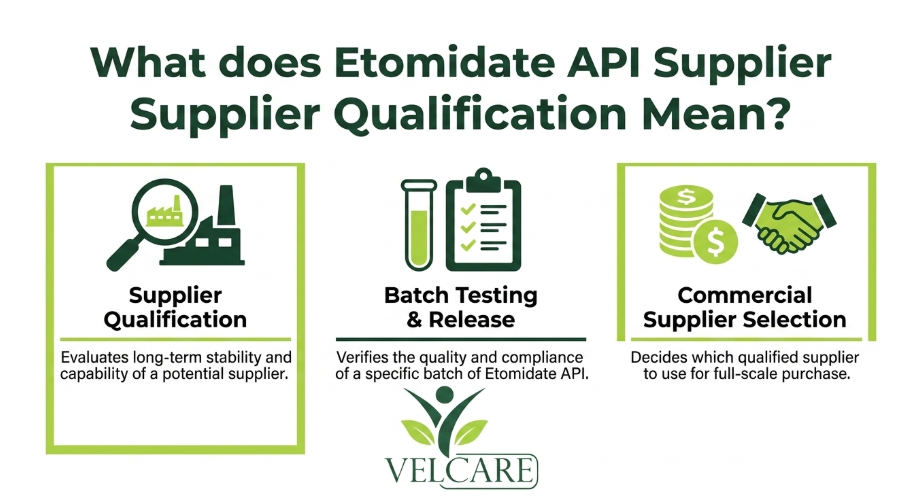
Supplier qualification is the documented evaluation used to decide whether a supplier and a named manufacturing site are acceptable for a defined Etomidate API requirement. The decision belongs within the pharmaceutical company’s quality system. It is normally supported by Quality Assurance, Quality Control, Regulatory Affairs, Technical Operations, Procurement and Supply Chain, with each function reviewing a different part of the risk.
| Activity | Decision being made |
| Supplier qualification | Evaluates the supplier and the specific site for a defined material, use and market. |
| Batch testing and release | Determines whether one received lot meets the approved specification and may enter manufacturing. |
| Commercial supplier selection | Compares price, quantity, payment terms, lead time and contractual conditions. |
The following are some ways to qualify an Etomidate API supplier:
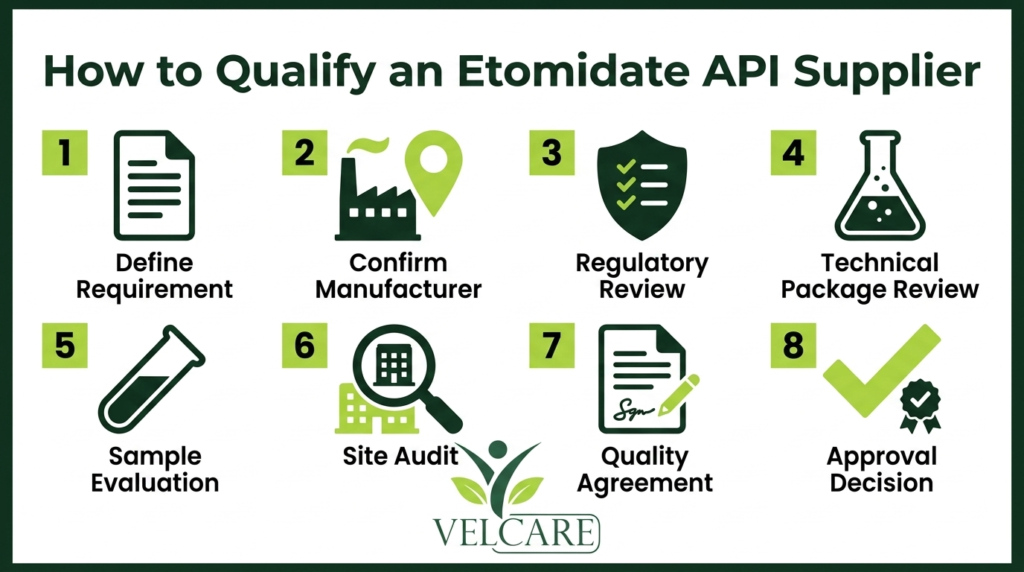
1. Define the Etomidate API Requirement
Qualification begins with a written material requirement. Without it, the review can only establish that a supplier has a functioning quality system; it cannot establish suitability for the buyer’s product.
The material record normally identifies Etomidate, CAS 33125-97-2, the applicable pharmacopoeial or in-house specification, intended dosage form, route of administration, target regulatory market and stage of use. It also records the required batch size or order quantity, estimated annual demand, packaging configuration and any process-relevant physical attributes.
Etomidate is a chiral small-molecule drug substance used in an intravenous dosage form. The customer specification may therefore need controls beyond assay and general related substances. Depending on the registered formulation and manufacturing process, the review may include stereochemical identity or enantiomeric purity, specified and unspecified impurities, residual solvents, elemental impurities, water, particle-size distribution, microbial quality or endotoxins. A test belongs in the specification because it controls a product or process risk, not because it appears in a generic supplier list.
Development, validation and commercial material should be identified separately. A development lot may support initial compatibility work, but process validation normally requires material that represents the proposed commercial process and site. The qualification plan should state when that transition occurs and what new evidence is needed.
2. Confirm the Manufacturer and Supply Chain
The name on the quotation may be the manufacturer, an authorized distributor, an exporter or another commercial entity. The buyer needs the complete legal name and address of the original manufacturing site, plus the identity and function of any separate testing, micronization, packaging, relabeling, storage or release site.
This mapping is part of batch traceability. ICH Q7 states that parties distributing APIs should retain the identity and address of the original manufacturer, purchase and transport records, the manufacturer’s batch number, authentic certificates of analysis and the retest or expiry date. The same source also calls for complete traceability when agents, brokers, traders, distributors, repackers or relabelers are involved.
The company then reconciles the site information across the quality questionnaire, certificate of analysis, manufacturing authorization, regulatory filing, audit report and commercial documents. Different addresses may be legitimate when manufacturing, testing and release occur at separate facilities. Unexplained differences require resolution before approval because the company cannot qualify an unidentified operation.
The review should also establish whether the batch supplied for evaluation was produced at the same site and under the same process proposed for future supply. A sample taken from unrelated stock or a nonrepresentative development process provides little evidence about commercial consistency.
3. Conduct the Initial Regulatory and Compliance Review
The preliminary screen determines whether the source merits a full technical review and audit. The usual request includes manufacturing authorizations, available GMP inspection evidence, the supplier’s quality questionnaire, a summary of inspection history and responses to significant observations, and information on recalls or other material compliance actions.
For a source intended to support a U.S. application, Regulatory Affairs also confirms the status and ownership of any Type II API drug master file and whether the holder can authorize the applicant to reference it. FDA explains that drug master files are optional confidential submissions. FDA neither approves nor disapproves a DMF; it reviews the technical content when an application references the file. A DMF number is therefore supporting regulatory infrastructure, not proof that the supplier or API has passed qualification.
Public checks can include FDA’s Inspection Classification Database, warning letters, recalls, import alerts and other market-specific authority records. Results must be matched to the exact legal entity and facility. A clean search does not replace supplier evidence or an audit because public databases differ in scope and reporting delay.
A GMP certificate, inspection classification or regulatory filing is one piece of evidence. The company still needs to determine whether it covers the correct site, activity and period and whether any observations affect Etomidate manufacture or testing.
4. Review the Etomidate API Technical Package
The technical package is compared with the customer’s drug-substance and drug-product requirements. The supplier specification is the starting document. It is not automatically adopted as the customer specification.
Specification and Analytical Control
Quality Control reviews the current specification, a representative certificate of analysis, analytical methods and available method-validation or verification information. The review covers identification, assay, individual and total related substances, chiral control where relevant, water or loss on drying, residual solvents, elemental impurities and any physical or microbiological attribute included in the proposed material standard.
ICH Q7 states that an API certificate of analysis should list each test performed under compendial or customer requirements, its acceptance limit and the numerical result when the test is quantitative. A company assessing a supplier COA can use the same structure to check whether the document is batch-specific and complete. Velcare’s separate guide on reading an Etomidate certificate of analysis covers the document-level checks in more detail.
Process Knowledge and Impurity Control
The package should describe the manufacturing process at a level that permits a scientific assessment without requiring disclosure outside the applicable confidentiality arrangement. Reviewers examine the control strategy, starting-material rationale, potential carryover, reprocessing or rework policy and the origin and control of observed impurities.
The impurity assessment usually covers organic process impurities and degradation products, residual solvents, catalysts or other elemental impurities, and potential mutagenic impurities. A nitrosamine assessment is requested when the process, materials, recovered solvents, packaging or degradation pathway presents a credible formation or contamination route.
FDA’s 2024 nitrosamine guidance addresses risk assessment, confirmatory testing and controls for both small-molecule nitrosamines and nitrosamine drug-substance-related impurities. The useful qualification evidence is the process-specific rationale and supporting data. A generic declaration with no connection to the actual Etomidate process cannot answer that assessment.
Stability, Reference Standards and Packaging
Stability data should support the proposed retest period and labeled storage conditions in the intended market container. Reviewers also confirm the reference-standard system, batch-numbering convention, retention-sample practice and the packaging materials that contact the API. If the supplied pack differs from the pack used in stability studies, the supplier needs a technical basis for the claimed retest period.
Transport requirements are part of this review. The distribution route, seasonal exposure and use of liners, drums, seals or temperature controls are checked against the API’s stated storage conditions. Qualification is incomplete when the API is controlled at the factory but its quality cannot be maintained through delivery.
5. Evaluate Samples and Representative Batches
The laboratory evaluation starts with a sample tied to a named manufacturing site, production batch and authentic certificate of analysis. Sampling history and container closure should be known. Anonymous material or a sample relabeled by an intermediary cannot establish the required chain of identity.
The customer confirms identity and tests the material against its proposed specification. Results are compared with the supplier COA, with attention to analytical bias, impurity pattern and any physical properties that affect the intended formulation. Method differences need to be understood before a numerical discrepancy is treated as batch variability.
Formulation and process studies answer a separate question: whether the API behaves acceptably in the customer’s operation. For an injectable product, this work may include solubility, filtration behavior, hold-time compatibility, solution stability and the effect of particle characteristics on dissolution or processing. The exact study set comes from the formulation and control strategy.
6. Perform a Risk-Based Manufacturing-Site Audit
The audit tests whether the documented system operates at the site. Its format can be on-site, remote or based partly on a qualified third-party report. The choice depends on the intended use, process knowledge, site history, regulatory evidence, supply-chain complexity and the company’s audit procedure. A recent third-party report is useful only when its scope covers the correct site and relevant operations and the company can assess the auditor’s competence and findings.
For Etomidate, the audit may trace a selected batch from receipt of starting materials through synthesis, purification, drying, milling, packaging, testing and release. Auditors examine quality-unit authority, data governance, material status controls, equipment qualification, maintenance, cleaning, contamination controls, laboratory records, reference standards, deviation and out-of-specification investigations, CAPA, change control, validation, stability, complaints and recall readiness.
Data integrity is assessed through records and system use, rather than policy statements alone. The auditor may compare chromatographic sequences, audit trails, raw data, calculations, sample logs, equipment records and the final COA for the same batch. Gaps between these records can indicate weak traceability or undocumented testing practices.
Audit observations are classified under the company’s procedure. The supplier’s response should identify the cause, correction, preventive action, owner and completion date and should include evidence when actions are closed. Approval may be deferred, limited or made conditional while noncritical actions remain open. Findings that call the identity, integrity or state of control of the material into question normally require resolution before use.
7. Establish the Quality Agreement
The quality agreement records how the parties will manage GMP and product-quality responsibilities during supply. It normally identifies the approved Etomidate specification and site, batch documents, testing and release responsibilities, record retention, deviation and out-of-specification communication, complaint and recall support, sample retention, audit rights, subcontracting controls and the exchange of annual product-quality information.
Change notification needs operational detail. The agreement should identify which changes require notice, who receives it, what supporting package is supplied and whether customer assessment or approval is required before implementation. ICH Q7 calls for dosage-form manufacturers to be notified of established production or process-control changes that can affect API quality. The customer then assesses the regulatory and technical impact under its own change-control procedure.
The quality agreement is separate from the purchase contract, quotation and confidentiality agreement. Commercial documents govern price, quantities, payment, delivery and liability. The confidentiality agreement governs protected information. The quality agreement assigns technical and quality responsibilities. Cross-references can be used, but one document should not leave the responsibilities of another undefined.
8. Make and Document the Approval Decision
The approval record brings together the compliance screen, technical-document review, laboratory and formulation results, audit report, CAPA status, regulatory assessment and supply-risk review. Each unresolved item is assigned a disposition rather than being left in correspondence.
A company may classify the source as approved, conditionally approved, approved for development use only, pending further evidence or rejected. The status should identify the legal supplier, original manufacturer, manufacturing site, material code or specification, permitted stage of use, effective date, restrictions and requalification date or trigger.
Conditional approval needs a defined condition. Examples include completion of a noncritical CAPA, receipt of data from the first commercial-scale batch or an increased incoming-testing plan. A vague conditional status creates uncertainty at purchase and batch release.
Quality-unit authorization is recorded in the approved-supplier system or equivalent controlled record. Procurement controls should prevent purchase from an unapproved source or site once the material moves into the stage governed by the qualification procedure.
9. Monitor the Etomidate API Supplier After Approval
Qualification continues after the first order. Each received lot is checked against the approved supplier, site, specification, packaging and required documents. Quality Control trends assay, related substances, chiral purity and other defined critical attributes so gradual shifts can be identified before they become specification failures.
The supplier-performance record may include deviations, atypical or out-of-specification results, rejected lots, complaints, documentation errors, change notifications, CAPA timeliness and delivery performance. The company also checks current manufacturing authorization and available inspection or compliance information at intervals set by its procedure.
ICH Q9(R1) places supplier oversight within product-lifecycle quality risk management and calls for monitoring suited to supply-chain partner performance. When material quality or supplier service shows substantial variability, the guideline supports increased review and monitoring.
Periodic or for-cause audits, confirmation of supplier-COA reliability and formal requalification are scheduled according to risk. A process change, site transfer, new impurity, repeated deviation, regulatory action, ownership change or prolonged supply interruption can trigger review before the routine requalification date. The possible outcomes include continued approval, added controls, restricted use, suspension or removal from the approved-supplier list.
What Suppliers Can Do to Support Qualification?
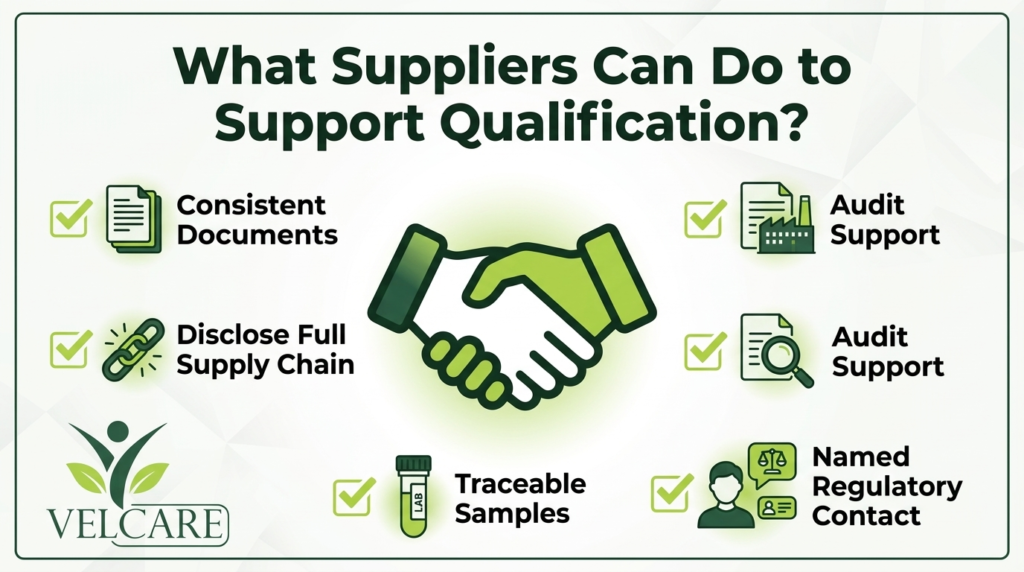
A supplier can shorten avoidable review cycles by issuing current documents that agree on the legal entity, site, specification, batch and retest period. The original manufacturer and every material-handling site should be disclosed at the start, especially when the commercial contact is a distributor or exporter.
Samples should be traceable to representative production batches and accompanied by authentic COAs. Technical questionnaires need complete, internally reviewed answers. When information is confidential, the parties can define a controlled disclosure route instead of substituting a generic statement for the required evidence.
Audit support includes access to the relevant operations and records, prompt responses to observations and CAPA packages that show what changed. Proposed changes should be communicated through the agreed route before implementation when customer review is required. A named regulatory and quality contact also prevents questions from being split across unconnected commercial correspondence.
Document availability helps the customer perform the assessment. It does not determine the outcome; approval remains the pharmaceutical company’s decision under its product requirements and quality system.
Request Etomidate API Qualification Information
Pharmaceutical companies can contact Velcare Pharma with the required Etomidate specification, target market, procurement stage, evaluation quantity and expected commercial demand. This information allows the request for available technical documents, representative samples and commercial terms to be scoped to the proposed use and applicable confidentiality arrangements.
Disclaimer
Qualification requirements vary by company procedure, intended drug product, procurement stage, target market and quality-risk assessment. This general information does not replace the buyer’s supplier-management procedure, product-specific regulatory assessment or applicable requirements.