An Etomidate API supplier should be screened before pricing discussions begin. The initial review needs to confirm the company’s legal identity, its role in the supply chain, the actual manufacturing site and its ability to provide traceable product documentation.
This matters because a credible-looking website or GMP certificate may not identify the company that manufactures the material. An intermediary may quote Etomidate without disclosing the original site, while certificates, bank details and regulatory records may refer to different legal entities. These gaps make it difficult to determine what material is being offered and whether it can support the buyer’s intended market.
A structured preliminary review helps procurement, quality and regulatory teams identify such discrepancies before spending time on samples, negotiations or formal supplier qualification. The following checks provide a practical basis for deciding whether a supplier is ready to receive an RFQ.
Direct Answer
Before sending an Etomidate API RFQ:
- Verify the supplier’s registered identity, physical address and official communication channels.
- Identify the original manufacturer and establish the role of every intermediary in the supply chain.
- Check regulatory and inspection records through official databases rather than relying only on supplier-issued certificates.
- Review preliminary Etomidate documentation and record every unresolved discrepancy before requesting commercial terms.
Why Verify a Supplier Before Requesting a Quote?
An API quotation has limited value if the buyer does not know who manufactures the offered material. Price, MOQ and lead time relate to a specific source, site, process, specification and supply route. If any of those elements remain unclear, quotations from different companies may not represent technically comparable material.
Early verification also prevents procurement from advancing an offer that quality or regulatory personnel will later reject. Common causes include an unsupported manufacturing site, an unsuitable specification, incomplete supply-chain traceability or a regulatory filing that does not cover the proposed source.
The screening process should therefore answer three questions:
- Does the company exist under the identity it has provided?
- Can the offered Etomidate be traced to an identifiable manufacturing site?
- Is sufficient evidence available to justify further commercial and technical evaluation?
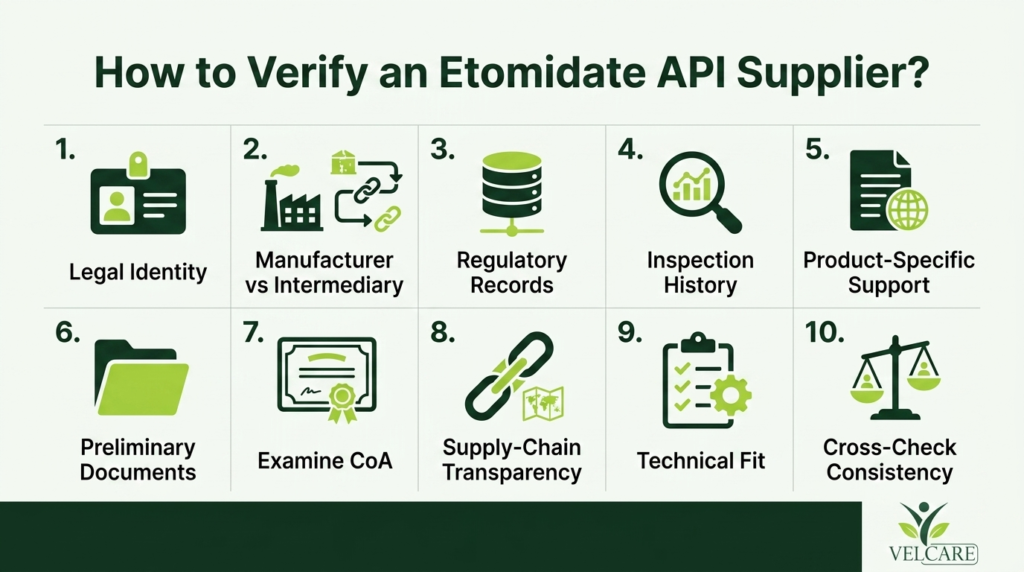
How to Verify an Etomidate API Supplier?
Step 1: Confirm the Supplier’s Legal Identity
Obtain the company’s complete registered name, registration number, registered address, operating address, website domain and official contact details. A trading name alone is insufficient because contracts, invoices and payments normally refer to the underlying legal entity.
Compare these details across the available records:
| Record | Information to Compare |
| Business licence or incorporation record | Registered name, number and address |
| GMP or manufacturing document | Licensed entity and facility address |
| Quotation or pro forma invoice | Contracting entity and registered office |
| Email and website | Corporate domain and published contact details |
| Banking information, if provided | Account beneficiary and receiving jurisdiction |
Step 2: Establish Whether the Company Is the Manufacturer or an Intermediary
Ask the company to define its role in writing. It may be the original manufacturer, an authorized distributor, an exporter, a sales agent or an independent trader.
The response should identify:
- The name and address of the Etomidate manufacturing site
- The company responsible for batch manufacture
- The laboratory performing release testing
- The entity authorizing batch release
- The location used for storage and dispatch
- The exporter named on shipment documents
Where an intermediary is involved, obtain authorization or another verifiable record connecting it to the manufacturer. Also confirm whether it can provide manufacturer-issued specifications, CoAs, stability information and regulatory support without removing the manufacturer’s identity.
The distinction affects document access, change notification and traceability—not only price. A more detailed comparison is available in Etomidate API Manufacturer vs. Supplier: Why the Distinction Matters.
Step 3: Check Regulatory Records Independently
Supplier-provided certificates should be checked against official databases applicable to the destination market. Search by both legal entity and manufacturing-site address, as similar company names can produce misleading matches.
For EU-related sourcing, the public EudraGMDP database provides access to manufacturing and import authorizations, GMP certificates and statements of non-compliance. The record’s activities, dosage-form or substance scope, facility address and inspection date need to correspond with the proposed Etomidate source.
For material intended for the United States, useful FDA resources include:
- Drug Establishments Current Registration Site
- Inspection Classification Database
- FDA Warning Letters
- FDA Import Alerts
Search results need to match the actual facility, not merely a sales office or related company. The absence of a public record also requires context because database coverage, disclosure and registration obligations differ by activity and market.
FDA establishment registration should not be described as approval. The FDA states that registration, drug listing or assignment of a registration number does not denote approval of the company or its products. Claims such as “FDA-approved API” therefore require more than a registration entry. See the FDA’s Electronic Drug Registration and Listing Instructions.
Step 4: Review Inspection and Compliance History
Regulatory history needs to be assessed by facility, activity and date. A record concerning a different site or product category should not automatically be attributed to the proposed Etomidate source.
Review publicly available information for:
- Warning letters
- Import alerts
- GMP non-compliance statements
- Final FDA inspection classifications
- Related compliance or enforcement actions
- Close-out letters or updated regulatory status
Do not treat every observation as equivalent. An old finding followed by documented corrective action has a different significance from an active import alert or unresolved GMP non-compliance statement.
Where a relevant record exists, ask the supplier for a written explanation covering the affected operation, corrective and preventive actions, current status and any impact on Etomidate manufacture. The supplier’s transparency also matters. A disclosed and adequately addressed issue can be assessed; an action omitted from the supplier’s compliance declaration raises an additional credibility concern.
Step 5: Confirm Product-Specific Regulatory Support
A facility-level GMP record does not establish that the supplier can support Etomidate in every market. The next check concerns the product-specific regulatory package.
| Regulatory Item | What the Buyer Needs to Confirm |
| US Drug Master File | DMF type, holder, status, manufacturing site and availability of a Letter of Authorization |
| Active Substance Master File | ASMF holder, covered site and availability of a Letter of Access |
| Certificate of Suitability | Substance, holder, manufacturing sites, current version and validity status |
| Equivalent national filing | Filing owner, authority, scope and right of reference |
Step 6: Request a Preliminary Document Set
The purpose of this stage is to determine whether essential evidence exists. It is not yet a full qualification dossier.
Request the following:
- Current GMP evidence relevant to the proposed site
- Manufacturing licence
- Representative or recent Etomidate CoA
- Current Etomidate specification
- Safety Data Sheet
- Product-origin declaration
- Manufacturing-site declaration
- Retest period and storage conditions
- Regulatory-support statement
- Supply-chain declaration
- Manufacturer authorization, where an intermediary is involved
Documents should be legible, complete and attributable to an issuing organization. Check certificate numbers, issue dates, expiry dates, facility addresses and authorized activities. A document carrying the correct company name but covering only packaging, testing or another substance does not establish the required manufacturing scope.
A separate document-level checklist is provided in Documents to Request from an Etomidate API Supplier.
Step 7: Examine the Etomidate API Certificate of Analysis
Start with batch identity. The CoA should state the product name, batch or lot number, manufacturing date and retest or expiry date. The manufacturer, testing site and person authorizing release should also be identifiable.
Next, compare the reported tests with the buyer’s required pharmacopoeial or approved in-house specification. Depending on the applicable specification and process, the review may cover:
- Description and identification
- Assay
- Related substances
- Residual solvents
- Water content or loss on drying
- Inorganic impurities or residue tests
- Any process-specific impurity controls
- Microbiological controls, if included in the agreed specification
Each reported result needs an acceptance criterion and, where relevant, a referenced analytical method. “Complies” can be appropriate for a qualitative test, but numerical tests should generally show an actual result where the approved reporting format requires one.
Formatting consistency is useful only up to a point. Mechanically identical results across multiple batches, reused batch numbers, unexplained changes in method references or missing release authorization warrant clarification. A representative CoA also does not prove that a future commercial batch will conform; incoming material still requires testing under the buyer’s approved procedure.
For a field-by-field review, see How to Read an Etomidate Certificate of Analysis.
Step 8: Assess Supply-Chain Transparency
Map the proposed route before evaluating commercial terms:
Original manufacturer → authorized intermediary, if any → warehouse or exporter → buyer
Record every organization that will manufacture, test, release, store, repack, relabel or export the API. The original manufacturer’s batch number should remain traceable through the CoA, container labels and shipping documents.
If a repacker or relabeller is involved, establish how original and reassigned batch numbers are linked. Also determine whether the organization operates under an appropriate quality system for the activity it performs.
The supply agreement or preliminary supplier declaration should address notification before changes to:
- The original manufacturer
- The manufacturing or testing site
- The specification
- The packaging configuration
- The storage location
- The distribution route
Step 9: Check Whether the Supplier Can Meet the Intended Requirement
Verification also needs to establish technical and operational fit. A legitimate company may still be unable to supply the required grade, quantity or documentation.
Provide the supplier with a concise requirement profile covering:
| Requirement Area | Point to Confirm |
| Material | Etomidate API grade and required specification |
| Development stage | Sample, analytical, validation or commercial use |
| Quantity | Initial quantity and projected demand |
| Batch support | Typical batch size and batch allocation |
| Documentation | CoA, SDS, regulatory documents and shipment records |
| Packaging | Container type, pack size and tamper evidence |
| Remaining shelf life | Minimum acceptable period at dispatch or receipt |
| Logistics | Destination, Incoterm and export documentation |
| Change control | Notification expectations for material changes |
Step 10: Cross-Check Information for Consistency
Complete a final comparison before releasing the RFQ.
| Information | Records to Compare |
| Legal company name | Registration, quotation, contract and bank details |
| Manufacturing-site name and address | Licence, GMP evidence, CoA and regulatory filing |
| Supplier’s role | Company declaration, authorization and supply-chain map |
| GMP scope | Certificate, official database and proposed activity |
| Etomidate specification | Technical offer, specification and CoA |
| CoA issuer | Manufacturer, testing facility and release site |
| Regulatory filing holder | DMF, ASMF or CEP information |
| Batch manufacturer | CoA, labels and origin declaration |
| Contracting entity | Quotation, invoice and payment instructions |
Red Flags to Identify Before Sending the RFQ
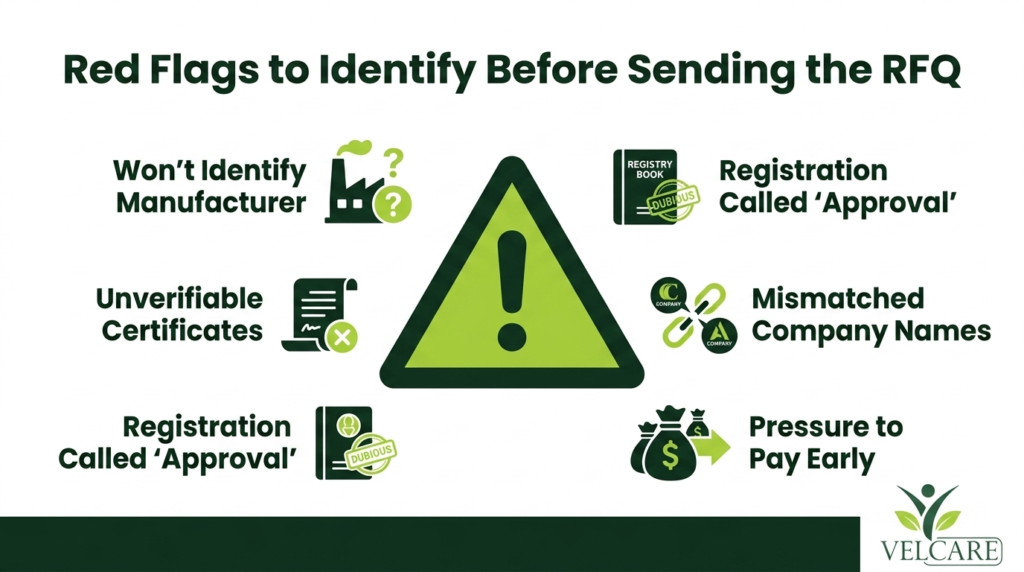
Pause the process if the review identifies any of the following:
- The company refuses to identify the original Etomidate manufacturer.
- GMP evidence belongs to an unrelated facility or does not cover the stated activity.
- A certificate cannot be confirmed with the issuing authority.
- FDA establishment registration is presented as proof of API approval.
- Commercial or quality correspondence uses unverifiable free-email accounts.
- Quotations, certificates and banking instructions contain different company names without an explanation.
- Documents appear altered, incomplete or expired.
- The CoA lacks an identifiable batch, manufacturer or release authorization.
- The stated country of origin or manufacturing site changes during discussions.
- A broker, repacker or warehouse remains undisclosed.
- The supplier pressures the buyer to pay before basic identity and document checks are completed.
Create a Preliminary Verification Record
Keep a short screening record for every candidate source. This makes the decision traceable and prevents procurement, QA and regulatory personnel from repeating the same checks.
| Review Area | Evidence Checked | Suggested Result |
| Legal identity | Registration and contact records | Verified / Clarification Needed / Rejected |
| Supply role | Manufacturer or intermediary declaration | Verified / Clarification Needed / Rejected |
| Manufacturing site | Licence and GMP evidence | Verified / Clarification Needed / Rejected |
| Regulatory history | Official database review | Acceptable / Review Required / Unacceptable |
| Product documentation | CoA, specification and SDS | Available / Incomplete / Unavailable |
| Traceability | Manufacturer and supply-chain evidence | Transparent / Partial / Undisclosed |
Request an Etomidate API Quote
Once the preliminary checks are complete, prepare the RFQ with the required specification, quantity, destination, intended market, packaging expectations and documentation requirements. Include any technical questions identified during screening so that the quotation addresses the actual procurement requirement.
Buyers can submit these details through Velcare Pharma’s Etomidate API quotation request page. For additional product, company and sourcing information, visit the Velcare Pharma homepage.