A Drug Master File (DMF) is a voluntary administrative submission to the United States Food and Drug Administration (FDA) containing confidential chemistry, manufacturing, and controls (CMC) details, but it does not constitute an FDA approval or drug certification.
Authorization to reference a Type II DMF for Etomidate active pharmaceutical ingredient (API) becomes operational only when the holder submits a written Letter of Authorization (LOA) naming the applicant’s submission.
Pharmaceutical procurement teams regularly face supply challenges when commercial quotes state that a USDMF is available, while failing to confirm administrative active status, completeness assessment readiness, facility address alignment, or holder execution of an application-specific LOA. Committing regulatory submission dates to unverified supplier statements exposes drug sponsors to refuse-to-receive decisions and review delays. Drug applicants require a structured four-gate audit covering public database verification, application-route suitability, physical supply chain tracing, and formal lifecycle change agreements.
What a U.S. Drug Master File Does and Does Not Do
The legal framework governing Drug Master Files is established under 21 CFR 314.420. The regulatory function of a DMF is to protect proprietary manufacturing processes and chemical synthesis parameters while allowing a third-party applicant to incorporate that technical information by reference into an Investigational New Drug (IND) application, New Drug Application (NDA), or Abbreviated New Drug Application (ANDA).
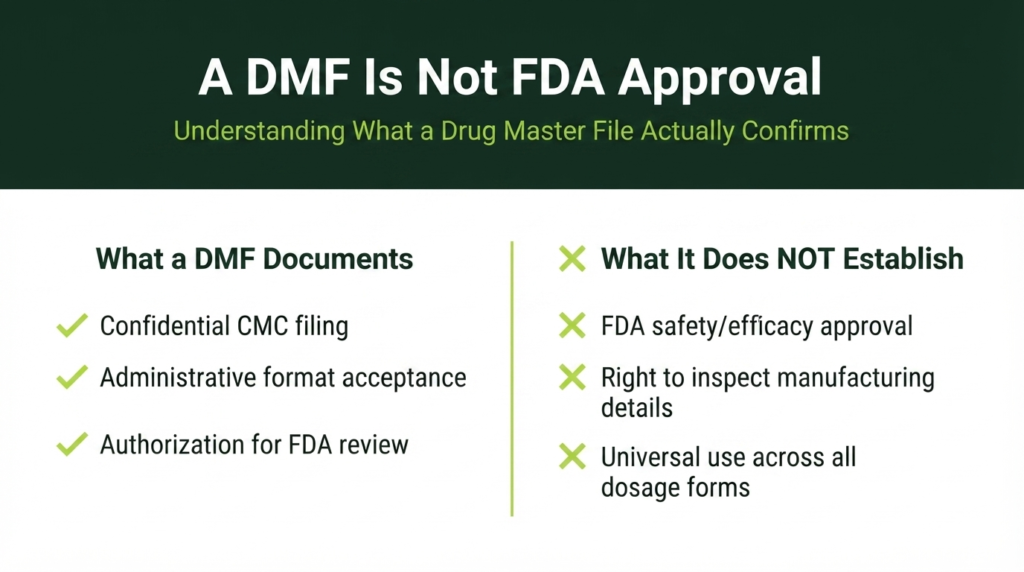
The FDA does not independently review or approve a DMF upon receipt. Technical content within the file is evaluated solely when referenced by a specific drug application submitted under 21 CFR 314 or 21 CFR 312. Describing a DMF as FDA-approved is technically incorrect. Administrative acceptance by the FDA Drug Master File staff confirms format compliance for filing, but does not establish scientific adequacy or commercial drug approval.
| Regulatory Scope | Documented Function | Unsubstantiated Assertion |
| Administrative Status | Filing confidential CMC data under an assigned FDA DMF number | FDA safety, efficacy, or quality approval of the API |
| Authorization | Written permission for FDA to review confidential data for a named applicant | Right of the applicant to inspect confidential synthetic details |
| Technical Review | Evaluation of CMC data within a specific referencing application | Universal acceptance across all dosage forms or delivery routes |
Type II API DMF Classification and Regulatory Pathways
Under 21 CFR 314.420(a)(2), drug substances, drug substance intermediates, and materials used in their preparation are submitted under the Type II DMF category. FDA guidance recommends restricting each Type II API DMF to a single active ingredient produced by a single manufacturing process at specified facilities.
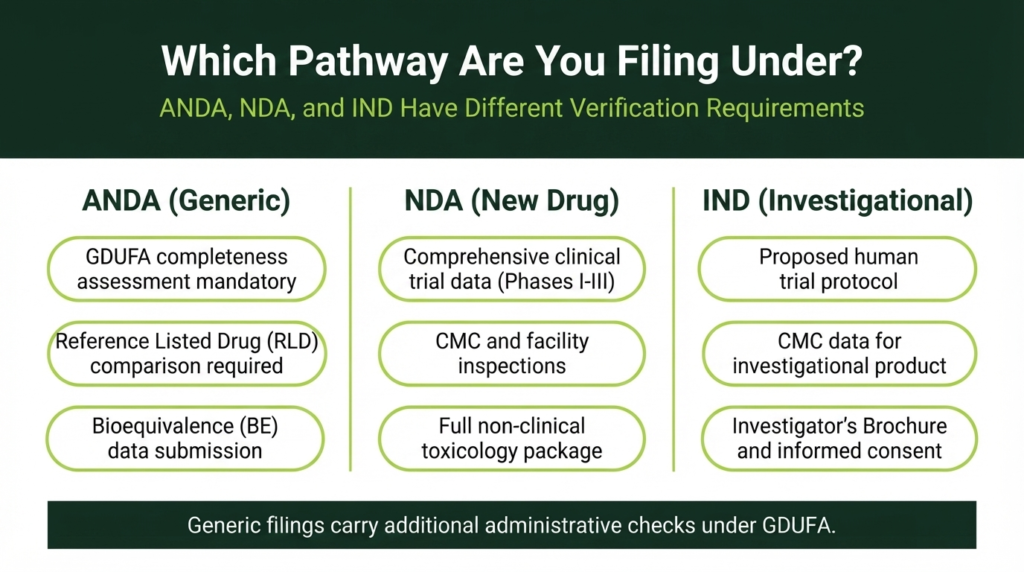
Verification requirements vary based on the intended U.S. regulatory submission route. Generic drug applications subject to Generic Drug User Fee Amendments (GDUFA) standards involve additional administrative checks compared to IND or NDA filings.
| Referencing Pathway | Confidential Reference Allowed | GDUFA Completeness Assessment Required | Primary Pre-Reliance Verification |
| ANDA (Generic Drug) | Yes | Yes, mandatory under GDUFA | Verify active status, Type II available-for-reference entry, and fee payment |
| NDA (New Drug) | Yes | No | Verify active status, LOA scope, and technical fit for dosage form |
| IND (Investigational) | Yes | No | Verify active status, LOA scope, and holder responsiveness to CMC queries |
Primary FDA Record Verification Method
Drug sponsors must verify claimed DMF parameters in official FDA public databases rather than relying on vendor declarations. Verification requires a date-stamped search across primary agency files.
First, quality teams check the FDA Quarterly DMF Activity List to verify administrative identity. The search must match the assigned DMF number, Type II classification, subject title listed as Etomidate, legal holder entity, and Active (A) status. Active status shows the file is administratively maintained, but does not verify readiness for generic application reference.
Second, for generic applications, teams check the FDA Type II API Available for Reference list. Historical records confirm that Etomidate filings, such as DMF 015983 held by Pisgah Labs Inc., entered this database upon fulfilling user fee obligations and completeness checks. If an active DMF is missing from this list, ANDA applicants risk filing refuse-to-receive actions unless fee and technical gaps are resolved.
| Verification Parameter | Primary Data Source | Required Proof |
| Administrative Existence | FDA Quarterly DMF List | Date-stamped search showing Active (“A”) status |
| Generic Reference Status | FDA Available for Reference List | GDUFA completeness assessment clearance |
| Supply Chain Alignment | Supplier Declaration | Written match of site address, process version, and DMF scope |
| Regulatory Authority | Executed Letter of Authorization | Signed LOA specifying applicant and application details |
Letter of Authorization Submission Mechanics
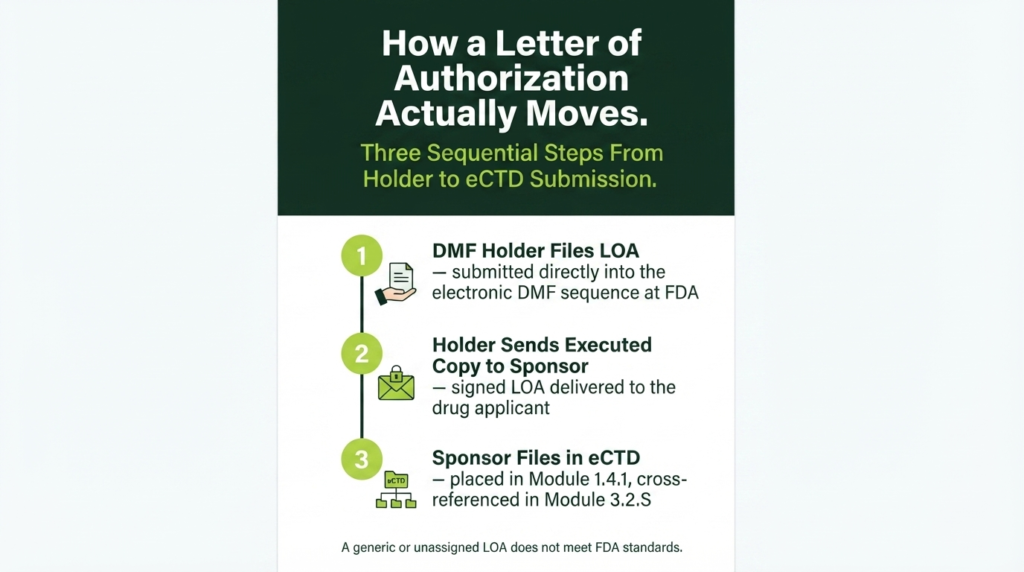
A Letter of Authorization is a formal document under 21 CFR 314.420(b) granting the FDA authorization to review confidential DMF content for a named applicant.
The authorization workflow requires three sequential steps:
- The DMF holder files the official LOA directly into the electronic DMF sequence at the FDA.
- The holder sends an executed copy to the authorized drug sponsor.
- The sponsor places the LOA copy in Module 1.4.1 of its eCTD submission and provides the explicit cross-reference in Module 3.2.S.
Following FDA administrative templates, an LOA must state the date, legal DMF holder name, DMF number, authorized entity legal name and address, covered product scope, specific submission section references, and holder commitment statements. Generic or unassigned authorization letters fail to meet FDA standards. An LOA permits FDA technical evaluation; it does not grant the sponsor access to inspect private manufacturing records contained in the DMF.
Aligning Regulatory Dossiers with Physical Supply Chains
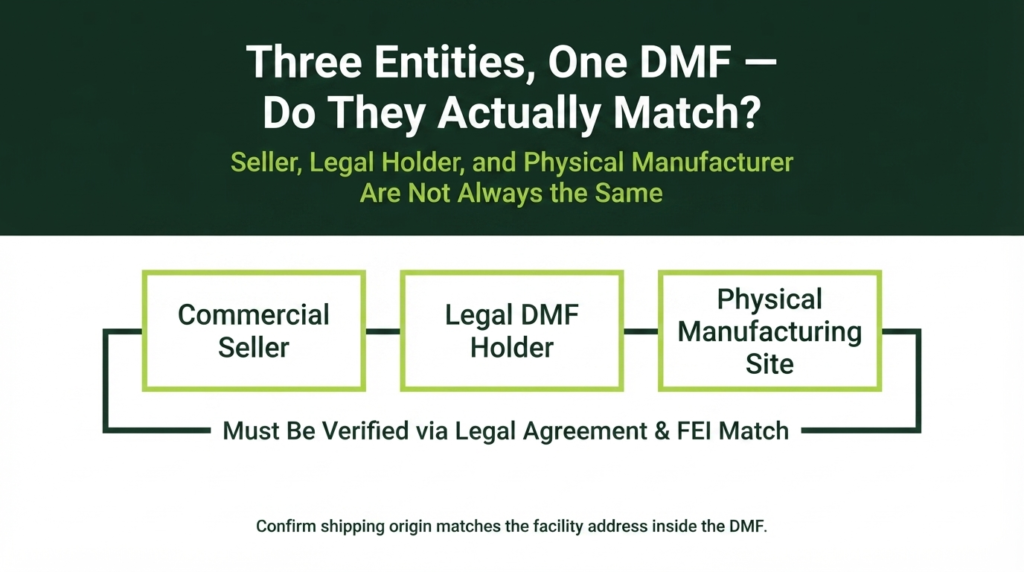
Regulatory verification must align administrative database records with commercial batch production. Pharmaceutical supply chains often separate the commercial vendor, legal DMF holder, and physical manufacturer into distinct corporate entities.
FDA guidelines expect the legal DMF holder to be the API manufacturer. If a sales organization or affiliate holds the dossier, documented legal agreements must establish the manufacturing relationship. The applicant must verify that the physical manufacturing plant address and FDA Establishment Identifier (FEI) listed on commercial offers match the sites documented inside the DMF.
A single Type II DMF covers a specific synthetic process and facility set. If a vendor operates alternate production sites or alters chemical synthesis steps, material from those sources cannot be referenced under the existing file without formal regulatory updates. When sourcing API from export manufacturing sites in India, procurement teams must confirm that physical shipping origin records match the facilities authorized in the DMF submission.
Post-Authorization Lifecycle Management
Obtaining an initial LOA does not conclude regulatory oversight. Maintaining valid reference authorization requires active communication across the commercial life of the drug product.
Under 21 CFR 314.420(c), a DMF holder must notify each authorized party in writing prior to making additions, changes, or deletions to the file. Although annual reports maintain administrative active status under 21 CFR 314.420(d), regulations prohibit using annual reports to report major technical changes. Technical modifications require formal DMF amendments filed directly with the FDA.
Quality agreements must define advance change notification timelines. If a DMF holder alters synthesis routes, transfers ownership, withdraws authorization, or closes the filing under 21 CFR 314.420(d), the sponsor’s application approval status is compromised. Advance notification protocols allow sponsors to evaluate technical impacts and submit necessary application supplements before commercial batch distribution occurs.
Sponsor Pre-Filing Checklist and Sourcing Decision Framework
Before referencing an Etomidate API source in a U.S. filing, regulatory and quality teams should evaluate a 12-point gate checklist.
| Checkpoint | Gate Review Evaluation | Verification Source |
| 1 | What is the exact DMF number, Type II scope, and legal holder name? | FDA Quarterly List Search |
| 2 | Is the DMF active in current FDA database records? | Administrative Status Check |
| 3 | For ANDA applications, is the file listed as Available for Reference? | GDUFA Completeness Database |
| 4 | Which physical manufacturing facility address does the file cover? | Holder Site Declaration |
| 5 | Does the quoted batch originate from the documented site and process? | Supply Chain Audit |
| 6 | What is the corporate relationship between seller, holder, and plant? | Legal Supply Agreement |
| 7 | Which legal entity will execute and submit the LOA? | Holder Corporate Authority |
| 8 | Does the LOA specify the applicant name, product, and application identifier? | FDA Template Compliance |
| 9 | Has the holder submitted the original LOA sequence to the FDA? | FDA Submission Proof |
| 10 | Who serves as the designated regulatory liaison for FDA inquiries? | Holder Contact Designation |
| 11 | Are any technical or administrative deficiency actions pending at the FDA? | Holder Written Statement |
| 12 | What contractual agreement governs advance change notices under 21 CFR 314.420(c)? | Quality Agreement |