An Etomidate active pharmaceutical ingredient (API) minimum order quantity (MOQ) depends on supplier synthesis campaign scales, available released inventory, and intended program phases, ranging from small analytical evaluation samples up to multi-kilogram commercial production batches.
Pharmaceutical procurement teams frequently request a generic MOQ without calculating stage-specific technical needs, leading to active ingredient shortages during formulation trials or excess inventory that reaches its retest date prior to manufacturing. Determining correct order quantities requires evaluating finished dosage master formulas, analytical retention requirements under 21 CFR 211.170, documented process losses, and risk buffers before submitting a quotation request.
This technical report provides calculation models, regulatory sampling standards, and inventory management criteria to guide Etomidate API purchasing decisions across all development stages.
Defining Minimum Order Quantity and Commercial Batch Terms
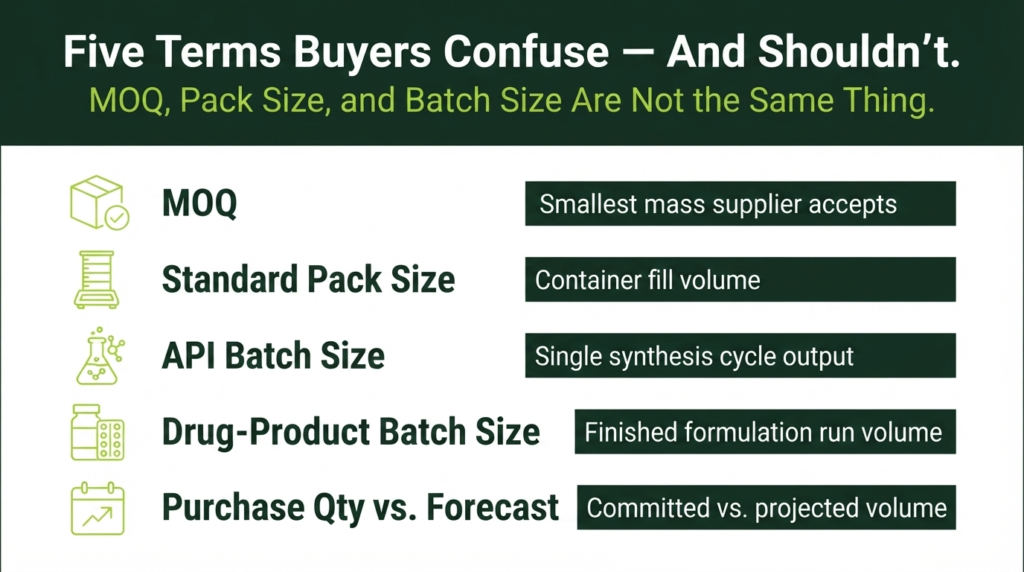
Minimum order quantity defines the smallest mass a supplier agrees to sell under specified commercial terms. MOQ reflects producer manufacturing requirements rather than active ingredient quality or regulatory status. Standard pack size specifies the physical mass filled into an approved primary container. Orders meeting an MOQ must round upward to complete container multiples.
Distinguishing commercial purchasing constraints from active substance synthesis parameters prevents misunderstandings between procurement teams and manufacturing sites.
| Term | Control Function | Buyer Evaluation Question |
| Minimum Order Quantity (MOQ) | Smallest active substance mass a manufacturer accepts for a single order under defined commercial terms. | What is the minimum mass available for stock items versus custom production runs? |
| Standard Pack Size | Physical packaging container volume used for safe transport and storage. | Must the purchase order round upward to full container increments? |
| API Batch Size | Total active substance mass produced in a single continuous manufacturing cycle under ICH Q7 Good Manufacturing Practice guidelines. | Is the order fulfilled from an existing released lot or dependent on a new synthesis campaign? |
| Drug-Product Batch Size | Planned volume of finished formulation, such as Etomidate Injection, produced in one manufacturing run. | What active substance charge does the approved master batch formula require? |
| Purchase Quantity vs. Forecast | Immediate mass committed on a purchase order versus projected long-term volume over a planning horizon. | Does the order reflect immediate production needs or non-binding projected volume? |
Categorizing Etomidate API Requirements by Program Stage
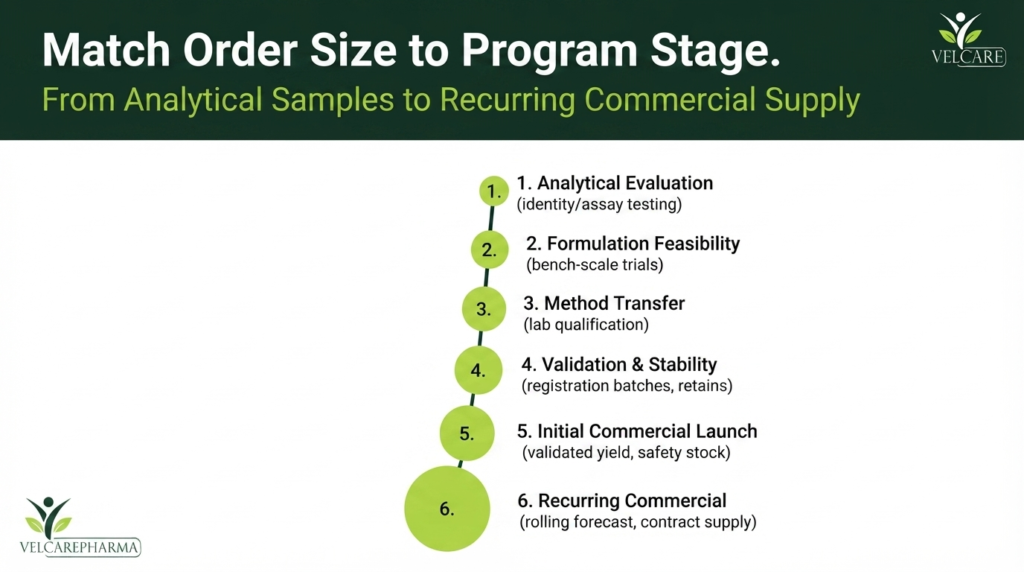
Active substance purchasing calculations depend on the technical requirements of each program phase.
| Program Stage | Target Technical Application | Primary Mass Calculation Inputs | Supplier Allocation Strategy | Stage Gate Approval Criterion |
| Analytical Evaluation | Identity testing, assay verification, and preliminary method establishment. | Protocol test counts, replicate requirements, and laboratory transfer reserves. | Off-the-shelf inventory samples. | Laboratory verification of protocol test mass. |
| Formulation Feasibility | Prototype screening, vehicle compatibility, and bench-scale processing trials. | Planned run counts, theoretical active charge, analytical draws, and loss allowances. | Small-pack allocations from released commercial stock. | Formulation sign-off on process loss parameters. |
| Method Transfer | Receiving laboratory verification and formal analytical qualification. | Multi-analyst trials, instrument setups, multi-day testing, and retest allowances. | Portion split from the intended commercial API lot. | Approved analytical transfer protocol. |
| Validation & Stability | Registration campaigns, formal ICH stability studies, and process validation. | Master batch formula charge, regulatory batch counts, and 21 CFR 211.170 retains. | Multiple dedicated commercial API lots. | Regulatory sign-off on submission lot map. |
| Initial Commercial Launch | Commercial product release and market introduction batches. | Launch volume schedules, validated yields, and distribution safety stock. | Campaign reservation or dedicated lot purchase. | Quality assurance release of submission parameters. |
| Recurring Commercial | Routine commercial dosage manufacturing. | Rolling finished unit forecasts, BOM conversions, and active ingredient retest windows. | Scheduled campaign allocation or contract supply. | Supply chain approval of inventory balance. |
Relationship Between Order Volumes and API Synthesis Lots
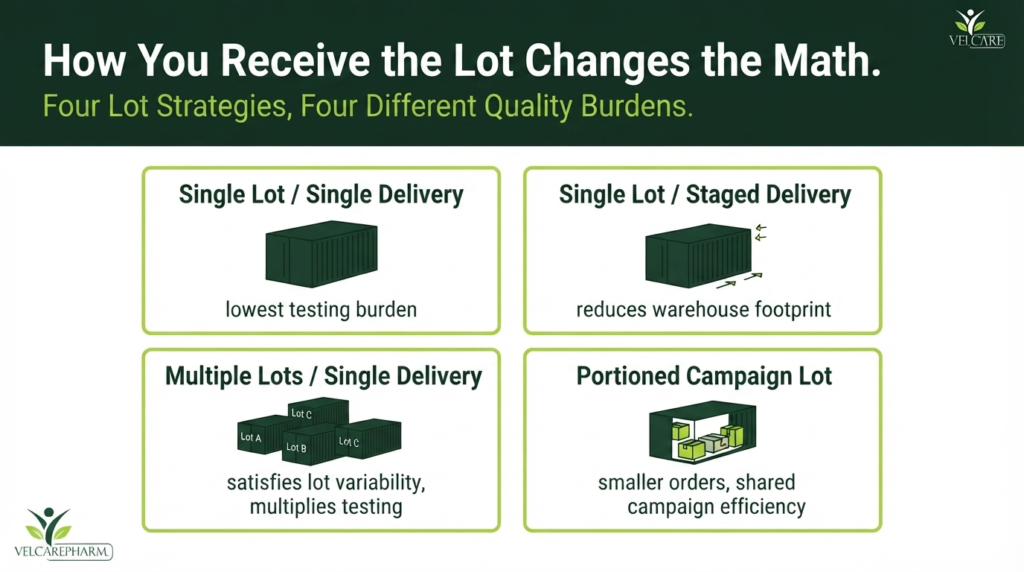
Fulfilling an order from a single synthesis lot delivered in one shipment minimizes quality control testing expenses and retain storage obligations. Delivering a single lot in staged installments lowers customer warehouse storage requirements without extending the material retest window, which begins at active substance synthesis. Receiving multiple synthesis lots in one shipment satisfies regulatory expectations for lot variability during registration campaigns, but multiplies analytical release testing, documentation, and retention sample storage obligations. Purchasing portioned allocations from larger commercial synthesis campaigns enables smaller order sizes while leveraging campaign production efficiencies.
| API Lot Strategy | Operational Mechanism | Operational and Quality Impact |
| Single Lot, Single Delivery | Total order mass fulfilled from one synthesis lot in one shipment. | Minimizes incoming testing costs, release documentation, and retain sample storage. |
| Single Lot, Staged Deliveries | Single synthesis lot held by supplier and shipped in scheduled installments. | Reduces customer warehouse footprint; does not extend material retest dates. |
| Multiple Lots, Single Delivery | Order fulfilled using multiple discrete synthesis lots in one shipment. | Satisfies regulatory lot variability needs; multiplies release testing and retain burdens. |
| Portioned Campaign Lot | Customer purchases a fraction of a larger commercial synthesis campaign. | Allows smaller purchase quantities without incurring custom synthesis campaign fees. |
Supplier Packaging Configurations and Campaign Scales
Active substance purchase calculations that do not match standard pack increments require rounding order volumes upward. Remaining unconsumed material must be managed under qualified storage conditions to prevent degradation. Purchasing released stock from supplier inventory permits fast fulfillment of smaller quantities, whereas custom synthesis campaigns require commitments matching reactor production scales. Staged deliveries from custom campaigns require formal agreements defining inventory holding terms, storage controls, stability commitments, and financial liability for uncollected inventory.
Structuring Forecasts and Inventory Replenishment Schedules
Translating finished dosage projections into active substance mass requires converting sales units using product formula concentrations. Segmenting supply projections into binding purchase orders, planned commitments, and non-binding forecasts provides synthesis facilities with operational visibility while limiting buyer financial liability.
Replenishment schedules must align with active substance retest windows and shelf-life limits. Managing inventory according to WHO Good Storage and Distribution Practices maintains First-Expired, First-Out (FEFO) material flow. Re-evaluating active substance quality near expiration dates requires procedural quality control authorization and does not guarantee shelf-life extensions.
Financial Evaluation of Order Tiers and Carrying Costs
Evaluating purchase options requires analyzing total acquisition costs rather than relying solely on active substance unit pricing. Financial evaluations must weigh volume price discounts against inventory carrying expenses, analytical release testing fees, and material expiration risk.
| Commercial Order Strategy | Technical & Economic Priority Conditions | Primary Financial Risk Drivers |
| Smaller / Staged Orders | Formulation parameters undergoing active optimization; low forecast certainty; limited material retest window. | Higher unit acquisition price; repeated analytical testing and shipment release fees. |
| Larger / Campaign Orders | Fixed commercial formulation; validated high yield; stable rolling forecast; efficient analytical release cadence. | Inventory carrying costs; tied-up working capital; write-off exposure from active substance expiration. |
Request for Quotation Checklist for Etomidate API
Submitting explicit technical and commercial parameters ensures accurate manufacturer responses.
| RFQ Dimension | Required Technical and Commercial Inputs | Internal Approval Sign-Off |
| Demand & Timeline | Immediate purchase mass, program stage, required delivery date, and non-binding annual forecasts. | Supply Chain / Procurement |
| Lot Structure | Required lot counts, lot separation rationale, and minimum remaining retest duration upon receipt. | Quality Assurance / CMC |
| Commercial Parameters | Target MOQ, acceptable pack sizes, campaign lead times, and custom synthesis tolerances. | Procurement / Finance |
| Technical Context | Finished dosage forms, active ingredient concentrations, batch scales, and target market regulatory standards. | Process Development / QC |
Common Procurement Mistakes in Quantity Planning
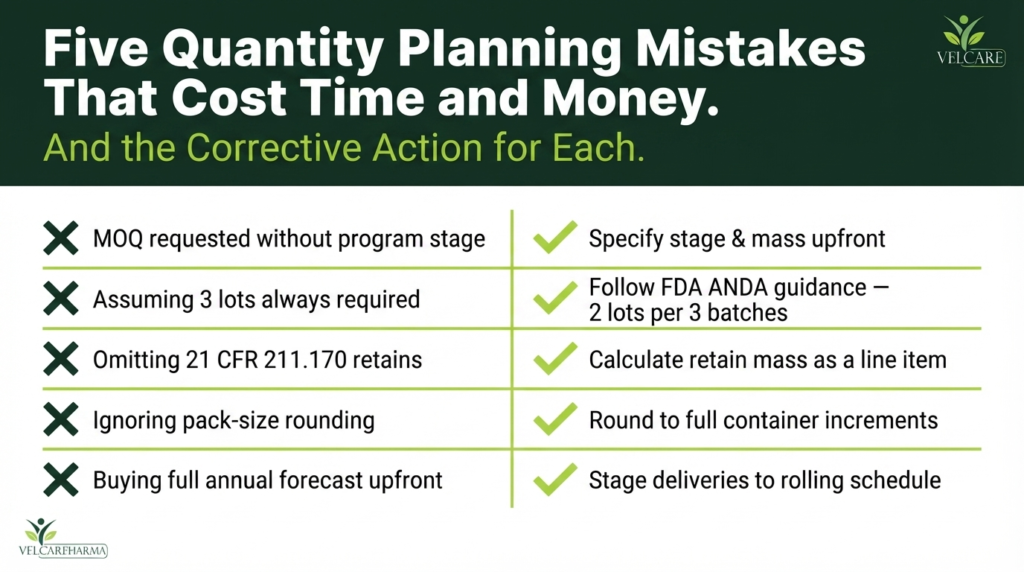
Avoiding standard quantity planning errors prevents project delays and unnecessary cost overruns.
| Quantity Planning Mistake | Technical Failure Mode | Recommended Corrective Action |
| Requesting MOQ without program stage | Supplier quotes commercial campaign scale unsuited for development work. | Specify exact project stage and target mass in initial inquiry. |
| Assuming validation mandates 3 API lots | Over-purchasing active substance without regulatory mandate. | Align lot counts with FDA ANDA stability guidance (2 active substance lots for 3 product batches). |
| Omitting 21 CFR 211.170 retains | Shortfall of active substance during commercial production runs. | Calculate explicit retain mass (twice full testing quantity) as a discrete line item. |
| Ignoring pack-size rounding | Order total leaves open partial containers subject to contamination or degradation. | Round gross requirement upward to full standard package increments. |
| Purchasing annual forecast upfront | Material exceeds retest window in warehouse prior to production. | Structure staged deliveries aligned with rolling production schedules. |
Five-Gate Approval Framework for Final Order Quantities
Implementing a structured five-gate verification model ensures technical, quality, and financial alignment prior to purchase order release.
- Technical Use Gate: Every gram of active substance corresponds to a documented master formula charge, analytical testing protocol, or validated process loss allowance.
- Quality Gate: Quality Assurance verifies that planned lot allocations comply with regulatory filing commitments, 21 CFR 211.170 retain rules, and active substance retest windows.
- Commercial Gate: Proposed purchase volumes reconcile with supplier MOQs, standard package increments, and campaign manufacturing tolerances.
- Schedule Gate: Delivery schedules align with manufacturing windows to ensure complete active substance consumption within its verified retest period.
- Financial Gate: Financial modeling confirms that net volume price savings exceed warehouse carrying costs, testing fees, and material write-off exposure.
Commercial Supply Coordination
Determining appropriate Etomidate API order volumes requires balancing finished dosage formulation requirements, regulatory analytical testing mandates, and manufacturer commercial parameters. Aligning active substance purchases with verified program stages protects development schedules while controlling inventory expenses.
Velcare Pharma manufactures active pharmaceutical ingredients at synthesis facilities in India, supporting global drug manufacturers with stage-appropriate lot allocations, analytical documentation, and flexible commercial packaging options.
Pharmaceutical procurement teams, formulation scientists, and supply chain managers evaluating Etomidate API purchasing requirements may submit project stages, batch scales, lot allocation parameters, and annual forecasts to Velcare Pharma to receive custom commercial supply configurations.