Chemical identity matching under CAS 33125-97-2 and chromatographic purity above 99% do not establish that an Etomidate lot is suitable for pharmaceutical manufacturing. Suitability requires an unbroken evidence chain connecting an identified drug substance application to a released batch produced under documented quality systems.
Procurement teams frequently evaluate quotes showing identical chemical descriptions yet displaying substantial price and pack-size disparities. Purchasing laboratory-grade or research-use material for pharmaceutical formulation risks invalidated development data, delayed filing schedules, and expensive repeated analytical trials. Implementing a structured evaluation protocol allows CMC, QA, and sourcing teams to separate simple chemical offers from qualified API candidates.
The following analysis outlines the technical criteria, verification gates, and material evaluation frameworks necessary to secure compliant Etomidate drug substance.
Intended Use and Evidence Define Material Status
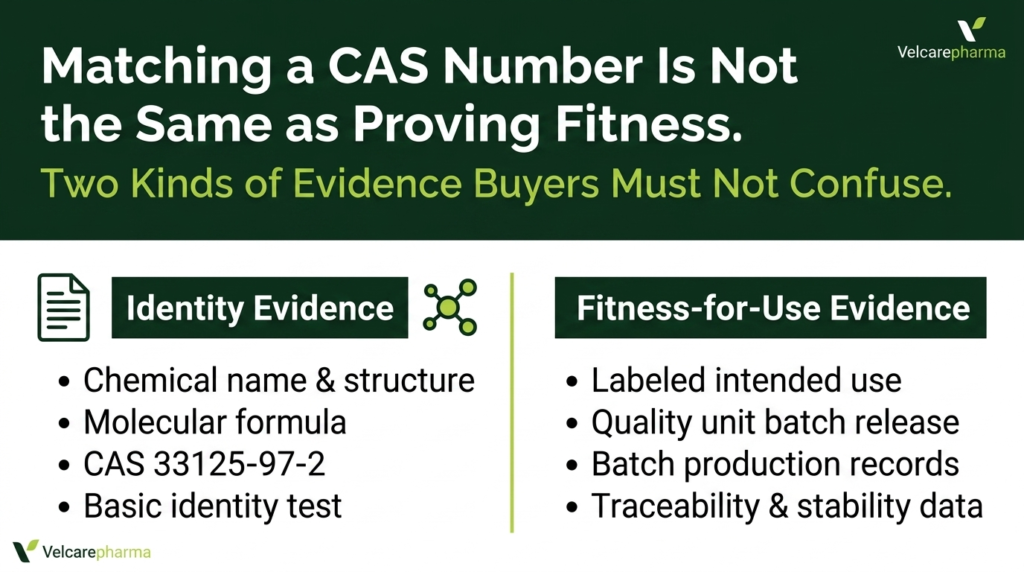
Etomidate is registered in NIH PubChem as ethyl 3-[(1R)-1-phenylethyl]imidazole-4-carboxylate under CAS Registry Number 33125-97-2 with molecular formula C14H16N2O2. The chemical structure remains constant regardless of commercial supply channels. Per ICH Q7 guidance, an Active Pharmaceutical Ingredient (API) or drug substance is any substance intended for use in manufacturing a drug product that becomes an active component of that product. The intended use declared by the manufacturer and buyer dictates the required regulatory controls and production records.
Research-grade or research-use-only (RUO) Etomidate is produced for analytical method screening, reference comparison, or non-clinical laboratory research. Commercial pharmaceutical Etomidate API candidates consist of batches produced under controlled process conditions, tested via validated procedures, and formally released by an independent quality unit for human or veterinary drug formulation.
Descriptors such as “GMP grade,” “pharma grade,” or “high purity” represent commercial vendor labels rather than uniform statutory classifications. The U.S. Food and Drug Administration (FDA) does not issue individual batch certificates declaring an API “GMP grade”. Compliance is established through batch production records, facility status, and documented quality operations. Per ICH Q7 Section 19, APIs intended for clinical trials must also be produced under suitable cGMP controls with an independent quality unit batch disposition.
| Identity Evidence | Fitness-for-Use Evidence |
| Chemical name, structure, molecular formula, CAS RN 33125-97-2, basic identity test | Labeled intended use, quality unit batch release, batch production records, traceability, stability programs |
Technical Comparison of Etomidate Material Categories
| Decision Dimension | Research/Analytical Etomidate | Pharmaceutical Etomidate API Candidate | Required Buyer Verification |
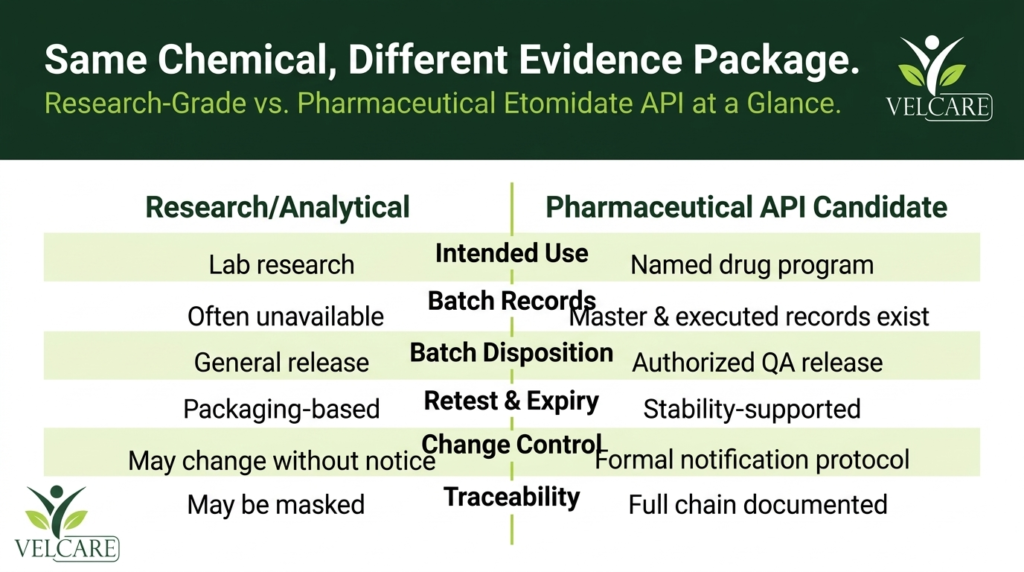
| Stated Intended Use | Laboratory research or analytical testing | Drug substance in named clinical or commercial program | Supplier accepts intended pharmaceutical use in writing |
| Product Presentation | Standard catalogue SKU, small pack sizes | Manufacturer and site-specific supply configuration | SKU does not mask a repacked research product |
| Identity | Matches CAS 33125-97-2 and formula | Reconciled identity plus buyer-approved release testing | Chemical identifiers align across all documentation |
| Purity Result | Single HPLC value (e.g., ≥98% or 99%) | Tested against validated specifications and limits | Results produced under controlled, validated methods |
| Batch Records | Often unavailable for drug substance use | Master and executed batch production records exist | Production site and batch lineage are traceable |
| Laboratory Governance | Research certificate or basic test data | Controlled laboratory records, OOS investigation systems | Data integrity and deviation controls are verified |
| Batch Disposition | Released for general analytical/research use | Released by authorized Quality Unit for drug product use | Official QA disposition status is documented |
| Retest and Expiry | Expiry dates reflect packaging stability | Retest/expiry date supported by real-time and accelerated stability | Storage conditions match drug substance container |
| Change Control | Source or process may change without notice | Quality-impacting changes evaluated and communicated | Formal change notification protocols are active |
| Traceability | Distributor catalogue may mask manufacturer | Full chain from original site to finished API container | Intermediate repacking and shipping routes are clear |
Four Evaluation Shortcuts That Create Regulatory Risk
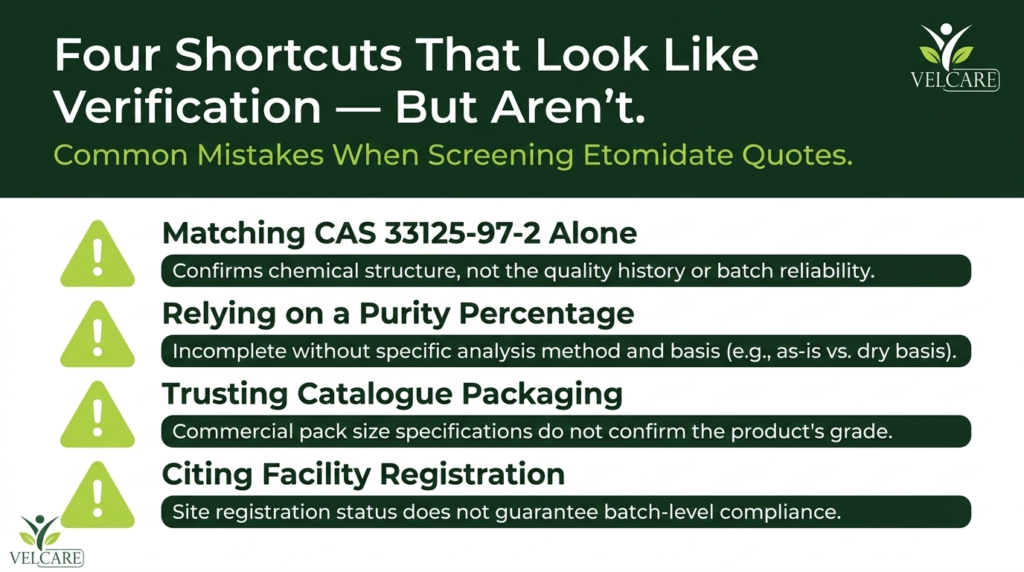
Shortcut 1: Matching CAS 33125-97-2
CAS registry numbers resolve chemical structure across different nomenclature conventions. NIH PubChem connects CAS 33125-97-2 to Etomidate, but the registry number does not specify synthesis route, impurity limits, physical form, quality system history, or batch release status. Sourcing teams must reconcile chemical names with original manufacturing site data rather than accepting a CAS match as proof of suitability.
Shortcut 2: Relying on Purity Percentages
A purity figure such as 99% or 99.8% is incomplete without details regarding the analytical method, sample preparation, basis of calculation, and reporting thresholds. Per ICH Q7 Section 11.4 and FDA API testing guidance, an authentic Certificate of Analysis (CoA) reports specific test methods, numerical results, and authorized acceptance limits established under a controlled laboratory environment.
Shortcut 3: Catalogue Packaging and Reference Standards
Small pack configurations often align with research distribution, though package size alone does not determine quality status. Under ICH Q7 Sections 11.40 through 11.44, legitimate CoAs identify the original manufacturing facility and preserve batch linkage across distributors. USP guidelines explicitly state that USP Reference Standards are designated exclusively for compendial testing and assay comparison, not for administration as manufacturing raw materials.
Shortcut 4: Facility Registration and Inspection Claims
A vendor statement that a facility is FDA-registered or GMP-inspected does not confirm that a specific Etomidate batch was manufactured on a compliant line under validated parameters. Inspection databases, such as the FDA Inspection Classification Database, provide historical site information but cannot verify individual batch suitability.
The Five Links of an API Batch Evidence Chain
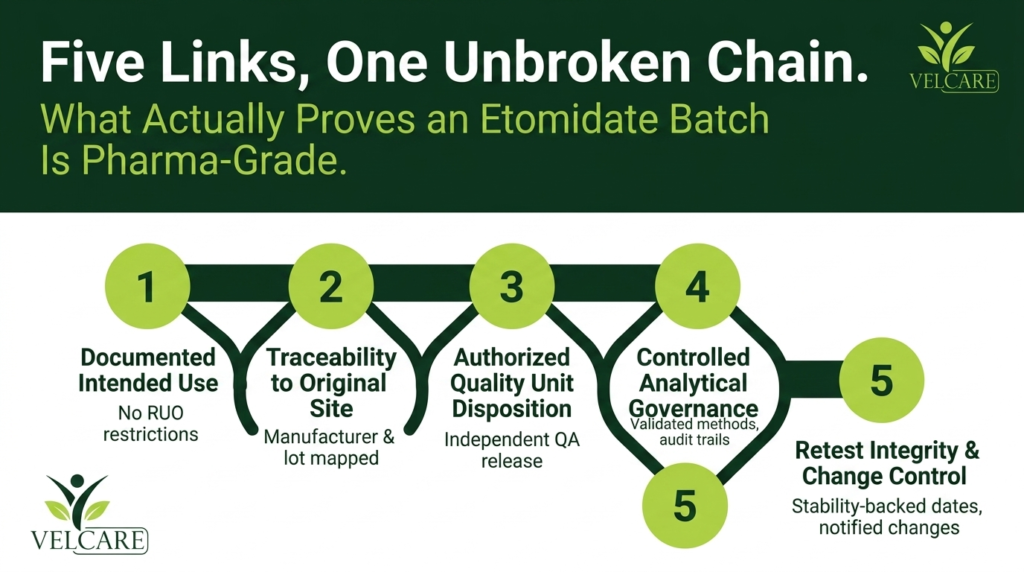
Link 1: Documented Alignment on Intended Use
Purchase orders and quotations must explicitly state the drug substance application. Restrictions such as “Research Use Only” or “Not for Human Use” on labels or terms of sale disqualify the lot for clinical or commercial drug manufacture. Conducting additional internal laboratory testing on an RUO batch does not supply missing production records.
Link 2: Traceability to the Original Manufacturing Site
Under ICH Q7 Section 17.20, distributors, agents, and repackers must maintain full supply chain traceability. The original manufacturing site, producer batch number, and repackaging details must link directly across all paperwork. Refer to container and storage suitability guidelines to evaluate how repacking affects material stability.
Link 3: Authorized Quality Unit Disposition
ICH Q7 Section 2.2 requires an independent quality unit to review production logs, oversee Out-of-Specification (OOS) investigations, and issue formal batch release. An FDA warning letter issued to an API facility demonstrates that drug substances produced without cGMP controls are legally adulterated under FD&C Act section 501(a)(2)(B), regardless of analytical purity scores.
Link 4: Controlled Analytical Governance and Data Integrity
ICH Q7 Section 12.8 specifies that analytical methods used for API release must be validated. Per FDA Data Integrity guidance, complete analytical records, raw spectral data, and audit trails must be maintained under controlled quality management systems.
Link 5: Retest Integrity and Change Control Protocols
Retest dates must be supported by stability programs under defined storage conditions. ICH Q7 Sections 13.10 through 13.17 mandate that quality-impacting changes to raw materials, synthesis routes, equipment, or testing methods must be documented, evaluated, and formally communicated to buyers prior to supply.
First-Pass Screening Protocol for Sourcing Teams
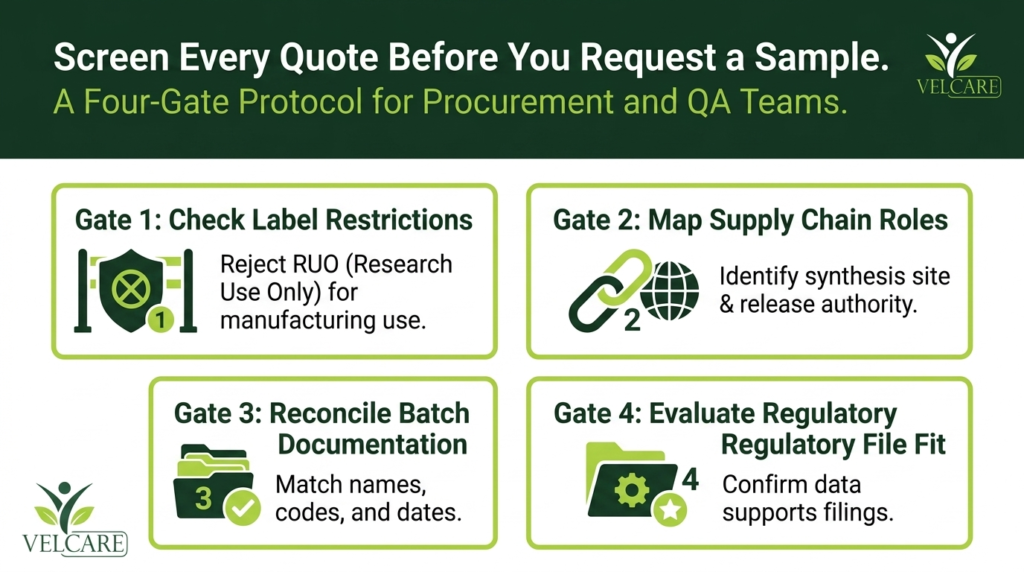
Before requesting samples, procurement and QA teams can apply a four-part screen to categorize incoming quotes:
Gate 1: Check Label Restrictions
Review product specifications for RUO or analytical limits. Reject restricted items for manufacturing applications.
Gate 2: Map Supply Chain Roles
Identify the original synthesis facility, testing laboratory, quality release authority, and distributor. Place orders on hold if the original manufacturing site is undisclosed.
Gate 3: Reconcile Batch Documentation
Compare product names, batch codes, release dates, and site identifiers across quotations, specification sheets, and sample CoAs.
Gate 4: Evaluate Regulatory File Requirements
Determine whether available technical data can support regulatory filings, method transfers, and batch comparability assessments. Refer to initial counterparty verification protocols to establish early supplier checks.
| Screen Field | Verified Record Entry | Status Assessment |
| Exact Catalogue SKU | Vendor item code and description | Verified / Unclear |
| Stated Intended Use | Buyer application accepted in writing | Accepted / Restricted |
| Original Manufacturing Site | Physical production facility address | Disclosed / Undisclosed |
| Factory Batch Number | Producer lot identifier | Reconciled / Unmatched |
| Quality Unit Authorization | Independent QA release sign-off | Present / Absent |
| Label Disclaimer Status | Container usage restrictions | Drug Substance / RUO |
Mis-Sourcing Scenario: Unqualified Material in Development
In an illustrative case, a formulation group purchases 10 grams of Etomidate under CAS 33125-97-2 showing 99.8% purity for injectable formulation screening. The catalogue item carries an RUO limitation that is not recorded in the internal material master. The team establishes solubility data, vehicle compatibility, and prototype parameters using this batch.
During CMC review, QA identifies that the vendor cannot disclose the original synthesis site, provide master production records, or guarantee future batch consistency. Under 21 CFR 211.84, finished drug manufacturers must test component identity and establish supplier reliability. Internal retesting evaluates sample parameters but cannot create missing cGMP manufacturing records, environmental logs, or change control histories.
Remediation requires quarantining the research material, identifying which development studies require bridging, and procuring a fully documented candidate. Sourcing teams must execute formal supplier and site qualification before ordering development lots.
Five Technical Clarification Questions for Suppliers
Sourcing teams can evaluate vendor quotes by submitting five targeted inquiries:
- Will the supplier confirm in writing that the offered batch is produced and released for drug substance manufacturing?
- Who is the original manufacturer, at which site was the batch synthesized, and how does the supplier lot number map to the original factory code?
- Which independent Quality Unit performed release testing and authorized batch disposition?
- What controlled analytical documentation and raw laboratory data are accessible for QC evaluation?
- What formal change notification protocols govern future process, testing, or site modifications?
Frequently Asked Questions
Does CAS 33125-97-2 Prove That a Product Is Pharmaceutical-Grade Etomidate?
No. CAS 33125-97-2 confirms chemical identity but does not specify manufacturing controls, batch release disposition, quality systems, impurity limits, stability data, or regulatory compliance. Pharmaceutical suitability requires controlled batch manufacturing records and independent quality unit authorization.
Is 99% Purity Sufficient for Use in Drug Manufacturing?
No single purity value determines pharmaceutical suitability. The reported percentage must be evaluated alongside validated test methods, specified impurity profiles, batch records, and Quality Unit release. Finished drug manufacturers retain component testing duties under 21 CFR 211.84.
Can a USP Etomidate Reference Standard Be Used as Manufacturing API?
No. USP Reference Standards are designed exclusively for compendial testing and analytical assays. USP guidelines state that reference standards are not manufactured, tested, or intended for use as active pharmaceutical ingredients in drug products.
Can In-House Retesting Convert Research-Grade Etomidate Into GMP API?
No. Laboratory retesting evaluates physical sample attributes but cannot reconstruct missing facility cGMP controls, environmental monitoring data, deviation logs, synthesis records, or process validation history. Quality status depends on complete manufacturing history.
Does an FDA-Registered Facility Guarantee API Approval?
No. Facility registration and inspection records apply to physical sites, not to automatic batch approval. Sourcing teams must separately verify batch release documentation, process validation, and quality records for each specific lot.
May Research-Grade Etomidate Be Used in Early Formulation Development?
Research-grade material may be used for preliminary exploratory testing if internal procedures permit and limitations are documented. However, RUO material must not be used to justify clinical or commercial source parameters without appropriate bridging studies using validated API candidates.