Cleared imports of Etomidate active pharmaceutical ingredient (API) into the United States depend on exact electronic alignment between the foreign manufacturing site registration, active API drug listing, and entry data transmitted through the Automated Commercial Environment (ACE). Bulk API shipments frequently encounter border holds, physical detentions, or automated PREDICT rejects because importers declare finished-drug National Drug Codes, omit required application context, or present inconsistent site address records. Establishing a pre-shipment regulatory verification protocol aligns facility registrations, listing numbers, bulk labeling, and ACE entry fields before cargo leaves the manufacturing plant. This operational report outlines the mandatory entry gates, data matching requirements, stakeholder duties, and pre-dispatch controls required to import bulk Etomidate API without regulatory disruption.
FDA Entry Review Mechanics and Border Controls
Under Section 801(a) of the Federal Food, Drug, and Cosmetic Act (21 U.S.C. 381), the FDA regulates APIs as drug components. U.S. Customs and Border Protection (CBP) receives customs entries through ACE and forwards FDA-regulated line data to the agency for admissibility evaluation. The FDA reviews each entry line independently of private commercial agreements.
The agency uses an automated screening system, PREDICT, to evaluate entry lines by matching transmitted Affirmations of Compliance (AofC) against internal databases. When transmitted data matches active FDA records, the system issues an automated “May Proceed” electronic status. Incomplete entries, invalid registration numbers, or mismatched product descriptions cause system lookup failures and manual review by FDA officers, who can request documents, inspect cargo, collect physical samples, or issue detention notices.
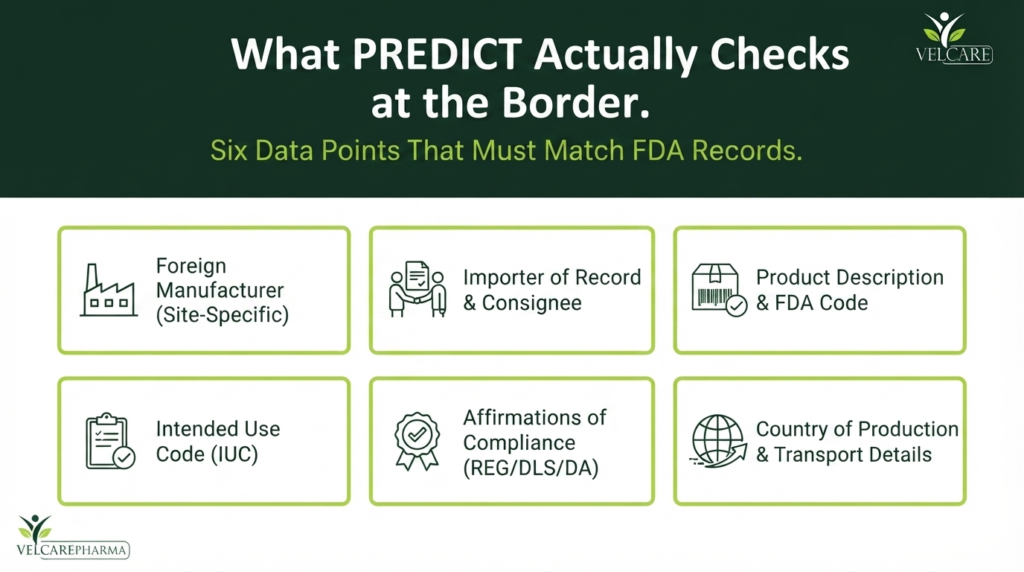
FDA entry reviewers compare six primary data points during admissibility evaluation:
- Declared site-specific foreign manufacturer.
- Declared Importer of Record and ultimate consignee.
- Product commercial description and 7-digit FDA product code.
- Intended Use Code (IUC).
- Affirmations of Compliance, including Registration Number (REG), Drug Listing Number (DLS), and conditionally the Drug Application Number (DA).
- Country of production, origin, and arrival transportation details.
An automated “May Proceed” status applies only to the specific shipment line reviewed. It does not constitute agency approval of the drug substance or authorization for future importations.
Regulatory Distinctions: Registration, Listing, and Application Context
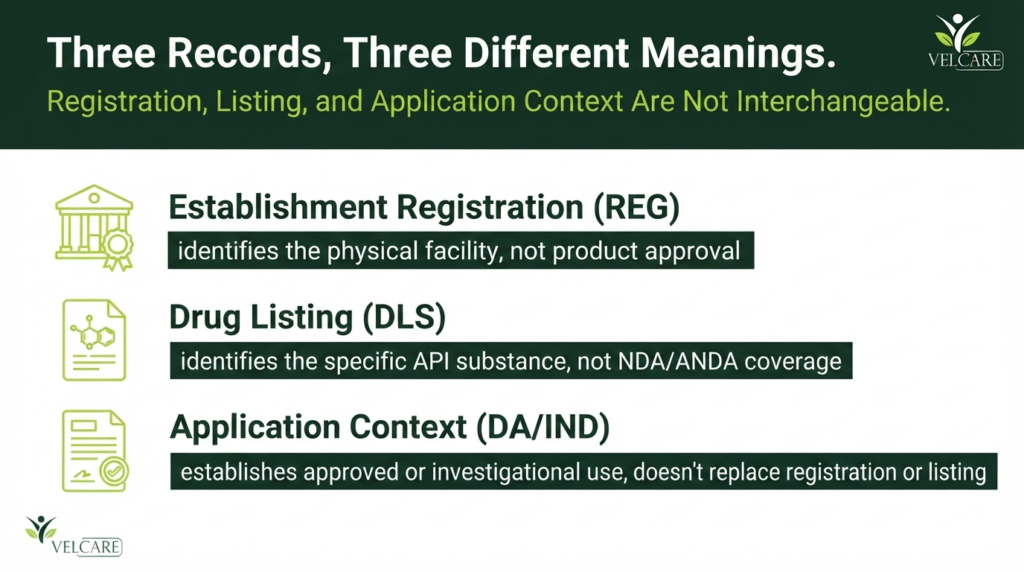
Preparing compliant import filings requires distinguishing between facility registration, drug listing, and drug application context. Conflating these three regulatory mechanics causes errors in customs transmissions.
Under 21 CFR 207.77, the assignment of an establishment registration number, a drug listing number, or a National Drug Code (NDC) does not signify FDA approval or legal authorization to market a finished drug. Describing a supplier as an “FDA-approved facility” based solely on registration records is legally inaccurate. Technical documentation should use precise terms such as “currently registered foreign establishment” or “listed API substance”.
| Requirement | What It Identifies | Responsible Party | Regulatory Scope |
| Foreign Establishment Registration (REG) | Physical manufacturing facility address and specific operations. | Foreign establishment owner or operator via FDA electronic portal. | Identifies the site; does not convey agency product approval or inspection clearance. |
| Drug Listing (DLS) | Specific bulk drug substance manufactured for commercial distribution. | Registrant or designated listing official. | Identifies the listed API; does not establish NDA/ANDA coverage. |
| Application Context (DA/IND) | New Drug Application (NDA), Abbreviated NDA (ANDA), or Investigational New Drug (IND) context. | U.S. Application Holder or IND Sponsor. | Establishes approved or investigational use; does not replace facility registration or API listing. |
| Entry Affirmations of Compliance | Line-level data elements transmitted in ACE for automated verification. | Importer of Record and Customs Broker. | Tests data accuracy in PREDICT; does not guarantee shipment entry. |
Site-Specific Registration for Foreign Manufacturers
Under 21 CFR Part 207, foreign establishments that manufacture, repack, relabel, or salvage drugs offered for import into the United States must register with the FDA. The manufacturer name and physical address declared on the entry must identify the specific facility where the Etomidate API was synthesized or processed, rather than a corporate headquarters, trading office, or secondary warehouse.
Foreign establishments must update their registration annually between October 1 and December 31 under 21 CFR 207.29. The registration record must identify the foreign site’s U.S. Agent, known U.S. importers, and entities that import or offer the drug for import. When an importer changes its legal entity name or address, the foreign manufacturer must update its registration record prior to dispatch.
Importers verify registration using the FDA Drug Establishments Current Registration Site (DECRS) by searching the firm name, physical address, and Food and Drug Administration Establishment Identifier (FEI) or Data Universal Numbering System (DUNS) number. Because DECRS updates daily, static PDF registration certificates do not verify real-time status. Importers must confirm that the registration is active for the current year and covers bulk drug substance manufacturing.
Drug Listing Requirements for Bulk Etomidate API
Registrants must list all commercially distributed drug substances produced at their registered sites. Establishment registration and drug listing form connected but separate records.
FDA import rules mandate that the drug listing submitted at entry (DLS) must represent the foreign manufacturer’s specific API listing. Transmitting substituted listing numbers causes entry rejects in PREDICT. Entry filers must not declare:
- The NDC or listing number for finished Etomidate Injection.
- A distributor listing that omits the primary API manufacturer.
- A listing for a different API manufactured at the same plant.
- Drug Master File (DMF) numbers, CAS numbers, or FEI numbers in place of the DLS.
Importers verify listing compliance by obtaining the active DLS from the manufacturer’s listing contact, searching public unfinished drug files in the NDC Directory, and confirming that the listing matches the physical manufacturing site. Because the public NDC Directory does not display all active drug listings, absence from public search results requires direct verification with the listing holder. Registrants must review and update listing information every June and December.
Intended Use Codes and Application Context in ACE
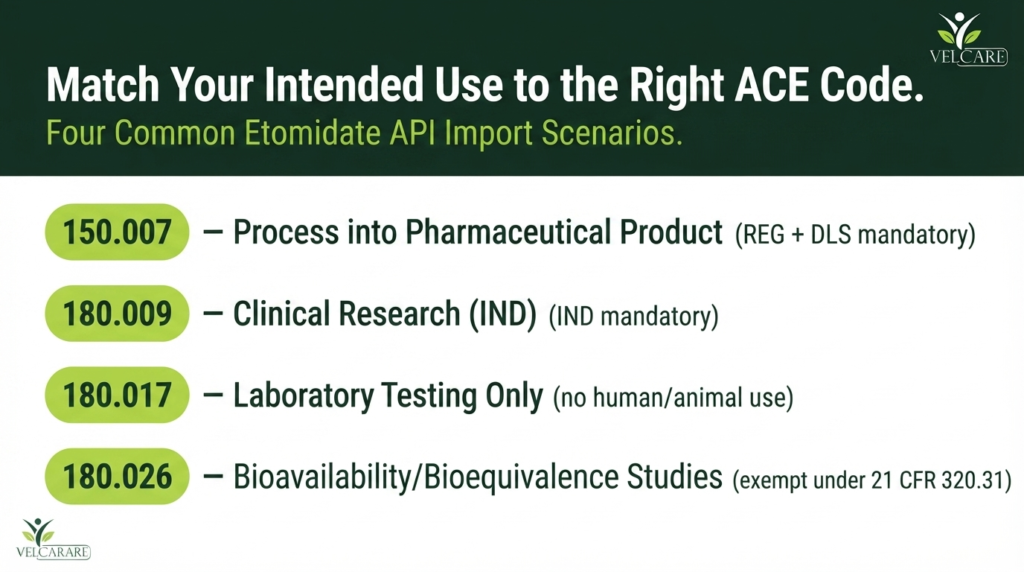
Declared intended use determines the mandatory ACE data structure, applicable Intended Use Codes (IUC), and required Affirmations of Compliance. Importers must define the explicit processing or analytical purpose of the shipment before filing.
| Actual Intended Use | FDA ACE Intended Use Code (IUC) | Required Affirmations of Compliance | Entry Guidance |
| Process into a pharmaceutical product | 150.007 | Mandatory: REG, DLS. Conditional: DA | Standard commercial API import scenario. DA is submitted when required by application context. |
| Clinical research under an IND | 180.009 | Mandatory: IND | IND sponsor must confirm protocol coverage and active status. |
| Laboratory testing only (no human/animal use) | 180.017 | None listed in ACE quick guide | Packaging and documents must restrict material to analytical lab use. |
| Bioavailability / Bioequivalence studies | 180.026 | Exempt under 21 CFR 320.31 | Exemption justification must be maintained in regulatory files. |
Responsibility Matrix for Cross-Functional Teams
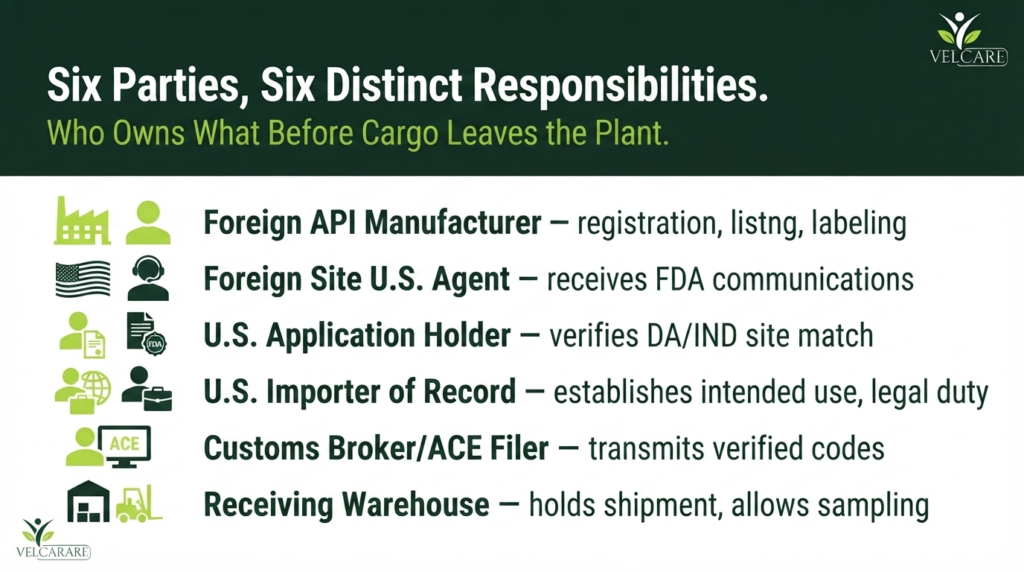
Preventing border holds requires dividing tasks across supply chain partners.
| Responsible Entity | Pre-Shipment Task | Mandatory Information Supplied | Boundary Limit |
| Foreign API Manufacturer | Maintain registration and API listing; list U.S. Agent and importers; label containers. | Physical site address, REG, manufacturer API DLS, lot numbers. | Registration does not constitute product approval. |
| Foreign Site U.S. Agent | Receive FDA communications; assist inspection scheduling. | U.S. street address and contact details. | Does not serve as Importer of Record or customs broker. |
| U.S. Application Holder | Verify site inclusion in drug filings; confirm DA or IND details. | Verified DA/IND numbers and facility function alignment. | Cannot delegate regulatory verification to non-regulatory entities. |
| U.S. Importer of Record | Establish intended use; verify trade documents; instruct broker. | Approved IUC instruction, legal entity details. | Retains primary legal duty for entry accuracy. |
| Customs Broker / ACE Filer | Build FDA line set; transmit codes; flag data errors. | FDA Product Code, IUC, REG, DLS, conditional DA/IND, FD1 code. | Must not guess intended use or invent regulatory codes. |
| Receiving Warehouse | Hold physical shipment pending FDA release; allow sampling access. | Physical delivery address, receiving contact. | Delivery to warehouse does not grant commercial release. |
Entry Packet Consistency and Bulk Labeling Rules
Before booking transit, regulatory and import teams must assemble a verified entry instruction packet. The packet maintains data alignment across invoices, bills of lading, packing lists, and customs submissions.
The entry packet specifies:
- Product description: Etomidate Active Pharmaceutical Ingredient (bulk drug substance).
- Intended Use Code: Selected from the official ACE guide (e.g., 150.007).
- FDA Product Code: Verified through the FDA Product Code Builder for bulk drug substances.
- Manufacturer details: Legal firm name and physical plant address.
- Regulatory identifiers: Verified REG and manufacturer API DLS.
- Application numbers: Verified DA or IND where required by application context.
- Entity identifications: FDA Importer (FD1), ultimate consignee, shipper, and filer contacts.
- Shipment metrics: Country of production, port of entry, arrival date, net quantity in kilograms, package counts, and lot numbers.
Bulk Etomidate API containers must comply with labeling exemptions under 21 CFR 201.122. Unfinished APIs lack directions for direct consumer use and are considered misbranded under Section 502(f)(1) of the FD&C Act unless packaging displays statutory exemption statements.
Container labels must state:
- “Caution: For manufacturing, processing, or repacking”.
- “Rx only” (when intended for prescription finished dosage forms).
Container label text must agree with entry transmissions. Discrepancies between container labels, commercial invoices, and ACE data lines trigger manual holds. Importers should require the customs broker to issue a pre-file data extract for compliance review before transmitting data to ACE.
Pre-Shipment Enforcement Screening and Exception Handling
Compliance teams must perform database screening prior to dispatch to identify potential enforcement actions.
Pre-shipment verification steps:
- DECRS: Confirm active registration for the current calendar year.
- NDC Directory: Verify active manufacturer API listing status.
- FDA Import Alerts: Search by manufacturer firm name, facility address, geographic origin, and drug product categories.
- Compliance History: Review recent FDA Warning Letters or inspection classifications.
Import Alerts permit Detention Without Physical Examination (DWPE) under Section 801(a). When a facility or product is placed on an Import Alert Red List, PREDICT flags the entry line for detention.
| Screening Finding | Action Required Before Dispatch |
| Active REG exists, but manufacturer API DLS is missing | Hold dispatch until listing official provides verified API DLS. |
| Transmitted DLS resolves to finished Etomidate Injection | Stop shipment; obtain manufacturer’s API listing. |
| Invoice address differs from DECRS registration record | Correct invoice to match DECRS facility address. |
| Bulk API label states “For Research Use Only” | Halt departure; update label text to match commercial IUC 150.007. |
| Unverified DA supplied by commercial procurement team | Omit DA from entry until application holder confirms site match. |
| Foreign site listed on an active FDA Import Alert | Escalate to regulatory counsel; do not ship under standard entry procedures. |
Post-Filing Procedures and Import Statuses
Importers track entry line status through the FDA Import Trade Auxiliary Communication System (ITACS). Using ITACS speeds up document submissions and provides real-time status notifications.
FDA import decisions fall into four primary categories:
- May Proceed: The FDA releases the shipment line without physical examination. The importer can move goods into commercial channels.
- Notice of Sampling / Examination / Document Request: The FDA holds the entry line for evaluation. Under 21 CFR 1.90, sampled merchandise must remain intact and secure at the receiving warehouse until the agency issues a release.
- Notice of FDA Action (Detention and Hearing): Issued under 21 CFR 1.94 when an entry appears to violate statutory standards. The importer has a defined response period to submit testimony or analytical data.
- Refusal of Admission: Issued when detention responses fail to overcome the appearance of violation. CBP supervises mandatory export or destruction of refused products.
Pre-Shipment Readiness Checklist
Prior to authorizing international transit, regulatory and procurement teams should execute and archive this verification checklist:
- Intended use is documented and approved by the regulatory compliance owner.
- Intended Use Code (IUC) and Affirmations of Compliance are selected from the current FDA ACE guide.
- Foreign manufacturing plant registration is active in DECRS.
- Foreign manufacturer recorded U.S. Agent details and U.S. Importer listings in its registration file.
- Manufacturer API drug listing number (DLS) is verified.
- Plant name, physical address, REG, DLS, and product description match across all trade documents.
- Application holder confirmed DA or IND numbers and validated site function alignment.
- FDA Product Code for bulk API is verified using the Product Code Builder.
- Container labels display mandatory 21 CFR 201.122 bulk drug exemption text.
- Import Alert database search is completed for the firm, site, geographic region, and product category.
- Broker pre-file extract is audited and signed off by import compliance personnel.
- ITACS status monitoring and escalation contacts are assigned for arrival tracking.
Commercial Coordination and Support
Achieving consistent customs clearance for bulk API imports requires establishing controlled workflows between procurement teams, foreign manufacturing plants, and regulatory compliance groups. Customs entry clearance depends on ensuring that physical plant locations, electronic registration records, bulk drug listings, and declared intended use codes match before cargo leaves the origin site.
Velcare Pharma coordinates site-specific establishment registration data, active drug listing records, and compliant bulk packaging controls for export supply chains from India. Procurement teams should request regulatory verification files during sourcing evaluations while maintaining internal compliance controls for final dispatch authorization. Qualified importers and regulatory professionals can request facility registration records, listing confirmations, and entry support details corresponding to their stated intended manufacturing applications.