An Etomidate API document package helps buyers verify the manufacturing source, quality controls, regulatory support and batch traceability. A quotation alone does not provide enough information to approve a supplier.
However, each document serves a different purpose, and the required package depends on the target market and purchasing stage. This article explains which documents to request during supplier screening, qualification and commercial supply.
Buyers can share their required grade, quantity, destination market and documentation needs with Velcare Pharma when requesting a quote
Quick answer: the Main Documents to Request
The Etomidate API document package commonly includes:
- Legal supplier and manufacturing-site details
- Authorization showing the relationship between the manufacturer and any distributor or agent
- Applicable GMP evidence and recent inspection information
- Supplier quality questionnaire and audit information
- Current Etomidate API release and retest specification
- Representative COAs from recent batches
- Analytical procedures and relevant validation summaries
- Batch-analysis and impurity-profile data
- Residual-solvent, elemental-impurity, mutagenic-impurity and nitrosamine assessments, as technically relevant
- Stability data supporting the proposed retest period and storage conditions
- Packaging specifications, label specimen and transport requirements
- Safety Data Sheet and applicable origin or material declarations
- Market-specific documents, such as a US Drug Master File reference and Letter of Authorization, or European CEP/ASMF documentation
- Commercial quotation, MOQ, lead time, pack size and Incoterms
- A batch-specific COA, invoice, packing list and other required shipping records with each consignment
Confirm Who Manufactures and Supplies the Etomidate API
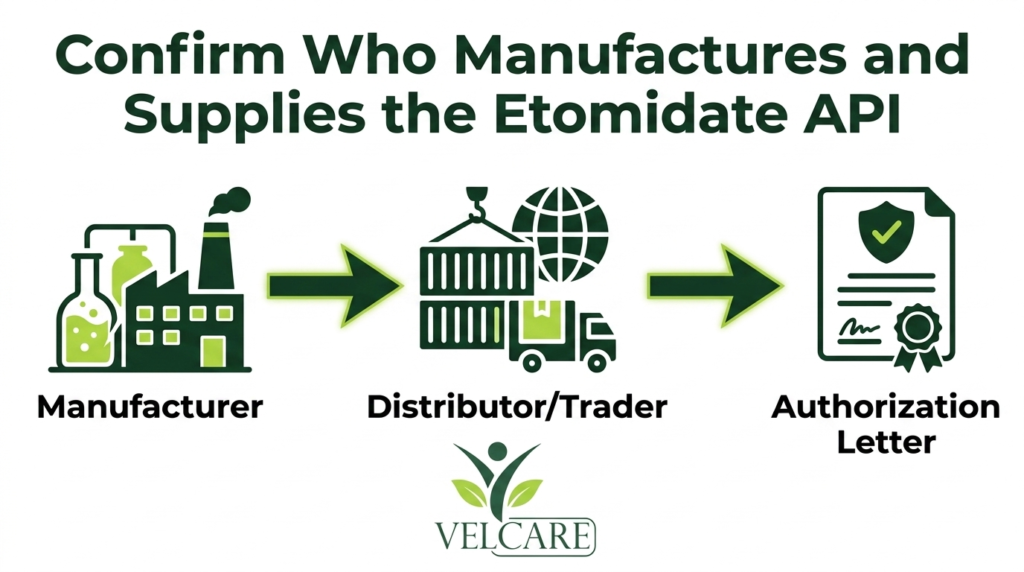
Source identity comes before technical review. The company issuing the quotation may be the original manufacturer, an authorized distributor, a trader, or an entity that performs repacking or relabeling. Treating these roles as interchangeable creates gaps in traceability.
Start with the legal name and registered address of the seller, followed by the name and address of the site where the final purified Etomidate API is produced. The supplier should also identify facilities responsible for subsequent physical processing, testing, micronization or milling, packaging, relabeling and storage. A supply-chain map is useful when more than one organization handles the material.
Where the seller is not the manufacturer, obtain an authorization letter or comparable evidence of the commercial relationship. It should identify the represented manufacturer and the scope of authorization. This helps distinguish an established supply arrangement from an offer assembled through undisclosed intermediaries.
Traceability must continue into the quality documents. ICH Q7 guidance covers agents, brokers, traders, distributors, repackers and relabelers, while the related Q&A states that the COA should identify the original manufacturer. This is particularly important when a distributor issues the COA in its own format. The distributor’s identity alone does not reveal the manufacturing source.
A certificate or license issued to one site cannot be used as evidence for a different facility. Names, addresses and stated operations therefore need to agree across the quotation, GMP evidence, specification, COAs and regulatory documents.
GMP and Quality-System Documents
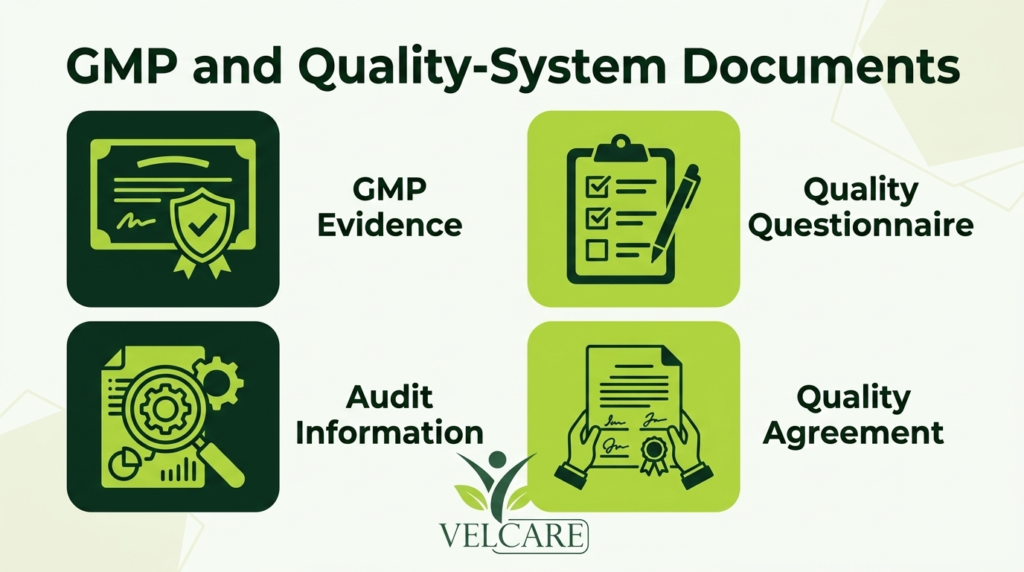
Evidence of GMP Status
Ask for current evidence applicable to the Etomidate manufacturing site and the operations performed there. Depending on the jurisdiction, this may include a GMP certificate, inspection database entry or another form of regulatory evidence. Review the issuing authority, site address, authorized activities, inspection or issue date, and stated validity.
An ISO certificate can provide information about a general management system, but it does not replace pharmaceutical GMP evidence. Nor does an old inspection establish the site’s present status. Publicly available inspection outcomes, import alerts, warning letters, statements of non-compliance or restrictions should be checked independently in the relevant authority’s records rather than relying only on a copy supplied by the seller.
FDA expects API manufacturers to follow the GMP principles described in ICH Q7, which addresses production, testing, release, storage and distribution under an appropriate quality system.
Supplier Quality Questionnaire
A completed questionnaire gives the buyer’s quality unit a structured view of the manufacturer’s controls before an audit. It normally covers quality-unit authority, document governance, data integrity, deviation and out-of-specification investigations, corrective and preventive action, change control, complaints, recalls, training, cleaning, cross-contamination controls and outsourced activities.
The responses need supporting evidence where the risk warrants it. A checked box confirming that a procedure exists is less useful than a controlled procedure number, effective date, responsible function and concise description of how the system operates.
Audit Information
For formal qualification, establish whether the manufacturing site has been audited for the relevant API operations. Useful records may include the audit date, scope, auditor qualification, summary outcome and status of corrective actions. Full audit reports often contain confidential information and may be shared under controlled conditions rather than attached to an initial RFQ.
The audit scope matters more than the location of the supplier’s sales office. If synthesis, final purification, micronization and release testing occur at different sites, the buyer’s risk assessment needs to account for those functions. A desk-based review may support preliminary screening, but it does not automatically replace an on-site or remote audit where the buyer’s qualification procedure or market requirements call for one.
Quality or Technical Agreement
The quality agreement assigns responsibilities that a purchase order cannot describe adequately. It should address testing and batch release, document provision, deviations, OOS results, complaints, recalls, investigations, record retention, subcontracting, regulatory support and notification of manufacturing or analytical changes.
This agreement is generally negotiated during qualification, not requested as a finished document with the first price inquiry. At the screening stage, the relevant question is whether the manufacturer will enter such an agreement and accept a defined change-notification process.
Regulatory Documents for the Intended Market
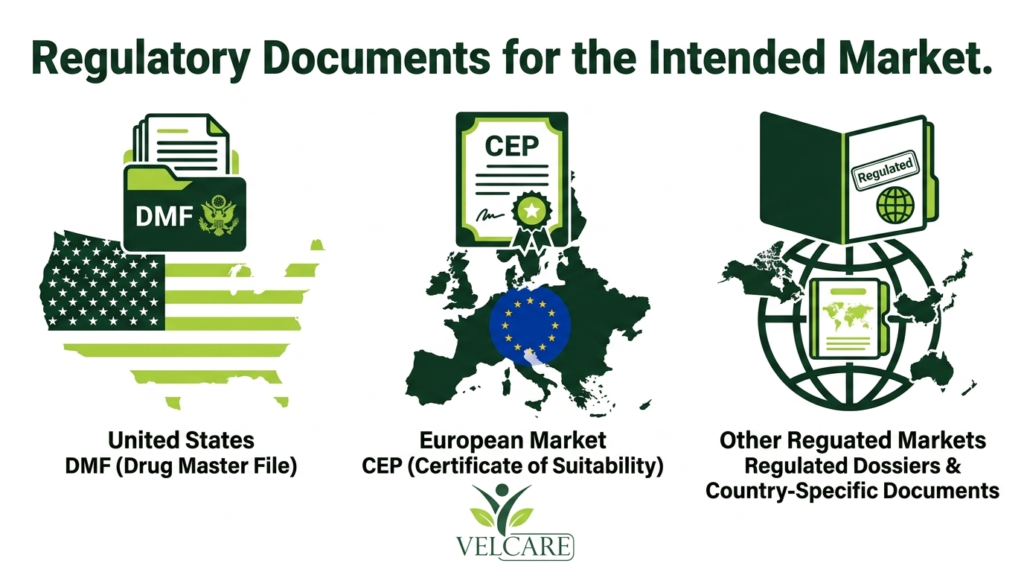
Regulatory support needs to match the country in which the finished medicine will be registered or maintained. A document useful in one jurisdiction may not provide the required route in another.
United States
For a US filing, determine whether the source has an applicable Type II Drug Master File for the drug substance and whether the holder can authorize the buyer’s application to reference it. The requested information may include the DMF number, holder name, current administrative status and commitment to maintain the file.
The Letter of Authorization is central to this route. It permits FDA to refer to specified information in the DMF when reviewing the authorized party’s submission. A DMF number on a sales document is not equivalent to authorization, and the existence of a DMF does not mean that FDA has approved the supplier, manufacturing site or individual API batches. FDA classifies drug-substance files under Type II and provides separate templates for Letters of Authorization. FDA overview of DMF types and DMF letter templates
European Market
For a European application, establish which active-substance documentation route the source supports. If the offered material is covered by a valid Certificate of Suitability to the monographs of the European Pharmacopoeia (CEP), obtain the current certificate and relevant annexes and confirm its status in the EDQM certification database. The holder, manufacturing chain, grade and any additional controls need to correspond to the proposed source.
If the Active Substance Master File procedure is used, the buyer normally needs the current Applicant’s Part and a Letter of Access that allows the competent authority to assess the restricted information. The ASMF holder is responsible for keeping the file current and communicating relevant updates.
The finished-product manufacturer or applicant may also need site and audit information to support the Qualified Person’s declaration, along with written confirmation for an imported active substance where the applicable EU framework requires it. These are not documents that can be inferred from the CEP alone.
A CEP, GMP certificate and COA answer different questions. The CEP addresses the suitability of pharmacopoeial control for the substance covered by that certificate; GMP evidence concerns the manufacturing system; the COA reports the disposition and test results of a specific batch. EDQM expressly notes that a CEP replaces neither a GMP certificate nor a COA.
Other Regulated Markets
For other jurisdictions, ask the supplier to identify the available master-file or dossier-support route, the authority with which it is maintained, and the process for granting access. The package may include local access letters, declarations, legalized documents or responses to authority queries.
Previous use of the source in that market is relevant background, but it does not establish acceptance for a new applicant or product. The buyer still has to evaluate whether the current site, process, specification and regulatory version fit its proposed dossier.
Etomidate API Specifications and Testing Documents
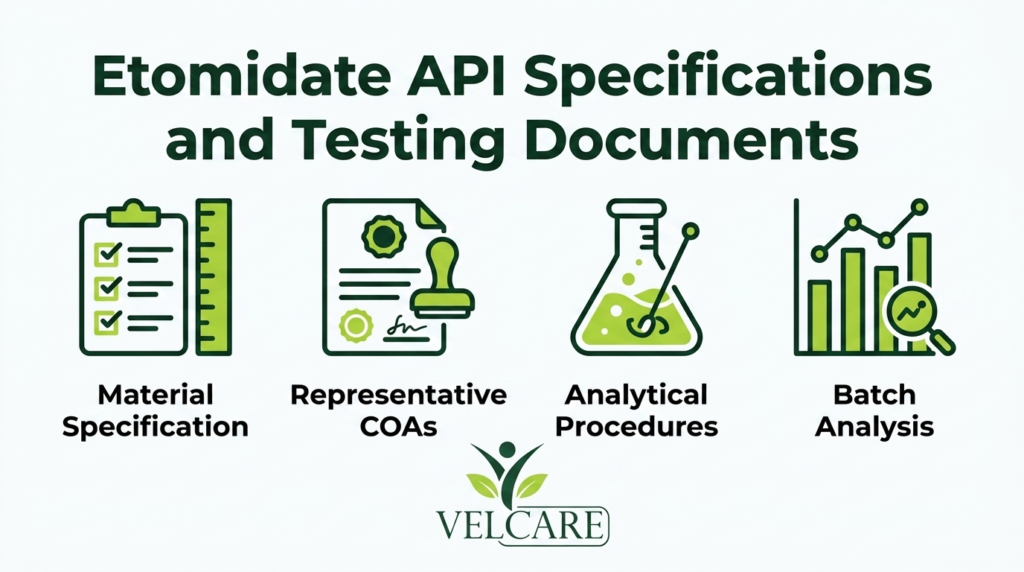
Current Material Specification
The specification defines the quality standard against which Etomidate API is released and, where applicable, retested. Obtain the controlled version applying to the exact grade on offer. It should identify the pharmacopoeial or in-house basis, test methods or method references, and acceptance criteria.
Typical controls for a synthetic API include description, identification, assay, related substances, water content or loss on drying, and residual solvents. Other attributes may be relevant because of the manufacturing process or finished-product requirements. These can include elemental impurities, particle-size distribution, microbial limits, bacterial endotoxins or sterility.
Etomidate is used in parenteral products, but that fact alone does not establish that every Etomidate API grade is supplied as sterile or that every parenteral-product test belongs in the supplier’s routine API specification. The buyer needs to compare the offered controls with its formulation, manufacturing process and registered dossier. EMA’s ASMF guidance likewise recognizes that product-specific tests such as particle size, sterility or bacterial endotoxins may need to be added by the applicant even when they are not part of the ASMF holder’s specification.
Representative Certificates of Analysis
Obtain COAs from several recent representative or commercial-scale batches. A single polished sample gives little information about consistency. Compare the reported tests, limits, numerical results, batch numbers, release dates, method references and retest dates across the set.
Under ICH Q7, an API COA is expected to state the API name and grade, batch number, release date, tests performed, acceptance limits and numerical results, as applicable. FDA also notes that a finished-product manufacturer relying on a supplier’s analytical results still needs to establish the reliability of those results under its own component-control obligations.
Check who issued the COA and who performed the tests. If a contract laboratory or distributor is involved, the document should preserve traceability to the original manufacturer and the released batch. Representative COAs support evaluation; they do not replace the batch-specific COA required for material actually shipped. A separate guide explains how to review an Etomidate API Certificate of Analysis in detail.
Analytical Procedures and Validation Support
The buyer’s laboratory needs enough information to verify or transfer the methods used for supplier-specific tests. Ask for non-compendial analytical procedures, relevant validation summaries, reference-standard information and impurity-standard availability. Chromatograms, system-suitability examples or additional method data may become necessary when the method is transferred or an atypical result is investigated.
Not every proprietary manufacturing detail needs to be released directly to procurement. Confidential analytical or dossier information can be routed to QA, regulatory affairs or the competent authority under an agreement that protects the manufacturer’s know-how while still allowing the buyer to take responsibility for material control.
Batch Analysis and Consistency
Batch-analysis summaries help reveal whether results remain comfortably within limits or repeatedly approach them. Ask for data from several representative batches, the typical commercial batch size and confirmation that the proposed sample and commercial material come from the declared process and site.
This comparison is especially relevant when development samples are drawn from laboratory or pilot manufacture. A passing sample does not demonstrate that subsequent commercial batches will be produced at the same scale, with the same impurity profile or under the same site controls.
Packaging and Transportation Documents
The packaging specification should identify the primary and secondary components, materials of construction, closure system, pack size and protective configuration. Ask for a representative label showing the material name, batch number, storage conditions, retest or expiry information, manufacturer and any required handling statements.
Packaging records must relate to the commercial pack. A sample supplied in a small laboratory container does not demonstrate that the drum, liner, seal or secondary protection proposed for a full order is suitable.
Transport requirements should follow the supported storage conditions. If the material requires temperature-controlled shipment, obtain the acceptable range, excursion-assessment procedure and expected monitoring records. If available stability data support ordinary controlled handling, demanding cold-chain records merely because the finished dosage form is injectable adds cost without establishing additional API control.
Safety, Origin and Special Declarations
A current Safety Data Sheet provides handling, hazard, first-aid, storage and transport information for the material. Procurement and logistics teams may also need a country-of-origin declaration for customs or trade documentation.
Other declarations are driven by the process, materials and intended market. These may address animal origin and TSE/BSE risk, genetically modified materials, allergens, irradiation or other product-specific concerns. They should identify Etomidate, the manufacturer and the basis of the declaration. Collecting generic declarations with no connection to the manufacturing route produces paperwork, not evidence.
Environmental, import, export or controlled-material documents also depend on the countries involved and the legal classification applied there. These points need confirmation before shipment, especially when the supplier and buyer operate in different jurisdictions.
Commercial and Supply Documents
The technical package establishes whether the source can be evaluated; the commercial package defines what is actually being offered. The formal quotation should identify the material and grade, quantity, pack size, price basis, quotation validity, payment terms, Incoterms and any separate charges for samples, analytical standards or regulatory support.
Ask for the MOQ at the relevant stage—sample, development or commercial—along with the usual commercial batch size, lead time, available remaining retest period at dispatch and sample policy. These details prevent a technically acceptable source from reaching qualification before procurement discovers that the batch scale, timing or pack configuration does not fit the program.
Regulatory access also needs to be priced and scheduled accurately. A supplier may provide a standard technical pack with the quotation while handling DMF authorization, ASMF updates, additional testing or authority responses through a separate process. Buyers can use the guidance on requesting an accurate Etomidate API quote to prepare the RFQ. The related discussion of factors that determine an Etomidate API price explains why grade, order size, documentation and delivery terms need to be defined before comparing offers.
Documents to Obtain With Each Shipment
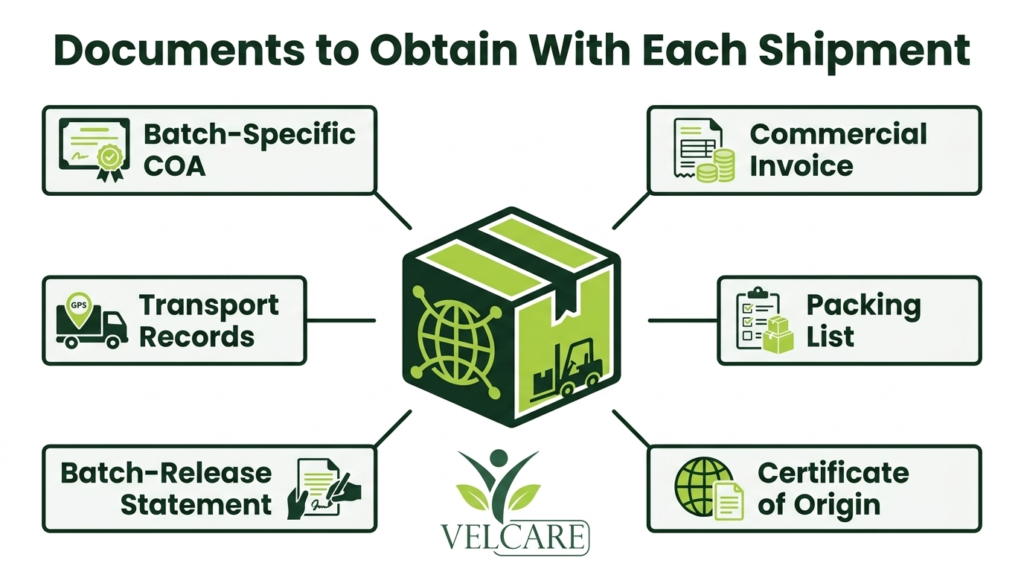
Supplier qualification records remain in the approved-source file. A separate set of documents identifies and supports each consignment. Depending on the transaction and destination, that set can include:
- Batch-specific COA
- Commercial invoice
- Packing list
- Certificate of Origin
- Batch-release or conformity statement
- Transport record and temperature data when controlled transport applies
- Dangerous-goods documentation when the shipment classification requires it
- Import, export or customs records
- Labels carrying the batch number, storage conditions and retest or expiry information
How to Review the Document Package?
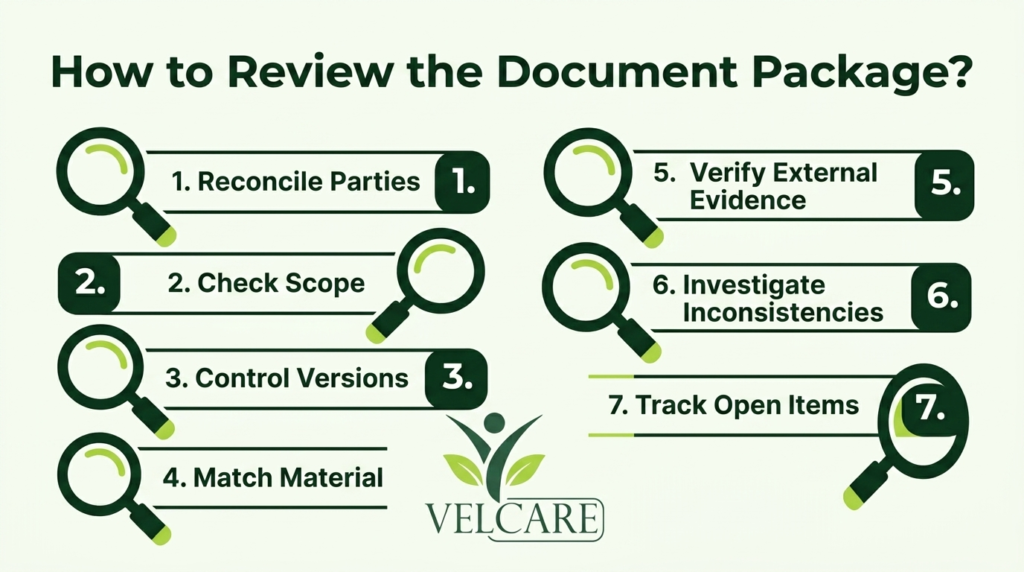
Document collection is not document approval. A disciplined review follows the information across files rather than assessing each PDF in isolation.
- Reconcile the parties and sites. Match the legal seller, original manufacturer, testing site, packer, relabeler and storage locations across the supplied records.
- Check scope. Confirm that each certificate or authorization covers the named facility, API activity and applicable period.
- Control the versions. Record document numbers, revision numbers, effective dates, signatures and expiry dates. Replace superseded copies in the qualification file.
- Match the material. Compare the Etomidate name, grade, specification, methods, packaging and manufacturing route across the quotation, COAs and regulatory documents.
- Verify external evidence. Use the issuing authority’s database for regulatory certificates, inspection status and CEP information where a public verification route exists.
- Investigate inconsistencies. Different addresses, unexplained test changes, missing original-manufacturer details or altered acceptance criteria require documented follow-up.
- Route confidential content correctly. Procurement may coordinate the request, but QA and regulatory affairs need access to the material required for their assessments. Restricted information can be exchanged through controlled channels.
- Track open items. Assign each missing record to an owner and state whether it blocks screening, qualification, filing or release of a shipment.
Documents to Request from an Etomidate API Supplier
An Etomidate API document package helps pharmaceutical buyers verify the manufacturing source, quality controls, regulatory support and batch traceability. A quotation alone does not provide enough information to approve the material or its supplier.
The required records depend on the target market and purchasing stage. This article explains which documents to obtain during initial screening, supplier qualification and commercial supply.
Share the required grade, quantity, destination market and document list with Velcare Pharma. Contact Velcare Pharma to discuss document availability and submit an Etomidate API inquiry.