Supply-chain transparency in Etomidate API sourcing means being able to identify the original manufacturer, every site that performs a quality-relevant operation, and the records connecting the received batch to those parties. The company issuing the quotation may instead be a trader, distributor, exporter, or repacker. If its role is unclear, the buyer cannot confirm that the CoA, batch number, approved source, and physical material all refer to the same batch.
Procurement and quality teams can resolve this before approval by mapping the supply chain, reconciling batch documents, and assigning responsibility for release, storage, transport, change notification, complaints, and recalls. This article explains what information to request and how to assess it when sourcing Etomidate API.
Quick Answer
- Supply-chain transparency confirms the identity and location of the original Etomidate API manufacturer.
- It maintains the connection between the supplied batch, its original number, its authentic CoA, and its distribution records.
- It identifies which parties perform testing, QA release, storage, transport, repacking, or other quality-relevant activities.
- It gives procurement and quality teams the information needed for supplier qualification, regulatory assessment, investigations, and recalls.
What Does Supply-Chain Transparency Mean for Etomidate API?
Transparency does not mean obtaining confidential synthesis instructions, proprietary process parameters, or private commercial agreements. It means having enough verified information to reconstruct the route taken by the API and the records created along that route.
The ICH Q7 Q&A applies its supply-chain expectations to all parties between the original API manufacturer and the drug-product manufacturer. It identifies the original manufacturer, for CoA purposes, as the facility where the final purified API is produced. A site performing later operations such as drying, micronization, milling, or sieving does not become the original manufacturer merely by performing that work. Those operations still form part of the manufacturing chain and need to be identified.
For an Etomidate API transaction, the buyer needs to establish:
- the legal name and address of the original manufacturing site;
- any site performing drying, milling, micronization, sieving, repacking, or relabelling;
- the laboratory performing release or contract testing;
- the quality unit authorizing the batch for release;
- the commercial role of the seller;
- the storage and transportation route; and
- the party retaining original manufacturing, batch, and distribution records.
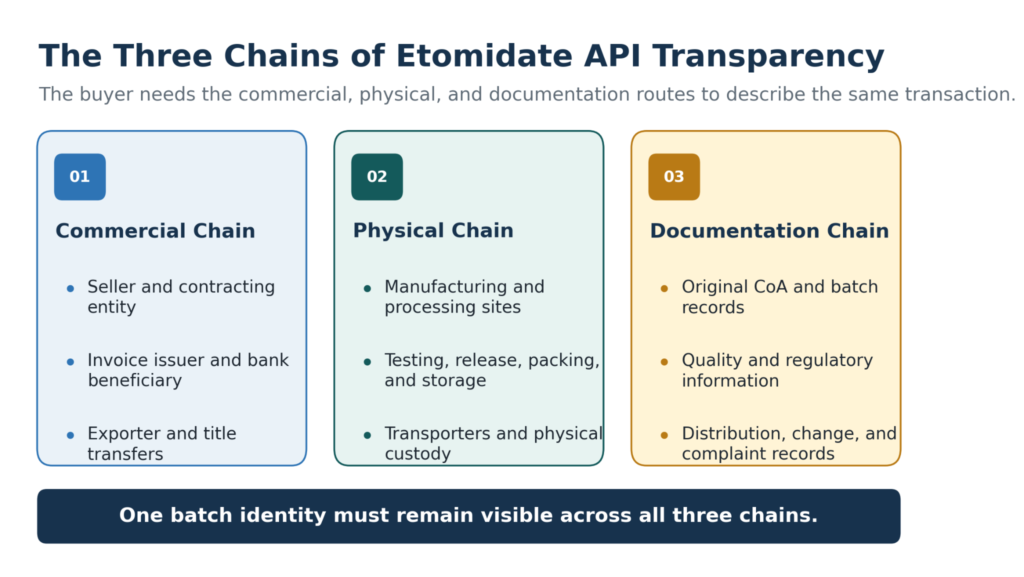
Infographic 1. The three chains of Etomidate API transparency.
Why Does Supply-Chain Transparency Matter?
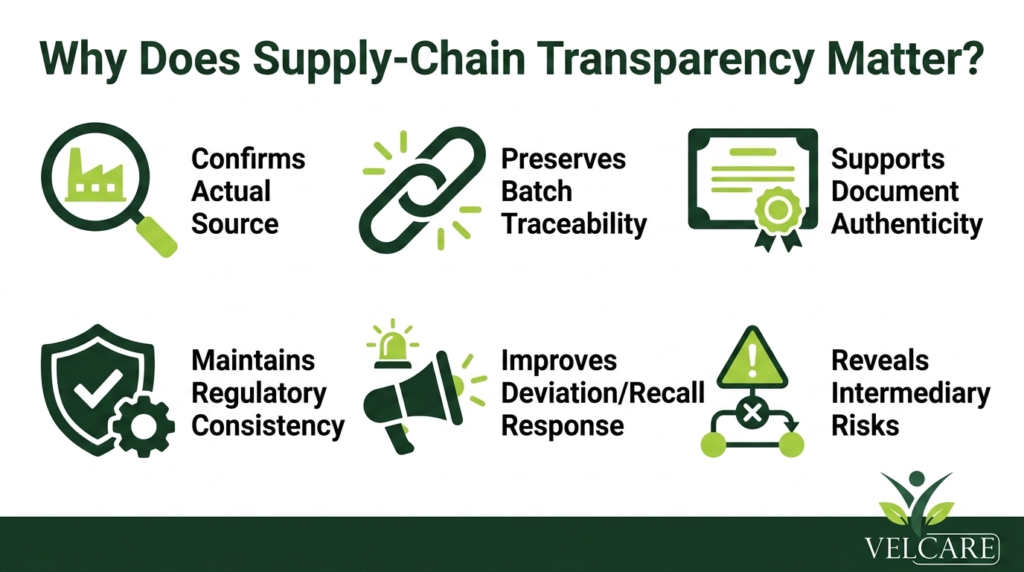
1. It Confirms the Actual Source of the API
The supplier named on a quotation or invoice is not necessarily the original manufacturer. This distinction affects which site the buyer evaluates, which site appears in regulatory or customer-approved records, and which organization owns the original manufacturing data.
The buyer therefore needs the manufacturer’s complete legal name, site address, and role in producing the final purified API. These details can then be compared with the CoA, GMP evidence, qualification records, and any relevant regulatory submission. The related distinction is covered in more detail in Etomidate API Manufacturer vs. Supplier: Why the Distinction Matters.
This is not a theoretical documentation issue. In a 2017 warning letter, the FDA described an API distributor that replaced original-manufacturer information with its own letterhead on CoAs and declared itself as the manufacturer in importation documents. The agency stated that omitting the original source compromised supply-chain accountability and traceability.
2. It Preserves Batch Traceability
Each Etomidate API batch needs an unbroken connection to its original manufacturer, manufacturer-assigned batch number, CoA, and distribution history. That connection can weaken when an intermediary assigns an internal lot number, splits a batch, replaces labels, or issues its own document without showing how the records correspond.
ICH Q7 lists the records expected to support complete traceability through agents, brokers, traders, distributors, repackers, and relabellers. These include the original manufacturer’s identity and address, purchase orders, receipt records, bills of lading, the manufacturer’s batch number, transportation records, authentic CoAs, and the retest or expiry date.
The buyer should be able to trace the received material backward to its manufacturing source and forward through each custodian. This is different from receiving a folder of documents that cannot be tied to the containers delivered.
3. It Supports the Authenticity of Quality Documents
A supplier-issued CoA may reproduce the manufacturer’s results, add distributor testing, or combine information from more than one source. The document needs to state its basis clearly. A buyer reviewing the CoA should be able to determine who performed each test, who approved the results, and whether an authentic manufacturer-issued CoA is also available.
The following details need to agree:
- the API name or approved material designation;
- the original manufacturer’s name and site;
- the batch number shown on the CoA and container label;
- the specification version and reported test results;
- the testing laboratory, if different from the manufacturer; and
- the retest or expiry date.
An intermediary’s format is not automatically unacceptable. The concern arises when reformatting removes the original source, changes attribution, or prevents the results from being authenticated. A separate review of How to Review an Etomidate API Certificate of Analysis can be used to examine the analytical document itself.
4. It Helps Maintain Regulatory Consistency
The physical manufacturing chain needs to match the chain evaluated and approved by the buyer. Where the API is associated with a regulatory submission, the declared manufacturing, testing, and processing sites also need to remain consistent with the applicable filing.
ICH Q10 places purchased materials and outsourced activities within the pharmaceutical quality system. It refers to supplier assessment using a defined supply chain and to monitoring incoming materials against the agreed chain. ICH Q12 addresses communication of manufacturing changes across multiple internal and external entities.
A new testing laboratory, an additional micronization site, a different manufacturer, or an undisclosed repacker can therefore require assessment before the affected batch is accepted. The regulatory reporting category depends on the product, registered details, market, and nature of the change. A GMP certificate alone does not establish that the full chain matches a particular product filing or customer approval.
5. It Improves Deviation, Complaint, and Recall Response
When a batch develops an atypical result, packaging discrepancy, transport excursion, or other quality concern, the investigation needs records from the parties that performed the relevant work. The supplier must know who holds the manufacturing record, analytical data, release decision, storage log, and shipping record.
ICH Q7 expects intermediaries to maintain complaint and recall records and, where warranted, review a quality complaint with the original manufacturer. The record should also retain the manufacturer’s response. This allows the investigating team to follow the evidence instead of sending requests through an undefined series of traders.
Distribution traceability serves the opposite direction. It identifies which customers received the affected batch and supports a targeted recall. Without complete batch and consignee records, the scope can take longer to establish.
6. It Reveals Risks Introduced by Intermediaries
An authorized distributor can provide a legitimate and efficient route to the manufacturer. The risk does not arise from the presence of an intermediary alone. It arises when the intermediary’s authority, handling activities, or access to source records cannot be established.
Points requiring clarification include:
- the original manufacturer is withheld or described only after payment;
- quality documents show the distributor but not the source manufacturer;
- repacking or relabelling is performed without identifying the facility;
- more than one trader takes title to or custody of the same batch;
- the shipment origin differs from the stated storage location;
- transport conditions cannot be supported by records; or
- the seller cannot obtain a technical response from the manufacturer.
Intermediaries also affect schedule visibility. A seller holding released stock has a different timeline from one waiting for production, testing, document release, or transfer from another trader. This relationship can be expanded through Etomidate API Lead Time: What Buyers Need to Confirm Before Ordering.
What Should an Etomidate API Supplier Disclose?
The requested information should correspond to the supplier’s actual role and the proposed transaction. A direct manufacturer, authorized distributor, and independent trader will not hold the same records, but each needs to explain where the authoritative record resides and how the buyer can obtain it.
Supplier and Manufacturer Identity
The disclosure should state the supplier’s complete legal name, registered address, and role in the transaction. It should separately identify the original manufacturer’s legal name and manufacturing-site address. When the seller acts as an agent or distributor, the buyer can request evidence that the manufacturer authorizes that relationship or recognizes the route of supply.
Manufacturing and Testing Chain
The buyer needs the locations used for final API manufacture, purification, later physical processing, contract testing, QA release, repacking, relabelling, and storage. The disclosure should name the responsible party for each activity instead of using broad statements such as “handled by our manufacturing partner.”
Batch and Document Traceability
The batch record set should include the original manufacturer-assigned batch number, the manufacturer-issued CoA, and any distributor lot number applied later. Where both numbers exist, the supplier needs a documented cross-reference. Container labels, packaging records, applicable GMP evidence, specifications, and regulatory documents should identify the same source and material.
Logistics and Communication
The supplier should identify the shipment origin, expected transport route, required storage and transport conditions, and each party taking physical custody. The buyer also needs named routes for change notifications, deviations, complaints, investigations, returns, and recalls.
The European Commission’s GDP guideline for active substances illustrates the level of distribution traceability expected in the EU. It calls for purchase and sales records that identify the supplier, original manufacturer, shipping agent or consignee, batch number, transportation records, and original manufacturer CoA. It also addresses contracted storage and transport, information transfer, and batch-specific recall identification. Requirements for a particular purchase still depend on the destination market and the parties’ regulatory roles.
How Can Buyers Assess Supply-Chain Transparency?
Map the Supply Chain Before Approval
Start with the physical route rather than the sales presentation. Ask the supplier to name the legal entity and site performing each applicable activity. If one company performs several activities, show that once and assign all relevant roles to it. If a stage does not apply, record it as not applicable rather than leaving a gap.
The map should distinguish title transfer from physical custody. An exporter may issue the commercial invoice without storing the API. A logistics provider may hold the material without owning it. A contract laboratory may test a sample without receiving the full batch. These differences determine which records each party can reasonably provide.
Reconcile Information Across Documents
Review the quotation, proforma invoice, CoA, container labels, GMP evidence, shipping documents, purchase records, and bank beneficiary details as one document set. Compare four identifiers throughout:
- legal entity;
- physical site;
- batch number; and
- stated role.
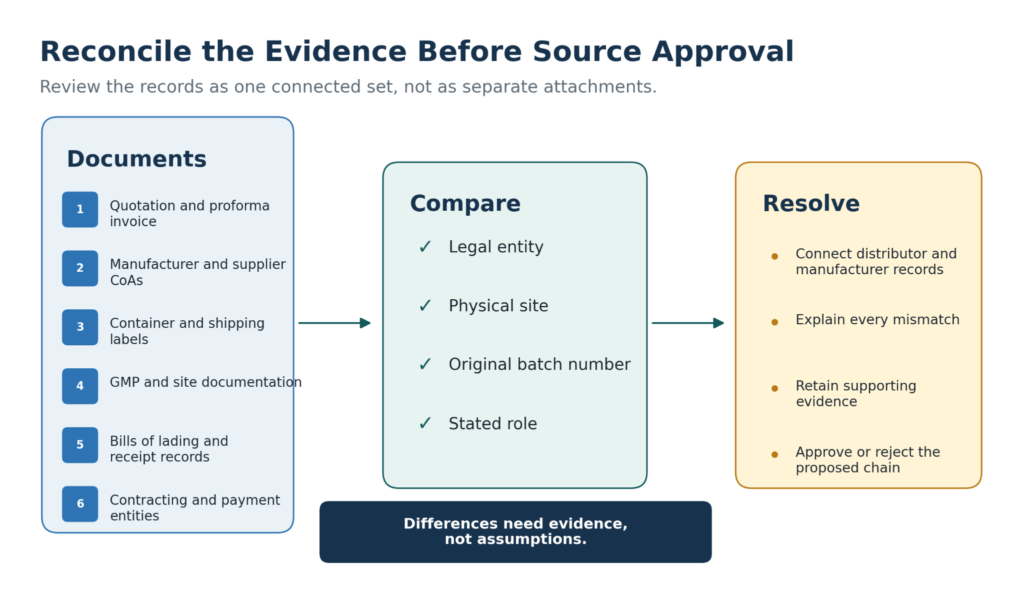
Infographic 2. Document reconciliation before source approval.
A difference is not automatically disqualifying. For example, the seller and bank beneficiary may belong to related legal entities, or an internal distributor lot may sit alongside the manufacturer’s batch number. The supplier needs to explain the relationship and provide records connecting the two. Unexplained substitution is the issue.
Verify the Supplier’s Access to the Manufacturer
Document availability alone does not prove that the supplier can support the material after delivery. Determine whether it can obtain original documents, arrange a quality or technical exchange, notify the manufacturer of a complaint, communicate proposed changes, support an audit or qualification questionnaire, and retrieve an investigation response.
The response route should be tested during qualification. A supplier that cannot obtain a basic technical clarification before purchase may have the same limitation during a deviation investigation.
Document Responsibilities in the Quality Agreement
Where a quality agreement is appropriate to the relationship, it should assign responsibility for manufacturing, testing, batch release, document transfer, change notification, storage, transportation, deviations, complaints, returns, recalls, and subcontracting.
The agreement needs to reflect the actual chain. It should not assign manufacturing obligations to a commercial agent that neither performs nor controls manufacturing. ICH Q7 states that contract manufacturing arrangements should define GMP responsibilities in a written and approved agreement. It also addresses prior evaluation and approval before contracted work is passed to another party.
Final Buyer Takeaway
A transparent Etomidate API supply chain lets the buyer connect the received containers to the original manufacturing site, batch identity, handling history, analytical records, and responsible quality units. It also establishes how changes, deviations, and complaints reach the party holding the underlying records.
If that chain cannot be reconstructed, the buyer has not established the source behind the quotation. Price, a supplier-branded CoA, and a general GMP document do not resolve that gap.
Discuss Your Etomidate API Requirements
Velcare Pharma can receive Etomidate API enquiries with the intended market, required quantity, specification or pharmacopeial grade, documentation requirements, delivery destination, and requested timeline. This information allows the proposed source, batch documentation, and supply route to be reviewed against the buyer’s request. Explore Velcare Pharma or submit the requirement through the company’s contact page.