An Etomidate API sample can progress to a commercial order only after the buyer confirms that the material meets its technical requirements.
Acceptable sample results alone are not sufficient. A sample may come from a different process or batch type than future commercial material. The company supplying it may also be different from the original manufacturer. Missing regulatory documents, unsuitable batch sizes or an undefined delivery schedule can prevent procurement even when laboratory results are satisfactory.
The process therefore requires coordination between technical, quality, regulatory, procurement and supply-chain teams. Learn below how you can source Etomidate from a seller after you have received their sample with complete guidance.
How to Move From an Etomidate API Sample to a Commercial Order
The following steps elaborate on how you can order a sample after receiving the sample:
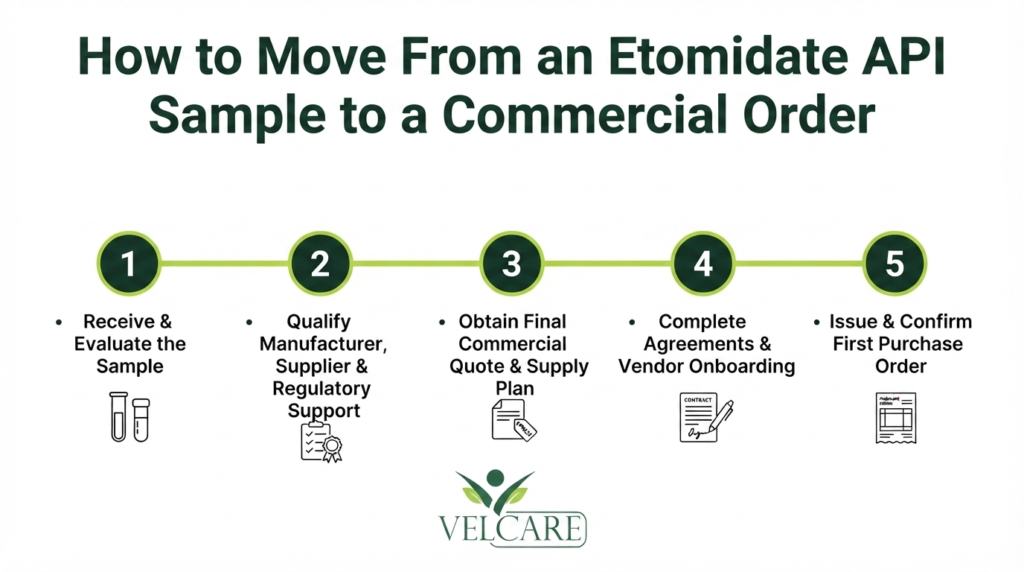
Step 1: Receive and Evaluate the Sample Against the Buyer’s Requirements
Begin by confirming what the sample represents. It should be traceable to the stated manufacturer, manufacturing site, batch and process proposed for future supply. If it comes from a development batch, specially prepared laboratory lot or another facility, its relevance to routine commercial production must be assessed before testing begins.
The sample should arrive with enough technical information to establish its identity and testing basis. The package commonly includes:
- Batch-specific Certificate of Analysis
- Current Etomidate specification
- Batch and manufacturing-site identification
- Analytical methods or method summaries
- Safety Data Sheet
- Storage and handling instructions
- Retest or expiry information
- Packaging and label details
- Relevant impurity and stability information
The receiving team should perform testing on the sample. It should follow a predefined protocol based on the buyer’s specification and intended use.
The buyer’s results should be compared with the supplier’s COA. A difference does not automatically mean the material has failed.
NOTE:
The controlled process is explained in more detail in the guide to evaluating an Etomidate API sample before commercial procurement. Buyers can also use the article on documents to request from an Etomidate API supplier to prepare the supporting information list.
Decision Gate
The sample can advance when it meets the buyer’s technical acceptance criteria and is sufficiently representative of the proposed commercial source. Approval shows that the evaluated sample is acceptable. It does not establish consistency across future commercial batches.
Step 2: Qualify the Manufacturer, Supplier and US Regulatory Support
Supplier qualification and regulatory review do not need to wait for the final sample report. Starting them while laboratory work is underway can shorten the procurement cycle without reducing the depth of the assessment.
Qualify the Manufacturer and Commercial Supplier
First, establish the identity and responsibilities of every company involved. The company issuing the quotation may manufacture the API, distribute material produced by another company or coordinate export without performing a manufacturing operation.
This distinction affects the qualification scope. The original manufacturing site controls synthesis and other assigned manufacturing operations, while the commercial supplier may control order processing, storage, repacking, export or communication. The article on Etomidate API manufacturers and suppliers explains how these responsibilities differ.
The qualification review should address:
- Legal identity and physical locations
- Manufacturing, testing, release and storage sites
- Supplier questionnaire and supporting evidence
- Relevant GMP and inspection history
- Quality-system and data-integrity controls
- Deviation, OOS, CAPA and change-control procedures
- Complaint and recall arrangements
- On-site or remote audit findings, where an audit is required
- Closure of qualification-related observations
Confirm Suitability for the US Program
For an API shipped directly into the United States, regulatory affairs should verify the establishment and import information applicable to the proposed supply route. FDA states that foreign establishments that manufacture, repack, relabel or salvage APIs imported or offered for import into the United States are subject to applicable API import and establishment-registration requirements.
Decision Gate
Commercial purchasing can proceed when QA has approved the relevant manufacturer and supplier, and regulatory affairs has determined that the source and supporting information are suitable for the intended US program.
Step 3: Obtain the Final Commercial Quote and Confirm the Supply Plan
A quotation issued for a sample or development quantity should not be carried forward without review. The commercial offer needs to reflect the approved source, required specification and actual purchasing conditions.
Start by defining the first-order quantity, commercial MOQ, standard batch size, pack configuration and expected ordering frequency. An annual forecast helps the supplier assess production scheduling and capacity, but it should be clearly identified as a forecast unless it creates a contractual purchasing commitment.
The quotation should then state the unit price, currency, price-validity period, payment terms and any volume-based price structure. The factors that determine a comparable commercial offer are covered in Velcare’s guide to Etomidate API pricing.
Material status needs equal attention. Procurement should establish whether the offered quantity is:
- Released stock available for allocation
- Manufactured stock awaiting QC or QA release
- Material requiring a new production campaign
The quotation should identify the event that starts the lead-time calculation, such as purchase-order acceptance, advance-payment receipt or final specification approval. It should also distinguish production and dispatch lead time from international transport and US import clearance. The guide to Etomidate API lead time explains how to define these milestones.
Decision Gate
The offer is commercially acceptable when the quantity, price, batch status, packaging, remaining retest period, delivery basis and supply schedule meet the buyer’s approved requirements.
Step 4: Complete the Agreements and Internal Vendor Onboarding
An accepted quotation does not necessarily authorize procurement to place the order. The buyer may still need a quality agreement, commercial supply terms and an approved vendor record.
The quality agreement should assign responsibilities for batch testing and release, documentation, change notification, deviations, OOS investigations, complaints, recalls, audits, record retention and regulatory communication. It should identify which quality unit handles each activity and how information passes between the manufacturer, supplier and buyer.
For supply from Velcare in India to a US destination, the parties should also confirm the importer, customs broker, shipping contacts and the records required for entry. These responsibilities should match the agreed Incoterm and purchase-order instructions.
Decision Gate
The order can be issued when QA, regulatory affairs, procurement, legal and finance have completed the approvals required by the buyer’s procedures.
Step 5: Issue and Confirm the First Commercial Purchase Order
The purchase order should identify the exact material being purchased rather than relying on a general product description. It should include:
- Etomidate API name and applicable product code
- Specification and revision
- Approved manufacturer and manufacturing site
- Quantity and pack size
- Price and currency
- Incoterm and named destination
- Required delivery date
- Minimum remaining retest period
- Payment terms
- Batch and production requirements
- Documents required with the shipment
- Applicable quality or supply-agreement reference
Any exception must be resolved before the order is treated as confirmed. For example, substituting a different manufacturing site, pack size or specification cannot be handled as a routine clerical change when the approved source is tied to those details.
What Happens After the Commercial Order Is Placed?
Purchase-order confirmation starts the fulfillment phase. The supplier allocates released inventory or schedules production, completes required testing, performs QA batch release and prepares the commercial COA and shipping records. The material is then packed, exported, entered into the United States and delivered to the named destination.
On receipt, the commercial lot remains subject to the buyer’s quarantine, sampling, testing and release procedures. FDA’s explanation of 21 CFR 211.84 states that representative samples of each shipment of each component lot must be collected after receipt. Pre-shipment or piggyback samples are generally not acceptable substitutes for this incoming assessment.
Information to Provide When Requesting an Etomidate API Sample or Commercial Quote
A complete inquiry should state:
- Company name and intended application
- US development or commercial stage
- Required Etomidate specification
- Sample quantity
- Expected first commercial quantity
- Estimated annual demand
- Required technical and regulatory documentation
- USDMF and Letter of Authorization needs, where applicable
- US delivery destination
- Requested sample or commercial delivery date
- Preferred packaging and Incoterm
Export Quality Grade Etomidate API from Velcare Pharma at Reasonable Pricing
Share these details with Velcare Pharma to discuss the applicable Etomidate API sample, documentation package and commercial quotation for the intended procurement stage. #