A request for “etomidate powder” sounds specific, but for a pharmaceutical supplier it can still leave an important question unanswered: does the buyer need bulk Etomidate active pharmaceutical ingredient (API), or a finished Etomidate Injection?
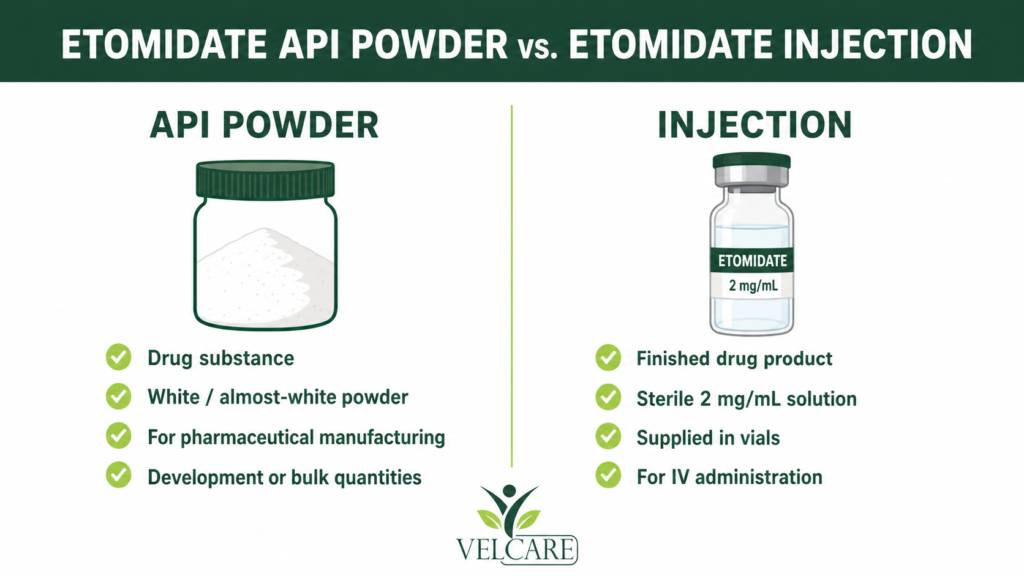
These are not interchangeable products. The API is the active drug substance purchased for pharmaceutical development or manufacturing. Etomidate Injection is a finished sterile dosage form prepared for intravenous administration.
The distinction affects the specification a buyer sends, the quantity being quoted, quality documentation, supplier qualification, and the regulatory route for importing the material into the United States.
For a U.S. pharmaceutical company sourcing material for injectable manufacturing, the inquiry should therefore clearly identify Etomidate API or drug substance, rather than simply requesting “Etomidate,” “Etomidate powder,” or “Etomidate Injection.”
Etomidate API Powder vs. Etomidate Injection: What Is the Difference?
The FDA’s ICH Q7 Good Manufacturing Practice Guidance for Active Pharmaceutical Ingredients defines an API, or drug substance, as a substance intended for use in manufacturing a drug product that becomes its active ingredient. The same guidance describes the drug product as the dosage form in its final immediate packaging intended for marketing.
This distinction can be seen clearly with Etomidate.
A current DailyMed listing for Etomidate Injection, USP identifies the finished product as a sterile 2 mg/mL solution for intravenous use. It is supplied in 10 mL and 20 mL single-dose vials containing 20 mg and 40 mg of Etomidate, respectively.
| Point | Etomidate API Powder | Etomidate Injection |
| Product type | Active pharmaceutical ingredient / drug substance | Finished drug product |
| Physical form | Powder | Sterile liquid solution |
| Main purpose | Used to manufacture a drug product | Intended for intravenous administration |
| Typical buyer | Pharmaceutical manufacturer, CDMO, R&D or formulation team | Hospital, pharmacy or healthcare distributor |
| Purchasing unit | Development or bulk quantity | Finished vials |
| Main quality focus | API specification, identity, assay, impurities, source and documentation | Finished-product strength, sterility, packaging and release requirements |
| Typical U.S. presentation | Not a finished dosage form | 2 mg/mL injection |
Why “Etomidate Powder” Alone Can Create Problems for Buyers
The phrase describes a physical form, but not necessarily the pharmaceutical role or quality requirement.
A search result or quotation for “Etomidate powder” might refer to an API intended for pharmaceutical manufacturing, research material, an analytical/reference material, or a listing that provides little information about its intended use.
For an injectable manufacturer, those differences matter.
A quotation can look commercially attractive while the proposed source is unsuitable for the company’s specification or regulatory strategy. Procurement should therefore establish whether the company providing the material is the actual manufacturer or another commercial intermediary. Understanding the difference between an Etomidate API manufacturer and supplier helps clarify who manufactures the material and who is handling the commercial transaction.
“Raw material” can also be too broad. ICH Q7 separately defines raw materials, API starting materials, intermediates, and the final API. A company purchasing the final active drug substance should therefore specify Etomidate API rather than relying solely on the phrase “Etomidate raw material.” FDA’s Q7 guidance provides the underlying terminology.
What U.S. Buyers Should Specify When Requesting Etomidate API
A sourcing inquiry does not need to contain every technical detail available about the molecule. It does, however, need enough information for the supplier to understand exactly what material is being evaluated.
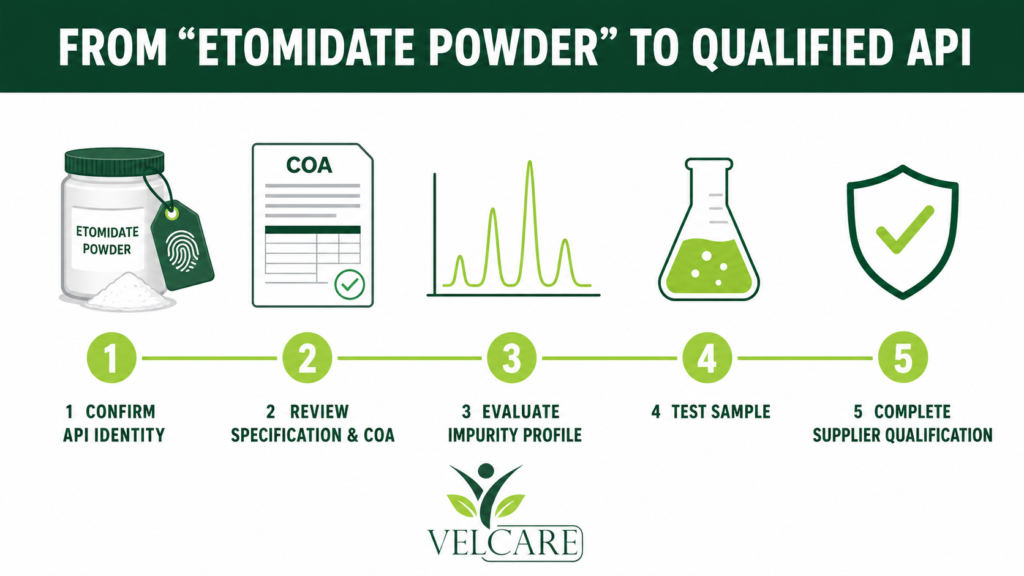
1. Product Identity and Intended Use
Start by identifying the requirement as:
Etomidate API / Etomidate drug substance
Where appropriate, add:
Intended for pharmaceutical development or manufacture of Etomidate Injection.
This immediately separates the inquiry from a request for finished injectable vials.
The material can also be identified using CAS No. 33125-97-2. Product identity should remain consistent across the specification, quotation, COA, supplier records, and subsequent shipment documentation.
Buyers can compare this basic requirement with the information presented on the Etomidate API product page before preparing an inquiry.
2. Required Specification
Next, state the quality standard against which the proposed API will be evaluated.
The requirement may be based on an applicable pharmacopeial standard, an internally approved specification, or additional controls established for a particular drug-development program.
Depending on the approved specification, the review may cover attributes such as:
- identification;
- assay;
- individual related substances;
- total impurities;
- residual solvents, where applicable;
- loss on drying or water, where applicable;
- and other drug-substance tests required for the project.
The objective should not simply be to ask for the “highest purity available.” Procurement needs material that meets the specification approved by QA, analytical, CMC, and regulatory teams.
A buyer can also use the Etomidate API impurity profile as a separate consideration rather than relying only on the headline assay result.
3. Sample, Validation, or Commercial Quantity
Quantity should reflect the stage of the project.
A buyer may need material for:
- analytical evaluation;
- formulation development;
- supplier qualification;
- validation or exhibit batches;
- or recurring commercial production.
An evaluation requirement should not be presented as though the buyer is immediately placing a commercial-scale order.
Where the first requirement is only a sample, the process for ordering an Etomidate API sample from India for U.S. evaluation should be considered separately from future commercial procurement.
After the material is received, the company should then evaluate the Etomidate API sample before commercial procurement according to its approved internal procedures.
Confirm the Actual Manufacturing Source
The company issuing a quotation may not always be the company that manufactures the API.
Before qualification progresses, procurement and QA should identify:
- the legal manufacturer;
- the manufacturing-site location;
- the supplier or intermediary, if different;
- and the relationship between those parties.
This information becomes particularly important when the API is being sourced internationally.
The same manufacturer identity should remain consistent across supplier questionnaires, specifications, batch documents, regulatory records, and commercial documentation. Establishing this chain is part of maintaining supply-chain transparency when sourcing Etomidate API.
If a particular URL is not yet indexed publicly, buyers can still begin with the broader regulatory documents required for Etomidate API sourcing and confirm source identity before progressing to commercial evaluation.
Request Documents According to the Qualification Stage
Avoid asking a supplier for “all documents” without first deciding what needs to be reviewed.
At an early stage, procurement or QA may request documents such as:
- API specification;
- batch-specific COA;
- SDS;
- manufacturer information;
- applicable GMP documentation;
- stability or retest information, where required;
- and regulatory information relevant to the project.
The document package should collectively help the buyer confirm material identity, quality controls, manufacturing source, batch traceability, and regulatory suitability.
A structured list of documents to request from an Etomidate API supplier can help procurement separate basic screening documents from material required later during formal qualification.
For U.S. programs, CMC and regulatory teams should also establish whether a Drug Master File is relevant.
FDA explains in its Drug Master File guidance that a DMF may contain confidential information concerning facilities, processes, or materials used in drug manufacturing. FDA also makes an important distinction: submitting a DMF is not itself required by law or regulation, and a DMF is not independently approved or disapproved.
For API-related submissions, FDA identifies Type II as the DMF type that may contain information on a drug substance, drug-substance intermediate, or materials used in their preparation.
If an applicant needs FDA to reference information within a DMF, the holder provides authorization. The role of the Etomidate API USDMF and Letter of Authorization should therefore be considered separately from the API’s physical quality specification.
“DMF grade” should not be treated as though it were a purity grade.
What QA Should Check Before Accepting Etomidate API Powder
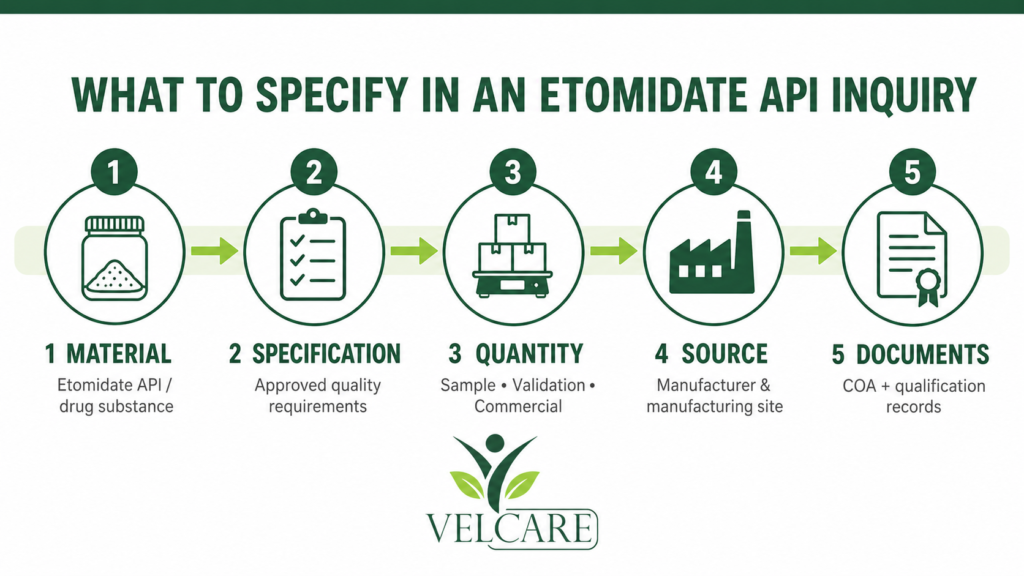
Using the correct product name gets the inquiry to the right type of source. It does not qualify the batch.
QA still needs to determine whether the proposed material meets the approved specification and whether the source is acceptable within the company’s supplier-management system.
Review the Batch-Specific COA
A COA should correspond to an identifiable batch and report actual results against the applicable specification.
The buyer should review details such as:
- product identity;
- batch number;
- applicable specification;
- test parameters;
- reported results;
- and release information.
For Etomidate, assay should not be reviewed in isolation.
Two lots can report similar assay results but show differences in individual impurities or total related substances. This makes the Etomidate API impurity profile particularly relevant when comparing evaluation and commercial batches.
Evaluate the Sample
A new source usually progresses from document review to physical sample evaluation under the buyer’s internal qualification procedure.
The sample should be traceable to a known batch and supported by the relevant documentation. Analytical teams can then compare their results against the supplier information and the company’s approved requirements.
The process is discussed in more detail in the guide on evaluating an Etomidate API sample before procurement.
Passing sample testing is an important milestone, but it should not automatically be treated as completion of supplier qualification or regulatory onboarding.
Do Not Apply Finished-Injection Requirements Directly to the API
Etomidate Injection is a finished sterile dosage form. Etomidate API is one of the materials used earlier in the pharmaceutical manufacturing process.
For example, the DailyMed label for Etomidate Injection identifies finished-product attributes such as 2 mg/mL strength, intravenous administration, single-dose vials, and specific package sizes.
These are finished-product requirements.
An API purchasing specification instead focuses on the drug substance: its identity, assay, impurity controls, applicable physicochemical tests, packaging, storage, batch traceability, and supporting quality documentation.
The storage condition printed on a finished injection label should therefore not simply be copied into an API purchase specification.
ICH Q7 specifically addresses manufacturing, packaging, labeling, storage, and distribution controls for APIs.
Importing Etomidate API Into the United States
The distinction between API and finished injection also affects import planning.
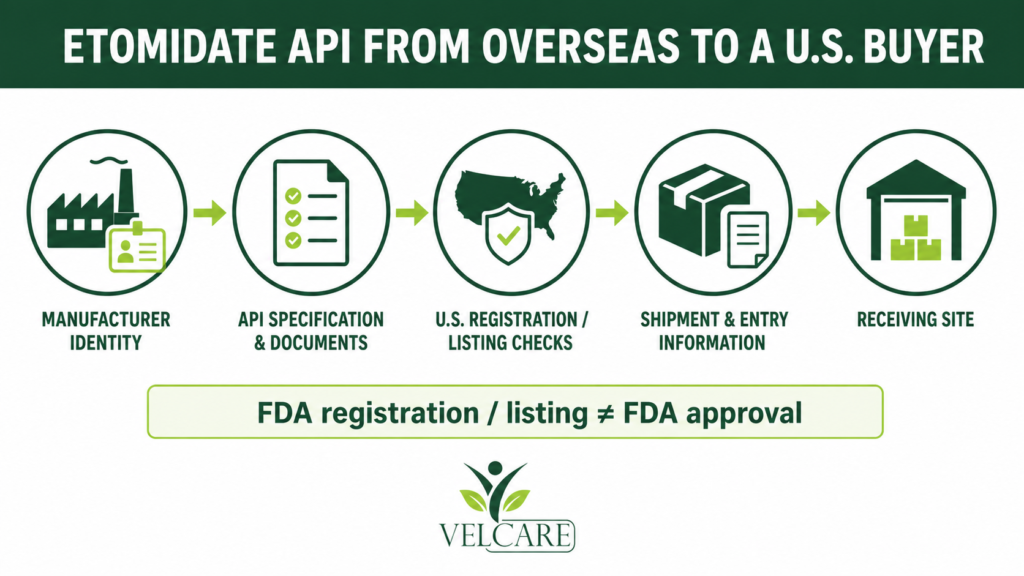
FDA states that APIs imported or offered for import into the United States must comply with applicable requirements under the Federal Food, Drug, and Cosmetic Act and Title 21 of the Code of Federal Regulations.
For imported APIs, FDA identifies requirements that may include foreign establishment registration and drug listing. Foreign establishments manufacturing APIs offered for U.S. import generally must register with FDA, and commercially distributed APIs are subject to drug-listing requirements. FDA’s current API import guidance explains these requirements directly.
The buyer should therefore confirm manufacturer identity and relevant U.S. regulatory information before the shipment is ready for dispatch.
The broader process is covered in Importing Etomidate API Into the United States, while companies specifically sourcing from India can also review Etomidate API supply from India to the USA when planning documentation, samples, lead time, and delivery.
One distinction is particularly important: FDA registration should not be presented as equivalent to FDA approval. Registration, listing, and product approval are separate regulatory concepts.
Common Etomidate Sourcing Terms That Should Not Be Used Interchangeably
| Term | What the buyer should understand |
| Etomidate API | Active pharmaceutical ingredient/drug substance |
| Etomidate powder | Physical description that may still require qualification |
| Etomidate USP | Should still clarify whether the requirement is the drug substance or finished dosage form |
| Etomidate Injection USP | Finished injectable drug product |
| Etomidate raw material | Broad term; confirm whether the final API is required |
| Research-grade Etomidate | Should not automatically be assumed suitable for pharmaceutical manufacturing |
| DMF-grade Etomidate | Avoid using DMF status as a substitute for an API quality specification |
The safest procurement approach is to define the material’s pharmaceutical role first and then state its quality requirements
What a Practical Etomidate API RFQ Should Include
Once the internal requirement has been agreed, procurement can communicate it without writing an unnecessarily long inquiry.
A useful RFQ may contain:
Product: Etomidate API / drug substance
CAS No.: 33125-97-2
Intended use: Pharmaceutical development or manufacturing
Required specification: [Insert approved requirement]
Quantity: [Evaluation/validation / commercial requirement]
Required documentation: [Insert required documents]
Manufacturer information: Required
Destination: [U.S. receiving location]
Commercial information: Price, availability, lead time, and applicable shipping terms
Providing these details also makes quotations easier to compare.
If one offer is based on research material, another on pharmaceutical API, and a third on a different specification, comparing only price per kilogram can give procurement a misleading picture.
The commercial review should therefore follow a properly defined inquiry. Buyers can use the guide on requesting Etomidate API pricing alongside the technical requirements before comparing commercial offers.
Final Takeaway
For U.S. pharmaceutical buyers, the difference between Etomidate API powder and Etomidate Injection is not merely a difference in physical form.
They sit at different stages of the pharmaceutical supply chain.
Etomidate API is the drug substance a manufacturer evaluates and purchases for pharmaceutical production. Etomidate Injection is the finished sterile product prepared for intravenous administration.
Instead of requesting only:
“Etomidate powder”
procurement should define:
Etomidate API/drug substance + specification + intended use + quantity + manufacturing source + required documents + destination.
This gives procurement, QA, CMC, regulatory teams, and the supplier the same understanding before technical qualification or commercial discussions begin.
Companies evaluating an API source can review the Etomidate API product information and prepare their required specification, quantity, destination, and document requirements before requesting a quotation.
FAQs
Is Etomidate API powder the same as Etomidate Injection?
No. Etomidate API is the active drug substance used in pharmaceutical manufacturing. Etomidate Injection is a finished sterile dosage form containing Etomidate in solution for intravenous administration.
What strength is Etomidate Injection in the United States?
Current DailyMed Etomidate Injection labeling identifies the product at 2 mg/mL, including 20 mg/10 mL and 40 mg/20 mL single-dose vial presentations.
Can Etomidate API powder be administered directly?
Bulk API should not be treated as a finished injectable medicine. Finished Etomidate Injection goes through drug-product formulation, sterile manufacturing, finished-product testing, packaging, and release controls before patient use.
Does “Etomidate USP powder” provide enough information for an RFQ?
Not necessarily. Buyers should still identify the requirement as Etomidate API/drug substance and state the applicable specification, quantity, intended use, source requirements, and documentation needed for qualification.
Is a U.S. DMF the same as an API quality grade?
No. FDA describes a DMF as a regulatory submission mechanism through which confidential manufacturing or technical information may support another regulatory submission. It is not a purity grade and does not replace evaluation of the API specification or batch quality. FDA’s DMF guidance also states that DMFs are not independently approved or disapproved.
Does FDA registration mean an overseas Etomidate API manufacturer is FDA approved?
No. Establishment registration, drug listing, and approval are different concepts. Buyers should verify the regulatory status relevant to their supply arrangement rather than treating registration alone as FDA approval.