
A retest date printed on an Etomidate API certificate of analysis gives procurement a date to record. For QA and CMC teams, it raises another question: what stability evidence supports that date?
The answer cannot be taken from one COA alone. The reviewer needs to understand which batches entered the stability study, whether they represent the proposed commercial material, how they were packaged and stored, which attributes were tested, and how those results changed over time.
This becomes more relevant when the proposed retest period extends beyond the amount of real-time data currently available. In that case, the buyer should understand what portion is supported by observed long-term data and what portion, if any, relies on scientifically justified extrapolation.
The following guide explains how procurement and QA teams can review an Etomidate API stability package without confusing stability assessment with a routine batch-release or COA review.
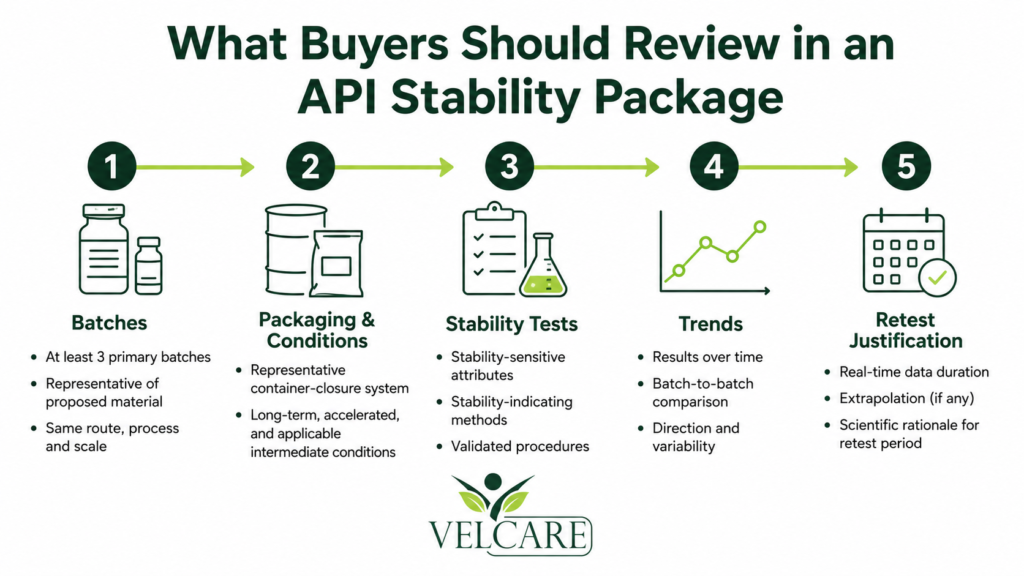
Quick Answer: What Should Buyers Review in Etomidate API Stability Data?
Start by checking the following areas:
Retest Period, Retest Date, and Expiry Date Are Not the Same Thing
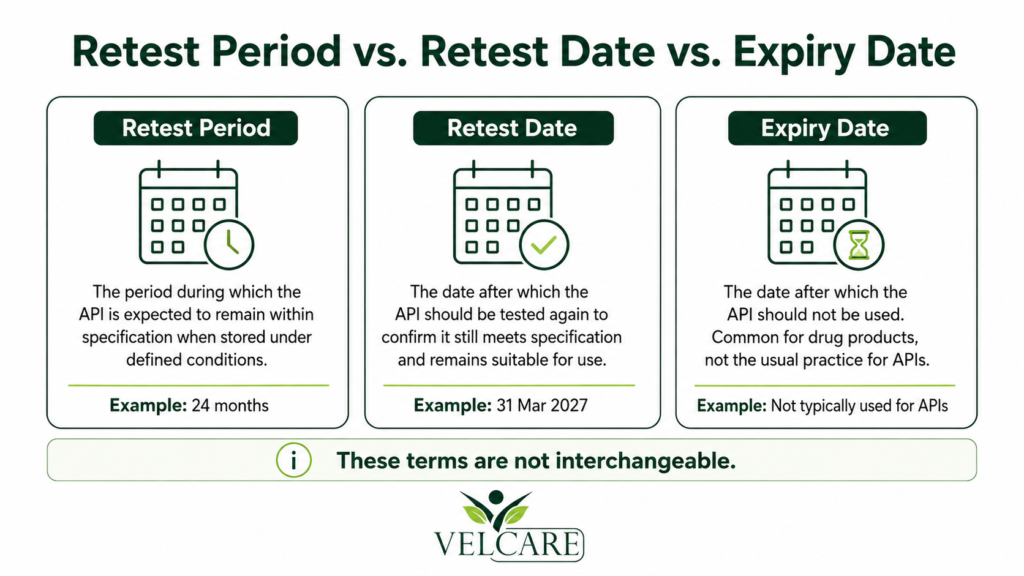
These terms can look interchangeable on purchasing documents, but they describe different concepts.
Under ICH Q1A(R2), the retest period is the period during which a drug substance is expected to remain within its specification when stored under defined conditions. A retest date is the date after which the drug substance should be examined again to determine whether it still complies with the specification and remains suitable for use.
An expiration date has a different meaning. ICH Q7 notes that common practice for APIs is to use a retest date rather than an expiration date. That should not be turned into a universal claim that every API in every situation must carry a retest date.
This distinction matters during supplier review. A COA can show the assigned retest date for a particular batch, but the stability program provides the scientific basis behind that date.
What Should an Etomidate API Stability Package Contain?
A stability summary becomes useful only when the reviewer can connect the results to the material that may actually be purchased. Start with the batches and study design before focusing on individual numbers.
Stability Batch Selection and Representativeness
Under the formal drug-substance stability framework in ICH Q1A(R2), data are provided on at least three primary batches. These batches should be manufactured at a minimum of pilot scale using the same synthetic route and a process representative of the intended production process.
This is different from asking a supplier for three recent COAs.
Three COAs compare separately manufactured batches at particular testing points. A stability study follows defined batches through multiple time points under controlled storage conditions.
When reviewing the stability package, check:
- Batch numbers
- Pilot or production scale
- Manufacturing site
- Synthetic route and relevant process version
- Manufacturing dates
- Specification revision
- Whether the batches represent the material proposed for future supply
If the question instead concerns variation between separately manufactured commercial batches, that belongs to the broader assessment of Etomidate API batch-to-batch consistency. Stability review looks mainly at how the studied material changes over time.
Container-Closure System Used in the Study
Packaging is part of the stability question.
ICH Q1A(R2) expects drug-substance stability studies to use a container-closure system that is the same as, or simulates, the packaging proposed for storage and distribution. ICH Q7 similarly recommends storing stability samples in containers that simulate the market container.
Therefore, check whether the study configuration reasonably represents the commercial pack being offered.
For example:
- Is the primary packaging material the same?
- Does the commercial pack provide comparable protection?
- Has the packaging changed since the study began?
- If a smaller study container was used, how does it represent the proposed commercial configuration?
Packaging materials and commercial storage arrangements have their own sourcing considerations, so the full assessment belongs in the separate guide to Etomidate API packaging and storage considerations.
Long-Term, Accelerated, and Intermediate Stability Conditions
The storage conditions tell you what type of evidence you are looking at.
Long-term studies follow the drug substance under the intended stability-study storage conditions and provide the real-time foundation for evaluating the retest period.
Accelerated studies use more stressful conditions and can help reveal degradation behavior over a shorter period.
For the general case, ICH Q1A(R2) includes 25°C ± 2°C/60% RH ± 5% RH or 30°C ± 2°C/65% RH ± 5% RH as long-term options and 40°C ± 2°C/75% RH ± 5% RH as the accelerated condition. Intermediate testing may become relevant under the conditions described in the guideline.
These are stability-study conditions rather than automatic commercial storage instructions for Etomidate API.
That distinction is important. A temperature or humidity condition should not be copied from a generic ICH study design and treated as the commercial storage instruction for a particular API.
Regional expectations can also differ by intended filing or supply market. QA and CMC teams should confirm that the available stability program supports the requirements applicable to their target market rather than assuming one study design covers every jurisdiction.
Stability Time Points and Available Study Duration
Do not review a stated 24-, 36-, or 48-month retest period without asking how much real-time data are actually available.
For drug substances with a proposed retest period of at least 12 months, ICH Q1A(R2) normally describes long-term testing every three months during the first year, every six months during the second year, and annually thereafter. Accelerated studies normally include at least three time points over six months.
From a buyer’s perspective, the useful questions are simpler:
- What is the latest completed long-term time point?
- Are all planned pulls available?
- Does real-time testing cover the full proposed retest period?
- Are later time points still being generated?
- Were any study points invalidated, missed, or investigated?
A proposed retest period being longer than the current real-time dataset is not automatically a deficiency. What matters is whether the extension has an appropriate scientific basis.
Which Etomidate Quality Attributes Should Be Trended Over Time?
The stability protocol should not be reduced to assay alone.
ICH Q1A(R2) states that stability studies should examine attributes susceptible to change during storage that could affect quality, safety, or efficacy. ICH Q7 also states that stability test procedures should be validated and stability-indicating.
The actual Etomidate stability panel should therefore come from the applicable specification and stability protocol rather than a generic checklist.
Depending on that control strategy, the review may include the following.
Assay
Look at both compliance and direction.
An assay can remain within specification at every time point while still moving gradually. Check whether the result remains relatively stable, varies without a clear pattern, or trends consistently toward an acceptance boundary.
This does not mean QA should invent a tighter internal limit during review. It means the direction of the results can provide information that a single pass/fail result does not.
The wider relationship between test methods, limits, and supplier results is covered in the guide to Etomidate API specifications for U.S. buyers.
Related Substances and Degradation Products
Review the applicable individual degradation products as well as any total impurity measurement included in the study.
One total result can remain relatively stable while a particular component changes. The question is whether the observed pattern is understood and remains consistent with the stability conclusion.
The full chemical and sourcing assessment of related substances belongs in the separate Etomidate API impurity profile guide rather than being repeated here.
Moisture-Related or Other Applicable Attributes
Moisture, loss on drying, appearance, or other physical and chemical characteristics may be relevant where they form part of the controlled stability protocol.
The important point is not to assume that every test on an API specification must appear at every stability time point. Review what the protocol identifies as stability-sensitive and why those attributes were selected.
Do Not Review Stability Results as Simple Pass/Fail Data
A specification tells you whether a result is acceptable at a particular point. Stability evaluation also looks at how the result reached that point.
Consider a simplified hypothetical example:
| Time point | Batch A | Batch B | Batch C |
| Initial | 0.05% | 0.05% | 0.06% |
| 6 months | 0.06% | 0.07% | 0.07% |
| 12 months | 0.07% | 0.09% | 0.08% |
| 24 months | 0.08% | 0.13% | 0.10% |
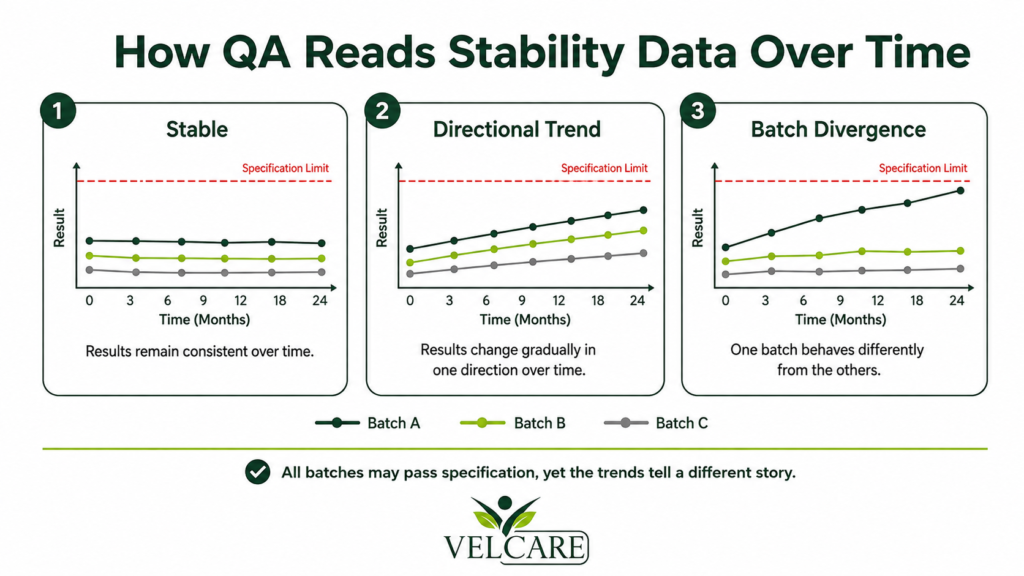
If the applicable limit were above every result shown, all three batches could still meet the specification. Yet Batch B is moving differently and deserves closer review.
That is why stability data should be read as a series rather than as isolated green check marks.
Look for Change Over Time
Check whether a result:
- Remains relatively stable
- Moves gradually in one direction
- Changes sharply between time points
- Approaches an acceptance limit
- Behaves differently from the other stability batches
A result near a limit remains compliant if it still meets the approved limit. The trend does not create a new specification. It can, however, affect confidence in the proposed retest period.
Compare Variability Between Stability Batches
The average trend should not hide one materially different batch.
ICH Q1A(R2) discusses batch-to-batch variability when evaluating stability data. When datasets cannot appropriately be combined, the retest period may need to reflect the batch providing the least support for the proposed period.
For a buyer, the practical point is to understand whether one stability batch behaves materially differently and how that difference was handled in the evaluation.
Understand Any Extrapolation
Real-time observations do not always have to extend through the complete proposed retest period before a longer period can be scientifically justified.
ICH Q1E: Evaluation of Stability Data provides the framework for evaluating stability data and considering extrapolation beyond the observed long-term period. The justification depends on factors such as the nature of the change, variability, available supporting data, and the appropriateness of the evaluation used.
For procurement and QA, this leads to one useful question:
How much of the proposed retest period is supported directly by completed long-term data, and how much is based on extrapolation?
If extrapolation is used, ask for its scientific or statistical basis rather than treating the difference itself as a failure.
Verify That the Analytical Methods Can Detect Stability-Related Change
A stability study is only useful if its analytical procedures can detect the changes the study is intended to measure.
ICH Q7 states that stability test procedures should be validated and stability-indicating.
During document review, check:
- Analytical procedure and version
- Validation status for the intended use
- Ability to detect relevant degradation products
- Relevant reporting or quantitation limits
- Whether the method changed during the study
- How historical and new-method data were compared if a change occurred
ICH Q1A(R2) also discusses stress testing as part of understanding degradation pathways and supporting the development of suitable analytical procedures. Depending on the substance, this can include heat, humidity, oxidation, hydrolysis, and photolysis.
A statement that a method is “validated” should therefore not end the review automatically. The relevant question is whether it is suitable for the stability attribute and degradation behavior being assessed.
What Does Ongoing Stability Tell a Buyer After Supplier Approval?
The original stability package does not close the subject permanently.
ICH Q7 recommends a documented ongoing API stability program. Normally, the first three commercial production batches should enter the stability-monitoring program to confirm the assigned retest or expiry date. Where earlier data show that the API is expected to remain stable for at least two years, fewer than three batches can be used.
After that, at least one manufactured API batch per year should normally be added to the program, unless no batch is produced that year.
Notice that this is different from the three primary batches discussed earlier. The first refers to establishing the drug-substance stability data under the Q1 framework; this Q7 provision deals with ongoing commercial monitoring.
During periodic supplier review, QA can therefore ask:
- Are newer commercial batches continuing to support the assigned retest period?
- Has the degradation pattern changed?
- Have atypical stability results occurred?
- Has the packaging or storage configuration changed?
- Have manufacturing or analytical changes affected the original stability conclusion?
These questions sit naturally within the wider process of qualifying an Etomidate API supplier and assessing the source’s long-term reliability after initial approval.
Changes That May Require the Stability Conclusion to Be Reassessed
Historical stability data support a defined material, process, manufacturing arrangement, packaging configuration, and analytical control strategy.
For this reason, a meaningful change should not automatically inherit the old stability conclusion without assessment.
Examples may include changes to:
- Manufacturing site
- Synthetic route or relevant process conditions
- Manufacturing scale where it could affect the material
- Impurity profile
- Stability-indicating analytical procedure
- Specification
- Container-closure system
- Storage condition
ICH Q7 specifically addresses repackaging and states that stability studies should be conducted to justify the assigned retest or expiry date when an API or intermediate is repackaged into a different type of container from the one used by the API manufacturer.
This is also why manufacturer identity matters. A trader or distributor may communicate the technical package, but the buyer still needs to understand which manufacturing source the underlying data represent. The distinction between these roles is covered in Etomidate API manufacturer vs. supplier.
How Stability Review Fits Into the Etomidate API Sourcing Decision
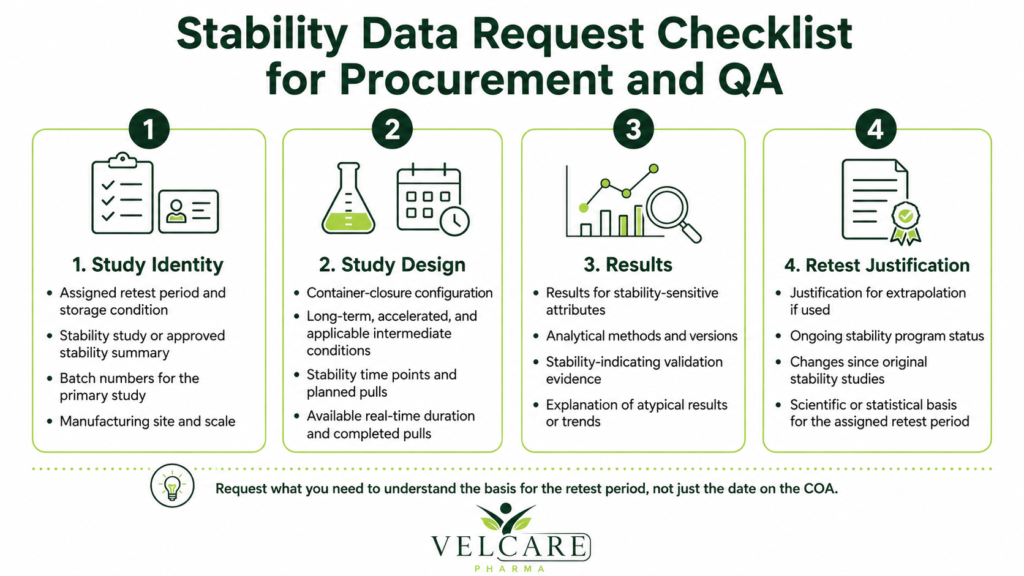
Stability data should be considered alongside the current specification, representative batch COAs, source identity, sample testing, analytical comparability, packaging, and the buyer’s regulatory requirements.
A sample can pass initial laboratory testing without demonstrating how the API will behave throughout its proposed storage period. Similarly, a compliant COA describes the reported quality of a particular batch at the relevant test point; it does not replace a stability program.
For buyers moving from development material toward supplier approval or commercial procurement, stability is therefore one part of the wider technical assessment. The laboratory side of that decision is covered further in how to evaluate an Etomidate API sample before commercial procurement.
Buyers evaluating Etomidate API can share their target market, intended use, specification, quantity, and documentation requirements with Velcare Pharma when discussing a sourcing inquiry. The availability and confidentiality conditions of specific technical or stability information should be confirmed for the material under evaluation.
Frequently Asked Questions
Can Etomidate API Be Used After Its Retest Date?
A retest date should not be treated automatically as equivalent to a drug-product expiration date. The FDA-hosted ICH Q7 Questions and Answers explains that an API manufacturer can extend the retest date of a specific batch based on appropriate long-term stability information for that API together with testing of the specific batch stored according to its labeled conditions. The document also notes that regulatory authority approval may be required in some regions.
Is a Retest Date on the COA Enough to Confirm API Stability?
No. The COA communicates the assigned batch information. ICH Q7 states that an API retest or expiry date should be based on an evaluation of data derived from stability studies. The date on the certificate is therefore not a substitute for understanding the supporting stability basis.
Does Accelerated Testing Determine the Retest Period by Itself?
No. Accelerated data contribute to the overall stability assessment, but the proposed retest period also depends on long-term data and the total scientific evaluation. Where extrapolation beyond available long-term data is proposed, ICH Q1E provides the framework for evaluating whether that extension can be justified.
How Many Batches Should Be Included in API Stability Studies?
Under ICH Q1A(R2), the formal drug-substance stability package includes at least three primary batches. Separately, ICH Q7 says that the first three commercial production batches should normally enter the ongoing stability-monitoring program, with the stated exception where previous data support stability for at least two years.