
An analytical procedure cannot be transferred by emailing an SOP and asking the buyer’s laboratory to run it. The receiving laboratory also needs the applicable method version, specification, validation support, reference-standard information, representative data, transfer criteria, and access to the technical knowledge behind the procedure.
Missing details can delay Etomidate API sample evaluation and supplier approval. An unexplained integration rule, unavailable impurity standard, different assay basis, or incompatible instrument configuration may produce results that cannot be compared with the supplier’s certificate of analysis.
The supplier or originating laboratory is responsible for making the technical package available. The receiving laboratory must assess the package, identify gaps, approve an appropriate transfer protocol, execute the work, and document whether the procedure is suitable for its intended use.
What Is an Etomidate API Analytical Method Transfer Package?
USP General Chapter <1224> Transfer of Analytical Procedures describes method transfer as a documented process that qualifies a receiving laboratory to use a procedure originating in another laboratory.
For Etomidate API, the transfer package is the controlled set of procedures, records, materials, responsibilities, and acceptance criteria needed to support that process. It should allow a qualified analyst to perform the method without relying on assumptions or undocumented instructions.
The package is not the same as a specification or certificate of analysis. A specification states the limits the material must meet, while a COA reports one batch’s results. The transfer package explains how those results are generated and how the receiving laboratory will demonstrate comparable performance.
Identify the Parties Involved
The commercial supplier, API manufacturer, method developer, routine testing laboratory, and buyer’s receiving laboratory may be different organizations.
That distinction matters when evaluating an Etomidate API manufacturer versus a supplier. A distributor may coordinate documents and communication, but the originating laboratory or technical method owner should remain identifiable and available for questions.
Responsibilities should be assigned to the actual parties performing the work:
- The method owner supplies controlled procedures and supporting knowledge.
- The testing laboratory provides representative data and operational experience.
- The commercial supplier coordinates document, sample, and standard access.
- The receiving laboratory assesses readiness, executes the protocol, and controls implementation.
- Quality representatives approve the protocol, deviations, and final report according to the agreed quality systems.
Which Standards and Regulatory Frameworks Apply?
The applicable framework depends on the method, market, product stage, and receiving laboratory. The main references include:
- USP <1224>, which provides a framework for analytical procedure transfer.
- USP <1226>, which addresses verification of compendial procedures under the receiving laboratory’s actual personnel, equipment, and reagent conditions.
- ICH Q2(R2), which addresses validation characteristics, comparative analysis, and partial or full revalidation when a procedure moves to another laboratory.
- ICH Q14, which connects method knowledge, robustness, system suitability, procedure control, and lifecycle management.
- WHO technology-transfer guidance, which describes sending- and receiving-unit responsibilities and several risk-based transfer approaches.
- ICH Q7, which addresses analytical-method validation, equipment qualification, and change records in API manufacturing.
- 21 CFR 211.160 and 21 CFR 211.194, which establish laboratory-control and record requirements for covered U.S. drug-manufacturing operations.
FDA’s Analytical Procedures and Methods Validation guidance also recommends a preapproved transfer protocol, representative test articles, predetermined acceptance criteria, and evaluation of interlaboratory variability.
These references do not have identical legal status. ICH, WHO, USP, and FDA guidance should not be described as universally binding law. The buyer must determine which obligations apply to its jurisdiction, filing, quality system, and intended use of the API.
Which Etomidate API Methods Are in Scope?
Begin with the tests in the agreed supplier and buyer specifications. Then identify which procedures will support:
- Sample evaluation
- Incoming API testing
- Supplier-result verification
- Release or stability testing
- Investigation support
- Validation or commercial batches
Methods may include identification, assay, related substances, stereochemical control, loss on drying or water, residual solvents, and supplier-specific tests. The final scope should reflect the material’s intended use, including the requirements applicable to Etomidate API for U.S. injectable manufacturers where relevant.
Not every procedure needs the same transfer approach. A straightforward compendial identification test may require limited verification, while a supplier-specific impurity procedure may need comparative testing and additional method knowledge.
How Should the Transfer Strategy Be Selected?
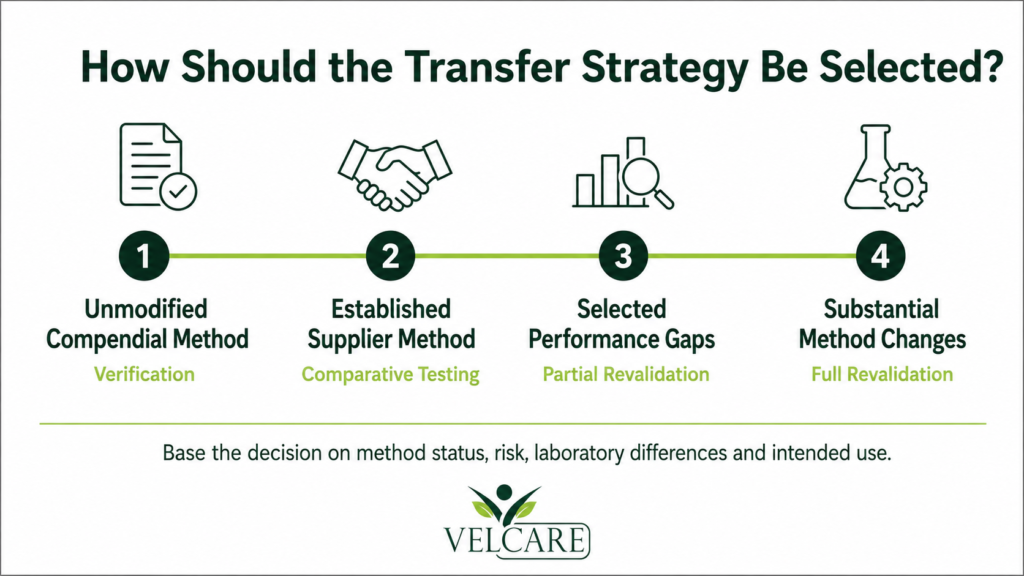
The strategy should be agreed before the protocol is written. It should reflect the test’s criticality, method history, laboratory differences, available evidence, and intended use.
Verification of an Unmodified Compendial Procedure
Verification may be appropriate when the receiving laboratory is implementing an official compendial procedure without material modification.
Under USP <1226>, verification assesses selected performance characteristics under actual conditions rather than repeating the complete original validation. The receiving laboratory still needs to show that its analysts, equipment, reagents, and materials can produce suitable results.
Comparative Testing Between Laboratories
For an established supplier-specific procedure, both laboratories may test representative Etomidate samples using the same controlled method. Results are then assessed against predefined criteria for agreement, precision, bias, or another relevant measure.
This approach depends on both laboratories having comparable method versions, standards, samples, calculations, and data-processing rules.
Co-Validation or Partial Revalidation
Co-validation may be used when the receiving laboratory participates in the validation work. Partial revalidation may be suitable when specific performance characteristics require confirmation because of differences in instruments, software, columns, samples, or laboratory conditions.
Full Revalidation
Full revalidation should be considered when substantial changes have been introduced or when a narrower exercise cannot demonstrate fitness for purpose. It should not be imposed automatically simply because the procedure is new to the receiving laboratory.
Factors That Affect the Decision
| Factor | Question to consider |
| Test criticality | How directly does the result affect release, stability, or patient-related risk? |
| Method status | Is the procedure compendial, modified compendial, or supplier-specific? |
| Complexity | Does it depend on sensitive preparation, separation, integration, or calculation steps? |
| Method history | Is validation, robustness, and routine performance evidence available? |
| Laboratory differences | Are instruments, detectors, software, or columns materially different? |
| Standards and samples | Are qualified standards and representative transfer samples available? |
| Sensitivity | Can the receiving system meet the required detection or quantitation capability? |
| Intended use | Will the method support screening, release, investigations, or stability studies? |
| Filing status | Is the procedure referenced in an applicable regulatory submission? |
| Laboratory experience | Has the receiving laboratory successfully performed similar procedures? |
The agreed transfer strategy should also be consistent with the buyer’s review of the applicable Etomidate API specification.
What Should the Etomidate API Method Transfer Package Contain?
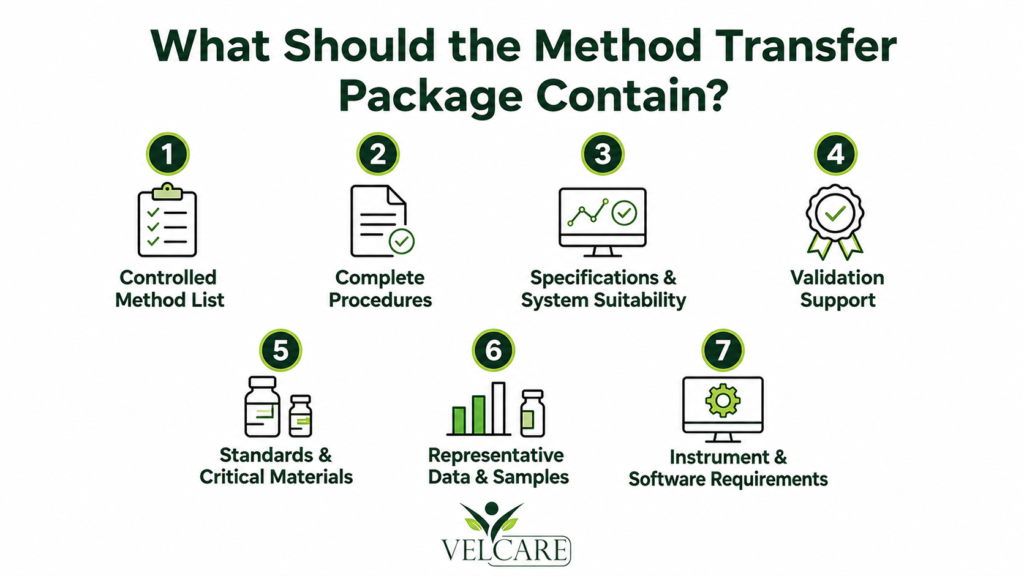
The sections below define what should exist in the package. The following Etomidate-specific section explains how selected information should be interpreted for this API.
Controlled Method List and Version History
The method index should identify the test, purpose, method number, revision, effective date, applicable specification, and whether it is compendial or in-house. It should name the originating and routine testing laboratories and summarize material method changes, including any validation or comparability work completed after those changes.
Complete Analytical Procedures
Each procedure should specify:
- Sample and standard preparation, including weights, concentrations, and dilutions
- Reagents, solvent grades, columns, and critical materials
- Instrument configuration and operating conditions
- Equilibration, injection sequence, and system-suitability requirements
- Peak identification, integration, and data-processing rules
- Calculations, correction factors, units, significant figures, and rounding
- Solution and prepared-sample stability
- Method-specific precautions
The instructions should be detailed enough for a qualified analyst to reproduce the procedure without informal coaching. This operational content should be reviewed alongside the broader documents requested from an Etomidate API supplier.
Specifications and System-Suitability Criteria
Each method should be connected to the quality attribute, acceptance criterion, reportable range, calculation basis, reporting convention, and intended testing frequency.
System-suitability requirements should identify what is measured, how it is calculated, and what happens when a criterion is not met. Suitability criteria should not be reconstructed from historical chromatograms after transfer testing begins.
Method Development and Validation Support
Depending on the strategy, the package may include an approved validation protocol and report, or a controlled summary sufficient for assessment. Relevant evidence may cover specificity, accuracy, precision, range, detection and quantitation limits, robustness, solution stability, revalidation history, and justification for omitted characteristics.
Selected development knowledge should be supplied when it explains sensitive method parameters, recurring analytical behavior, or the rationale for system-suitability limits.
Reference Standards and Critical Materials
The package should identify the Etomidate reference standard, assigned potency, correction basis, storage conditions, expiry or retest controls, and any working-standard qualification.
It should also address relevant impurity standards, an opposite-enantiomer standard where applicable, critical reagent grades, column specifications, and the availability of standards and samples for transfer work.
Representative Analytical Data and Samples
Useful examples include:
- Representative batch COAs
- Approved chromatograms or spectra
- Standard and sample sequences
- Peak-identification and integration examples
- Calculation worksheets
- System-suitability data
- Expected analytical variability
- Spiked, impurity-enriched, or degradation-containing samples where justified
These records help the receiving laboratory connect the written procedure to actual output. They also provide context when learning how to read an Etomidate API COA.
Instrument, Software and Data-Processing Requirements
The laboratories should compare detector capability, hardware, column compatibility, data-acquisition software, integration settings, sensitivity, audit-trail requirements, and qualified operating ranges.
The same instrument model is not always necessary. Different platforms may be acceptable when their suitability is assessed scientifically and documented in the protocol.
Which Etomidate-Specific Details Should Be Explained?
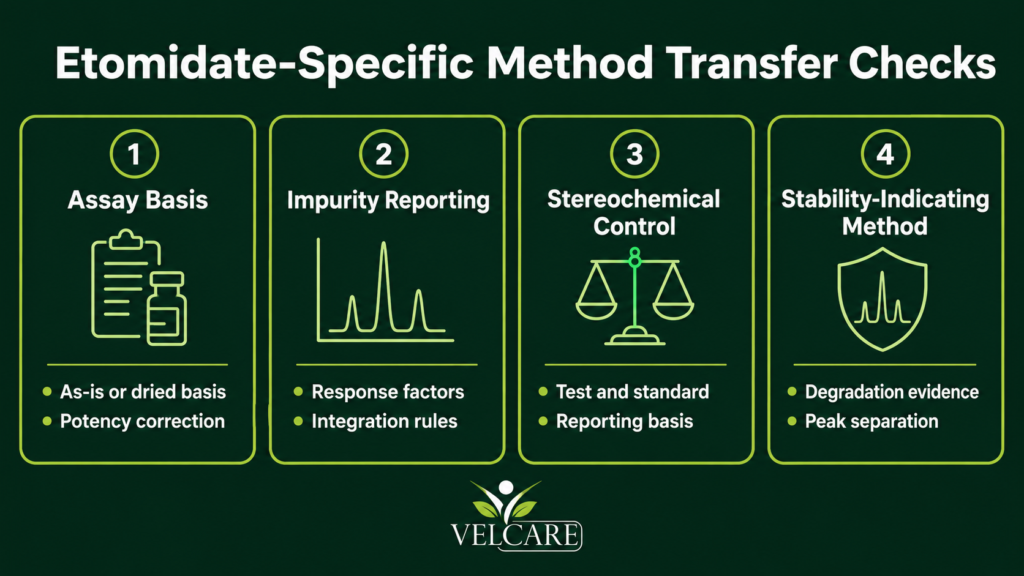
Assay and Calculation Basis
The method should state whether assay is reported as-is, on a dried basis, or using another defined basis. It should explain reference-standard potency correction, any loss-on-drying adjustment, formulas, conversion factors, units, significant figures, and rounding.
A calculation-basis mismatch can create an apparent interlaboratory difference even when the underlying analytical responses agree.
Related Substances and Impurity Reporting
The package should explain named and unspecified impurities, relative retention information, response or correction factors, integration rules, quantitation thresholds, reporting thresholds, resolution requirements, and treatment of unidentified peaks.
Availability of impurity standards should be confirmed before the study begins. These details should be assessed as part of the wider Etomidate API impurity profile rather than treated as isolated chromatographic settings.
Stereochemical Control
Where required by the agreed specification or control strategy, the package should state whether the procedure measures optical rotation, opposite-enantiomer content, or another stereochemical attribute.
It should provide the applicable selectivity evidence, reference-standard information, calculation, and reporting convention. One specific chiral test should not be presented as universally required for every Etomidate source.
Stability-Indicating Capability
If the procedure supports stability testing, the receiving laboratory should review its ability to detect relevant degradation-related changes. Supporting information may include development studies, forced-degradation evidence, peak-separation data, degradation-containing samples, and method changes made during ongoing stability studies.
This review should be coordinated with the available Etomidate API stability data and retest period.
Other Specification-Dependent Procedures
Identification, residual solvents, loss on drying, water, and other tests should be included only when they form part of the agreed specification or control strategy. Their transfer depth should reflect their intended use and analytical risk.
What Should the Transfer Protocol Define Before Testing?
Scope and Responsibilities
The protocol should identify included and excluded methods, sending- and receiving-laboratory responsibilities, technical contacts, training requirements, analyst qualifications, instrument requirements, and approval authorities.
Experimental Design
The design should specify the Etomidate batches and samples, reference and impurity standards, analysts, preparations, injections, replicates, testing days, instruments, comparison characteristics, and statistical evaluation.
The study should use samples capable of evaluating method performance, not merely material expected to produce an uncomplicated passing result.
Acceptance and Investigation Rules
Before results are available, the parties should agree on:
- Method-specific suitability and transfer criteria
- Permitted interlaboratory variation
- Evaluation of analytical bias
- Deviation and investigation procedures
- Rules for repeats or confirmatory testing
- Required data and report formats
Acceptance criteria should not be selected or revised simply to accommodate the observed results.
What Are the Main Method Transfer Milestones?
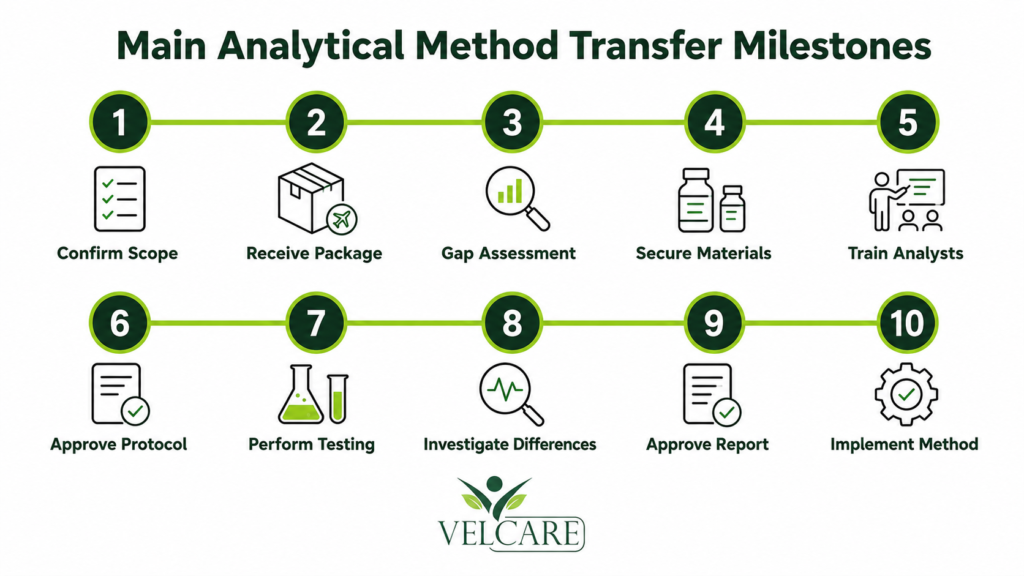
A transfer should be managed through milestones rather than a universal promised duration:
- Confirm method scope and parties.
- Receive the controlled technical package.
- Complete the laboratory gap assessment.
- Secure standards, samples, columns, and equipment.
- Complete training where required.
- Approve the transfer protocol.
- Perform the experimental work.
- Investigate differences and deviations.
- Approve the transfer report.
- Implement the method under the receiving laboratory’s quality system.
Document access, reference-standard procurement, equipment gaps, and discrepant results are common sources of delay. These activities should be built into the wider Etomidate API supplier qualification plan.
What Support Should the Supplier Provide?
Before and During Transfer
The supplier should connect the buyer with the originating laboratory or method owner, coordinate available standards and representative samples, and arrange method-specific training where needed.
Technical support may also be required to clarify sensitive preparation steps, instrument differences, integration settings, calculations, or unexpected analytical behavior.
During Investigations and Transfer Closure
When laboratories obtain different results, the supplier and method owner should help compare method versions, samples, standards, preparations, instruments, software settings, and calculation bases.
They may need to review deviation investigations, provide additional controlled information, assess remaining actions, and review or acknowledge the final report according to the agreed protocol. Historical batch-to-batch consistency data may help distinguish analytical variation from material variation.
Confidentiality and Intellectual Property
Proprietary development and validation information may require a confidentiality agreement, direct quality-to-quality exchange, controlled data-room access, or staged disclosure.
A controlled validation summary may be sufficient for initial assessment. Additional information may be needed if the receiving laboratory cannot evaluate or reproduce the procedure.
Confidentiality can determine how information is shared, but it should not leave the receiving laboratory without enough operational and scientific information to perform and assess the method.
How Should the Buyer Review Package Completeness?
Before approving experimental work, confirm that:
- Documents are current, controlled, and approved.
- Method and specification revisions agree.
- Representative COAs were generated using the stated methods.
- Instruments, software, standards, columns, and reagents are available.
- System-suitability criteria and calculations are complete.
- Transfer acceptance criteria are predefined.
- Samples represent the proposed commercial source.
- Confidential information can be accessed through an agreed route.
- Identified gaps have owners and closure dates.
This analytical review should be connected to the buyer’s wider assessment of Etomidate API regulatory documentation.
Red Flags
Investigate further if:
- Only a COA and specification are provided.
- The method is called validated without supporting evidence.
- Operational, integration, or calculation instructions are missing.
- Method revisions conflict across documents.
- Impurity peaks or standards cannot be identified.
- Representative chromatograms are unavailable.
- The supplier cannot identify the originating laboratory.
- Acceptance criteria will be chosen after testing.
- Confidentiality restrictions make the procedure impossible to reproduce or assess.
When Is the Analytical Method Transfer Complete?
The transfer can be closed when the approved protocol has been executed, predefined criteria have been met, interlaboratory differences have been evaluated, and deviations have been resolved.
Required training should be documented, the final report approved, and the current methods implemented at the receiving laboratory. Standards and critical materials must remain available, and future method or specification changes should be covered by change notification.
Discuss Your Etomidate API Requirements With Velcare
Pharmaceutical companies evaluating an Etomidate API source can share their intended market, proposed specification, required analytical procedures, and receiving-laboratory needs with Velcare.
Contact Velcare about Etomidate API to discuss the currently available specification, sample documentation, and analytical support for your qualification process.
The availability of specific procedures, validation information, reference standards, samples, and transfer support, together with applicable confidentiality conditions, should be confirmed for each inquiry.